

Ham Radio Science Citizen Investigation

Advance scientific research and understanding through amateur radio activities.
Encourage the development of new technologies to support this research.
Provide educational opportunities for the amateur community and the general public.

Join HamSCI

 
Logos of HamSCI Collaborators and Funding Agencies
 
The HamSCI Community is led by The University of Scranton Department of Physics and Engineering W3USR, in collaboration with Case Western Reserve University W8EDU, the University of Alabama, the New Jersey Institute of Technology Center for Solar Terrestrial Physics K2MFF, the MIT Haystack Observatory, TAPR, additional collaborating universities and institutions, and volunteer members of the amateur radio and citizen science communities. We are grateful for the financial support of the United States National Science FoundationNASA, and Amateur Radio Digital Communications (ARDC).

Quick Links

Have you ever wondered how to interpret the Doppler shift spectrograms generated by Personal Space Weather Stations, eg Grape 1s, Grape 1 DRFs, Grape 2s, WSPRDaemon SDRs?  Wonder no more, as a team of skilled HamSCI volunteers has assembled an 'Atlas of Forms', showing examples of ionospheric phenomena as seen in Doppler shift spectrograms:  Read the Docs Atlas of Spectrograms

Many readers may wish to begin with the first topic, The Ionosphere and HF Propagation.

Just in time for distribution at the Dayton/Xenia Hamvention, the Spring, 2026 issue of the HamSCI Newsletter has been published, available on the HamSCI website's Newsletter Page.  Topics include:

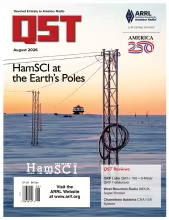
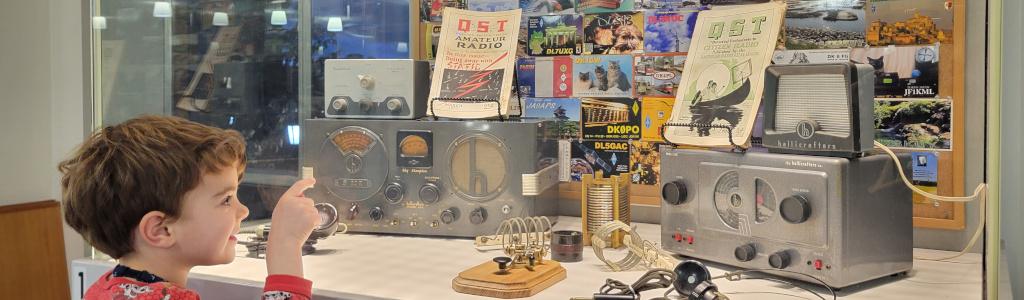
The ARRL Foundation’s 2025 Bill Orr, W6SAI*, Technical Writing Award has been awarded to Dr. Ethan Miller, K8GU, and Dr. Nathaniel A. Frissell, W2NAF, for their August 2025 QST article, “About Traveling Ionospheric Disturbances.”  Their article (QST0825 Miller-Frissell About TIDs.pdf ) was prominently featured in that issue of QST, which featured HamSCI on the cover as well as in a special section.