Is your club is looking for new and interesting things to do that involve the April 8, 2024 eclipse? HamSCI, its partners and supporters have a few ideas!
First and foremost, consider having members participate and compete in the HamSCI Solar Eclipse QSO Party or Gladstone Signal Spotting Challenges. The SEQP has a multi-operator entry category. Gather a group and operate from a member's home station or put on a Field Day style event - operate from the Great Outdoors, taking time, of course, to view the eclipse as it passes over North America.
► Print and distribute HamSCI flyers at your next club meeting. There are links to many HamSCI projects, some noted below. Challenge members to do something other than the same old things they've been doing with their licenses for years. (2 flyers exist - 'HamSCI General' and 'Eclipse Specific')
► You don't have to wait until the day of the eclipse - put the eclipse on your club's program schedule: Schedule a HamSCI speaker to inform the members about HamSCI's mission and the ham-friendly projects it supports.
►Build one or more Grape 1 Personal Space Weather Stations. Compare notes, compare results, see how the ionosphere reacts to space weather events such as solar flares and coronal mass ejections.
►Partner with a local astronomy club, before, during and after the eclipse. Exchange news and information on how the eclipse affects radio frequency signals, and learn about observations made in the visible light spectrum.
►Do you have club members who fluently speak 'SDR' (software defined radio)? Modern SDR rigs, such as the Flex product line, offer multi-slice reception. It might be possible to observe carriers from time standard stations (WWV, CHU) to observe eclipse effects on the various bands.
►Tools such as VOACAP allow amateurs to make propagation predictions (predictions of MUF and band openings). Club members could generate pre-eclipse predictions, operate during the eclipse, and discuss if or how the eclipse affected the propagation vs. the predictions.
►Local schools may be putting on eclipse 'parties' for their students. Offer to supplement their activities with live amateur radio demonstrations. Modes such as PSK31 and FT8 may grab the students' attention.
►Are club members familiar with WSPR, the Weak Signal Propagation Reporter mode? Simple, inexpensive WSPR radios are readily available (or you can use the same gear as is used for FT8). Transmitting WSPR is fun - but watching a QRPp WSPR signal propagate around the world, as noted by the WSPR receiving network, is fascinating.
►STEM opportunities - ideas from Mike Walters (ARRL). Help schools answer these questions: What causes an eclipse? Differences between annular and total solar eclipses, others?
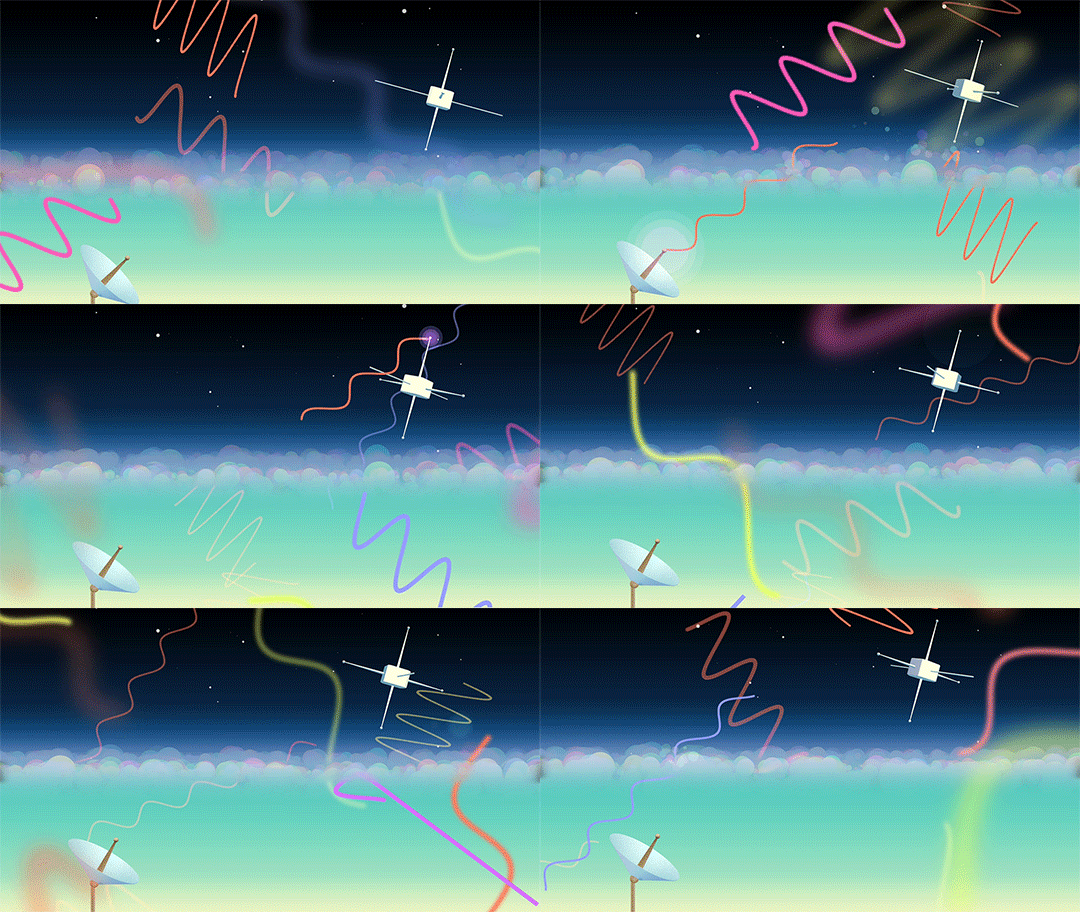
Animation courtesy of NASA, science.nasa.gov/eclipses/media-resources/