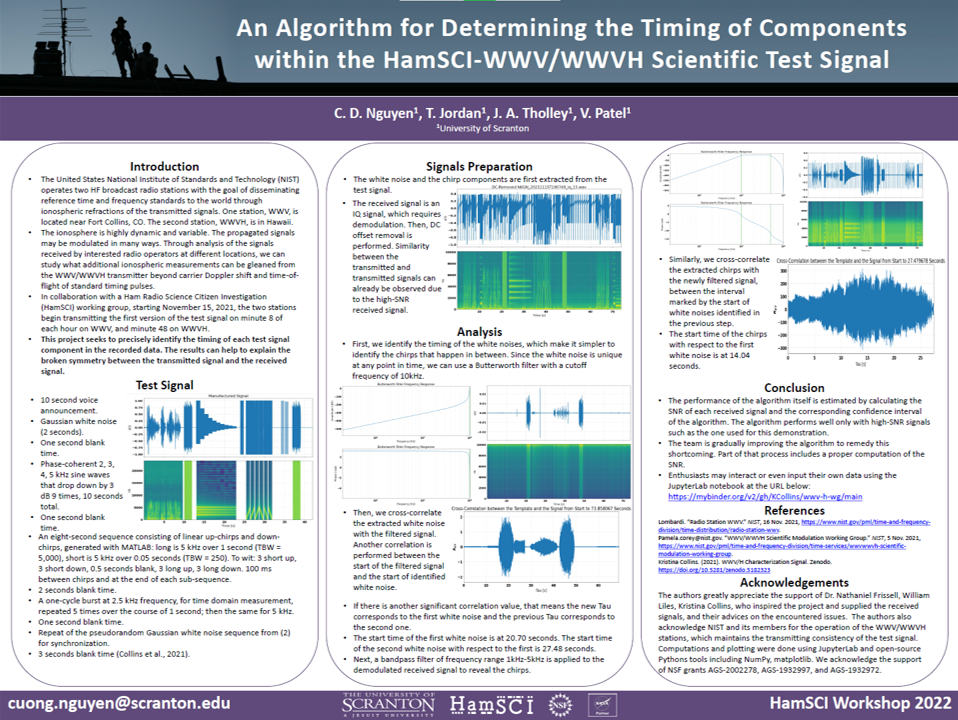
An Algorithm for Determining the Timing of Components within the HamSCI-WWV/WWVH Scientific Test Signal
| Publication Type | Conference Proceedings |
|---|---|
| Author | |
| Conference Name |
HamSCI Workshop 2022
|
| Date Published |
03/2022
|
| Year of Conference |
2022
|
| Publisher |
HamSCI
|
| Conference Location |
Huntsville, AL
|
| Abstract |
Beginning in November 2021, WWV and WWVH radio stations have been broadcasting a test signal developed by a Ham Radio Science Citizen Investigation (HamSCI) working group to study what additional ionospheric measurements can be gleaned from the WWV/WWVH transmitter beyond carrier Doppler shift and time-of-flight of standard timing pulses. The signal consists of various individual components including tones, chirps, and Gaussian noise bursts [1]. Interested operators record the signal data at their location, providing researchers with the data naturally manipulated in many different ways [2]. This project seeks to precisely identify the timing of each signal component in the recorded data. The algorithm involves passing the data through various software filters to remove unwanted elements such as frequencies outside of range of interest, DC offset, and so on. Correlation is then performed between the recorded data and each original component to produce their timing. The performance of the algorithm itself is estimated by calculating the SNR of each received signal and the corresponding confidence interval of the algorithm. The results can help to explain the broken symmetry between the transmitted signal and the received signal. References |
| Refereed Designation |
Non-Refereed
|
| Full Text |
|
| Publication Language |
eng
|
| Download citation |