Unauthorized Use Of Military Satellites: Threats To Mission Security And Integrity
| Publication Type | Conference Proceedings |
|---|---|
| Author | |
| Conference Name |
HamSCI Workshop 2026
|
| Date Published |
03/2026
|
| Year of Conference |
2026
|
| Publisher |
HamSCI
|
| Conference Location |
Newington, CT
|
| Abstract |
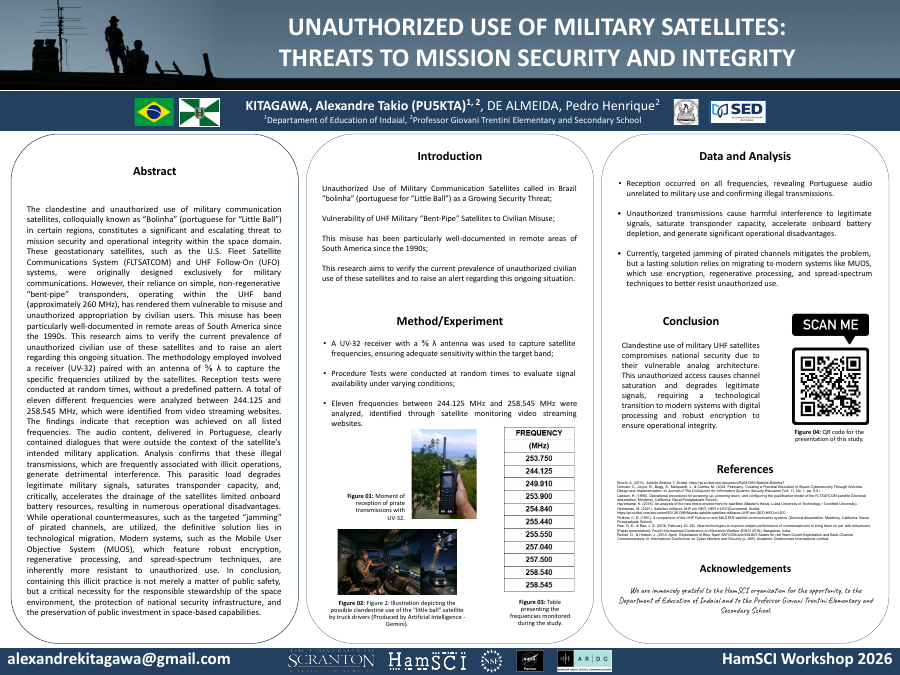
The clandestine and unauthorized use of military communication satellites, colloquially known as “Bolinha” (portuguese for “Little Ball”) in certain regions, constitutes a significant and escalating threat to mission security and operational integrity within the space domain. These geostationary satellites, such as the U.S. Fleet Satellite Communications System (FLTSATCOM) and UHF Follow-On (UFO) systems, were originally designed exclusively for military communications. However, their reliance on simple, non-regenerative “bent-pipe” transponders, operating within the UHF band (approximately 260 MHz), has rendered them vulnerable to misuse and unauthorized appropriation by civilian users. This misuse has been particularly well-documented in remote areas of South America since the 1990s. This research aims to verify the current prevalence of unauthorized civilian use of these satellites and to raise an alert regarding this ongoing situation. The methodology employed involved a receiver (UV-32) paired with an antenna of 5/8 λ to capture the specific frequencies utilized by the satellites. Reception tests were conducted at random times, without a predefined pattern. A total of eleven different frequencies were analyzed between 244.125 and 258.545 MHz, which were identified from video streaming websites. The findings indicate that reception was achieved on all listed frequencies. The audio content, delivered in Portuguese, clearly contained dialogues that were outside the context of the satellite’s intended military application. Analysis confirms that these illegal transmissions, which are frequently associated with illicit operations, generate detrimental interference. This parasitic load degrades legitimate military signals, saturates transponder capacity, and, critically, accelerates the drainage of the satellites limited onboard battery resources, resulting in numerous operational disadvantages. While operational countermeasures, such as the targeted “jamming” of pirated channels, are utilized, the definitive solution lies in technological migration. Modern systems, such as the Mobile User Objective System (MUOS), which feature robust encryption, regenerative processing, and spread-spectrum techniques, are inherently more resistant to unauthorized use. In conclusion, containing this illicit practice is not merely a matter of public safety, but a critical necessity for the responsible stewardship of the space environment, the protection of national security infrastructure, and the preservation of public investment in space-based capabilities.
|
| Refereed Designation |
Non-Refereed
|
| Full Text |
|
| Publication Language |
eng
|
| Download citation |