Frissell, N. A., Moses, M. L., Earle, G., McGwier, R. W., Miller, E. S., Kaeppler, S. R., … Gerrard, A. J. (2016). HamSCI: The Ham Radio Science Citizen Investigation. Fall 2016 American Geophysical Union. Presented at the. San Francisco: American Geophysical Union. Retrieved from http://hamsci.org/sites/default/files/publications/2016_AGU_Frissell_HamSCI.pdf (Original work published 2016)
Publications
HamSCI Members Recognized by the RCA
Dr. Kristina Collins KD8OXT, Dr. Nathaniel Frissell W2NAF, Angel Vasquez WP3R, and Tim Duffy K3LR
Honored By the Radio Club of America at Upcoming Symposium
The Radio Club of America (RCA) has recently announced that Dr. Kristina Collins KD8OXT will be receiving the Carole E. Perry Young Professional award at its upcoming annual banquet. Collins is currently an electrical engineering researcher at the Space Science Institute. She is also active in HamSCI, as the Chief Operations Scientist for the HamSCI Personal Space Weather Station (PSWS) project, organizing pilot experiments for distributed ionospheric sensing, including the HamSCI Eclipse Festivals of Frequency Measurement. She is also managing the WWV/WWVH Scientific Modulation Working Group, to add scientifically valuable modulations to WWV and WWVH. See hamsci.org/wwv.
HamSCI has been further honored as the club has announced that Dr. Nathaniel Frissell W2NAF and Angel Vasquez WP3R are being elevated to RCA Fellows. Longtime HamSCI supporter and HamSCI Personal Space Weather Station Host Tim Duffy K3LR will be receiving the Edgar F. Johnson Pioneer Citation at the same time. Dr. Collins, Dr. Frissell, and Diego Sanchez will also be presenting at the RCA Technical Symposium. Collins will be presenting “The Lion in the (Propagation) Path and Frissell and Sanchez will presenting “HamSCI and an Investigation of Large Scale Traveling Ionospheric Disturbances Using Amateur Radio Data”.
The RCA Technical Symposium and Awards Banquet will be held on Saturday, November 22, 2025, at the Hyatt Regency on Capitol Hill in Washington, DC.
The RCA was formed when a group of teenaged radio experimenters gathered on January 2, 1909 for the first meeting of the Junior Wireless Club. The meeting at the Ansonia Hotel in New York City was organized by E. Lilian Todd, a local inventor who was also the first female airplane designer who wanted to encourage “tinkering and experimentation”
RCA’s Mission: The promotion of cooperation among those interested in scientific investigation in the art of Radio Communication.
RCA’s Vision: Wireless is the ubiquitous invisible thread that ties together social, business, government, and international communications. Modern society cannot function without it. Therefore advancements in wireless science and art must be encouraged in order to improve society for all.
ARDC Grant Application Deadline: 1-Feb-2026

ARDC (Amateur Radio Digital Communications) has announced their 2026 funding priorities along with the deadline for grant applications (1-Feb-2026).
As members of the HamSCI and amateur radio communities may already be aware, the mission of Amateur Radio Digital Communications (ARDC) is to support, promote, and enhance digital communication and broader communication science and technology, to promote Amateur Radio, scientific research, experimentation, education, development, open access, and innovation in information and communication technology.
Further, ARDC is a foundation that funds projects which advance Amateur Radio (AR), Digital Communications (DC), and related technologies. HamSCI's research efforts have greatly benefited from their giving, as a number of projects, activities and individuals have benefitted from ARDC grants in recent years.
This link describes ARDC's funding priorities, which were introduced earlier in 2025: ardc.net/apply/priority-areas-for-funding/
ARDC is especially interested in projects that align with these three areas:
-
Research and Development: Open hardware and software systems that enable learning and experimentation (e.g. SDRs, open codec technologies, new modulation techniques).
-
Space-Based Communications: Projects that create or expand access to satellite communications for amateur radio (AR) and digital communications (DC), engaging communities in wireless experimentation (e.g. GEO or HEO programs, repurposed commercial satellites, space-based tools for learning).
-
Open Source Education: Scalable, open educational materials and hands-on projects that make AR and DC more accessible, especially for new learners and clubs (e.g. curricula, videos).
While ARDC welcomes proposals across the full range of Amateur Radio and Digital Communications, projects that align with these areas remain a priority in their grantmaking decisions.
The ARDC website fully describes their mission and values, the people behind the organization, priorities, scholarships and the grant application process.
HamSCI at HamCon Colorado 2025
HamSCI made its first ever appearance at the 2025 HamCon Colorado/ARRL Rocky Mountain Division Convention, held 24-26 October, in Grand Junction, Colorado.
HamSCI had a table in the vendor/club room, passing out materials including Meteor Scatter QSO Party (MSQP) flyers, MSQP business cards, three editions of HamSCI newsletters, and business cards inviting people to join HamSCI as citizen scientist volunteers. HamSCI brought posters describing various projects, such as the Contesting/DX Dashboard, the Meteor Scatter QSO Party and the Ground Magnetometer. The latter generated a lot of interest - perhaps appealing to the technical nature and natural science curiosity of many attendees. Staffing was provided by three HamSCI members (AF8A, W0DAS, KF7ZN) and KF7ZN's wife, Gaylene.
We were fortunate to have the WWV ARC (Ft. Collins, CO) table right next to us, staffed by Dave Swartz, W0DAS. Of course, NIST time and frequency standard station WWV is key to many of our research efforts, and Dave has been instrumental in providing/installing HamSCI research equipment and coordinating efforts with the technical staff at WWV. Some attendees went home with unique bumper stickers (“I Set My Clocks to WWV”), that are sure to attract interest from local hams and time/frequency enthusiasts.
HamCon is a forum-oriented event, rather than the flea market/commercial vendor focus of most regional ham radio gatherings. This year’s HamCon was true to form, with well over 50 hour-long forums on Friday and Saturday. HamSCI members filled multiple time slots with topics including the HamSCI Personal Space Weather Station (Gary Mikitin, AF8A), WWV’s First Century (Dave Swartz, W0DAS), The Early Days of Ham Radio & DX’ing (Ron Wilcox, KF7ZN) and The Ionosphere (Ron Wilcox). Other HamSCI members including Bill Mader, K8TE and Doug Leber, N0MM were also on the presentation schedule.
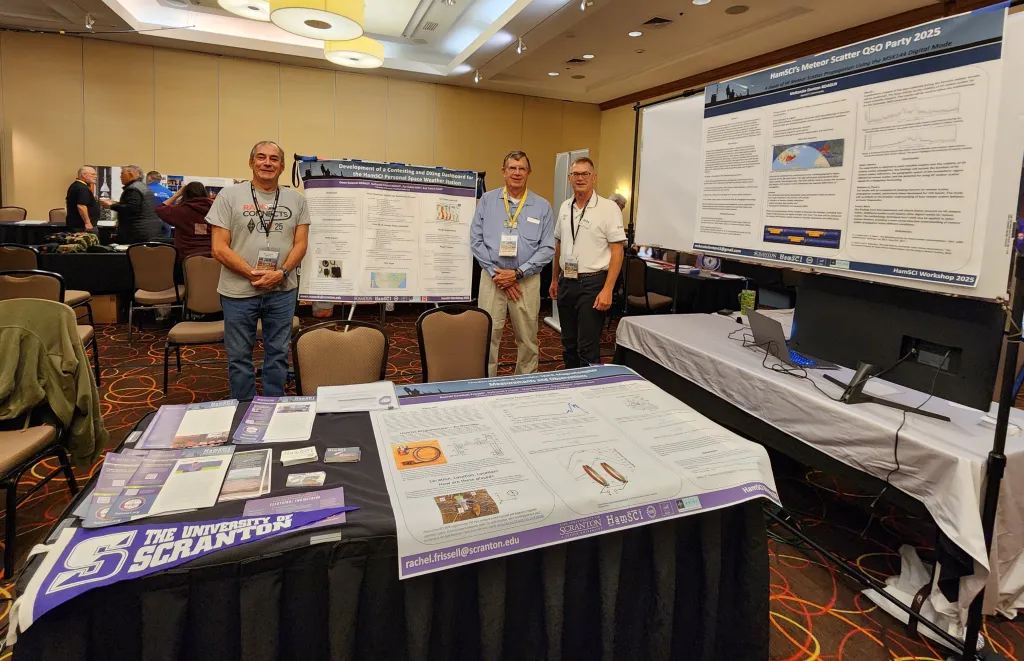
W0DAS, KF7ZN, AF8A at HamSCI Table
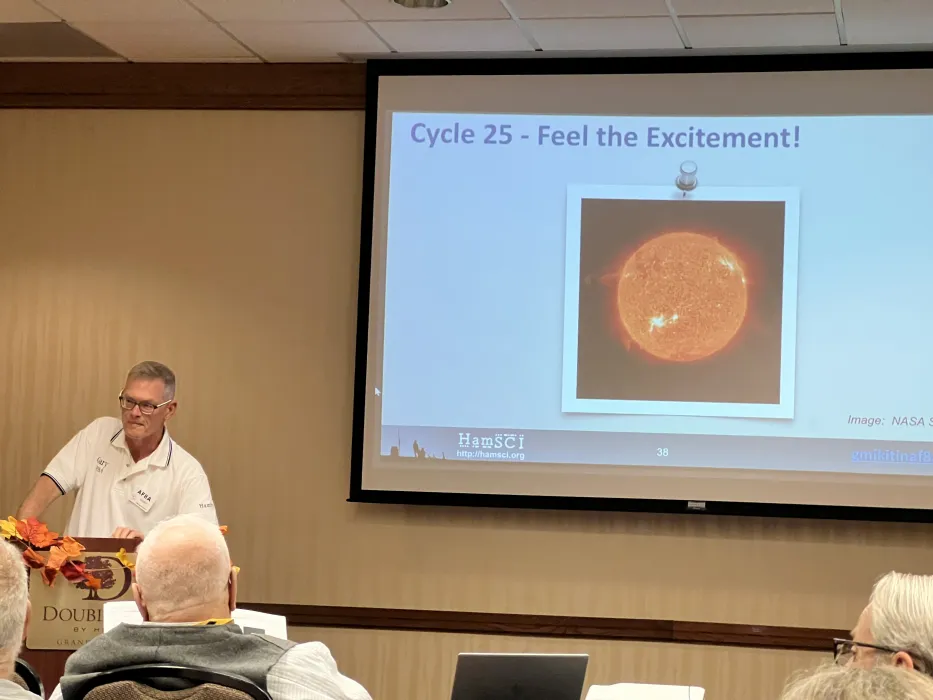
Gary AF8A Presenting
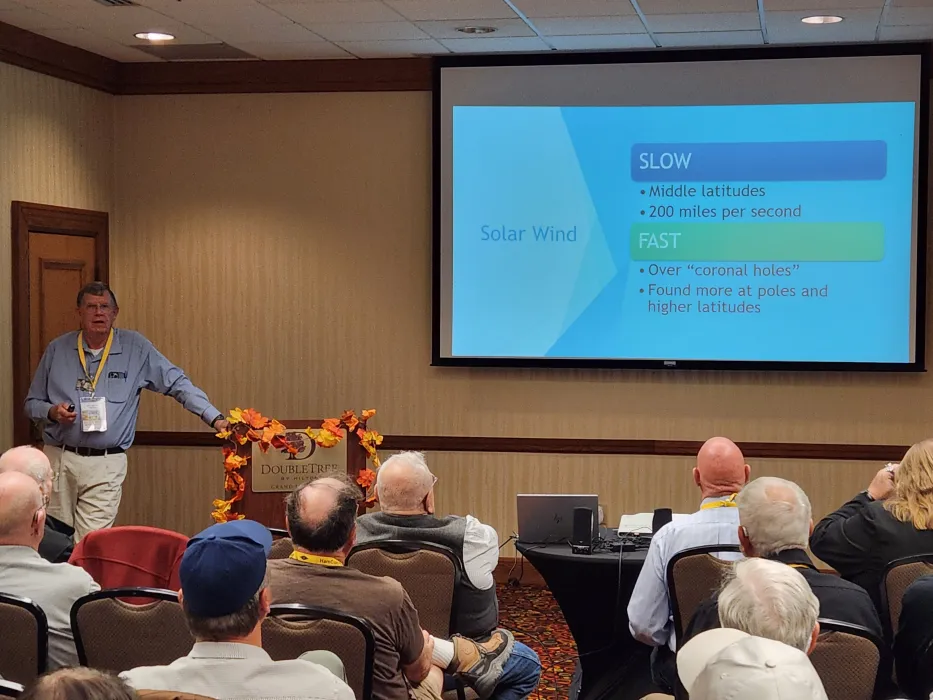
Ron KF7ZN Presenting
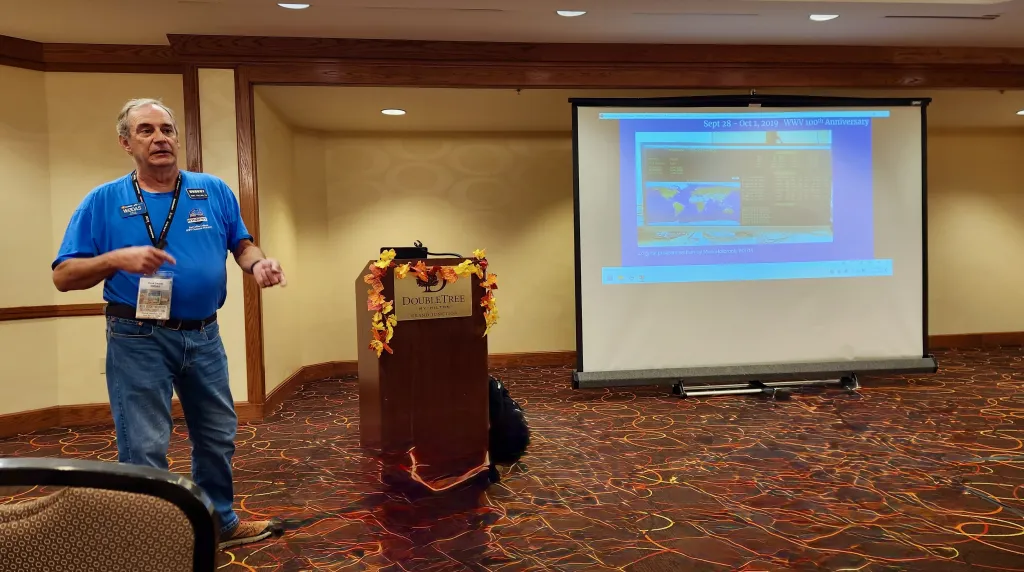
Dave W0DAS Presenting

MSQP Practice: Test Your Gear, Create Valuable Data
HamSCI hopes to have many stations participate in the upcoming (12-13 December, 2025) Meteor Scatter QSO Party. As with any astronomic activity (especially one that peaks over just a 1 to 2 day period) it helps to be prepared. HamSCI suggests that future MSQP participants practice making QSOs and/or receiving pings from the meteoroids entering the Earth's atmosphere. Three upcoming showers/practice opportunities are listed the table below.
Aside from participants gaining confidence in their antenna, receiver and software, the data collected prior to the MSQP will have scientific value. HamSCI fully welcomes and encourages those making meter scatter (MS) QSOs, or those who choose to operate receive-only during these events, to submit their data, in the form of WAV files, to HamSCI's data repository at zenodo.org. Complete instructions are available at the MSQP GitHub Site.
Note: There is no need for a separate submission form, as there won't be any scoring of entries for dates other than the official MSQP period (12-13 December, 2025). Questions are welcome at the HamSCI mailbox.
Lastly, don't forget about the resources available to MS ops, rookie to expert:
- The Ping Jockey Central website is a real-time messaging tool, where friendly MS ops share tips regarding what they are working, when and where. Simply reading the live comments can point you in the right direction, on the right bands, whenever meteor showers are active.
- The weekly HamSCIence telecon offers an open net-type roundtable where questions are welcome (details are on the HamSCI Get Involved page) (the second Thursdays of each month are generally reserved for presentations, roundtables may not be possible on those days).
- HamSCI's 'How-to' MSQP page
Meteor Showers for Remainder of 2025
The following meteor showers from the American Meteor Society website may be useful for testing your equipment and data collection and upload procedures for the HamSCI Meteor Scatter QSO Party prior to the Geminids (also listed). The zenithal hourly rates (ZHRs) are small but may provide useful rates. Testing using sporadic meteors especially during the diurnal peak around sunrise each morning is also appropriate but the population index, r, for showers indicates a slightly higher probability of larger meteoroids which may be useful for testing.
|
Shower |
Activity Period |
Maximum Date Sol Lon |
Radiant RA Dec |
Velocity Km/s |
r |
Max. ZHR |
Time |
Moon % |
||
|
Orionids (ORI) |
Oct 02-Nov 12 |
Oct 23 |
209.5° |
06:25 |
+15.8° |
65.5 |
2.5 |
20 |
0500 |
02 |
|
Leonids (LEO) |
Oct 28-Dec 07 |
Nov 17 |
235.4° |
10:16 |
+21.8° |
69.7 |
2.5 |
15 |
0500 |
27 |
|
Geminids (GEM) |
Dec 01-Dec 21 |
Dec 13 |
261.85° |
07:33 |
+32.4° |
33.8 |
2.6 |
120 |
0100 |
24 |
Further Information (Thanks to Rob, NN4NT, for all of the information on this page)
The full list of large meteor showers (Class I) as well as the smaller Class II shower list are available at https://www.amsmeteors.org/meteor-showers/2020-meteor-shower-list/
A nice graphic of the Comet Halley material responsible for the Orionids and Eta Acquarids is available at https://www.amsmeteors.org/meteor-showers/meteor-shower-calendar/ You may want to click “View Other Showers and Learn More” to see animations for other showers.
You may check the current activity levels as measured by the Canadian Meteor Orbit Radar near London, Ontario at https://fireballs.ndc.nasa.gov/ Click on “Radar” on the menu at left.
HamSCI at the Northeast HamXposition
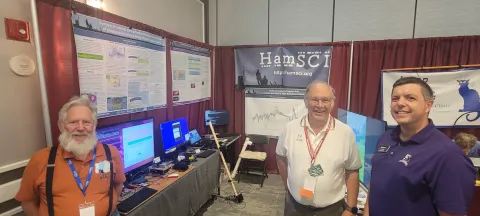
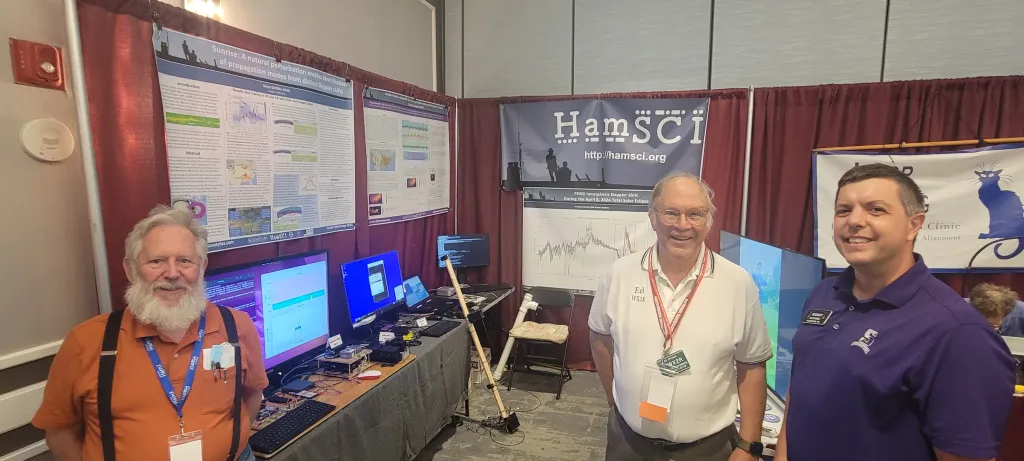
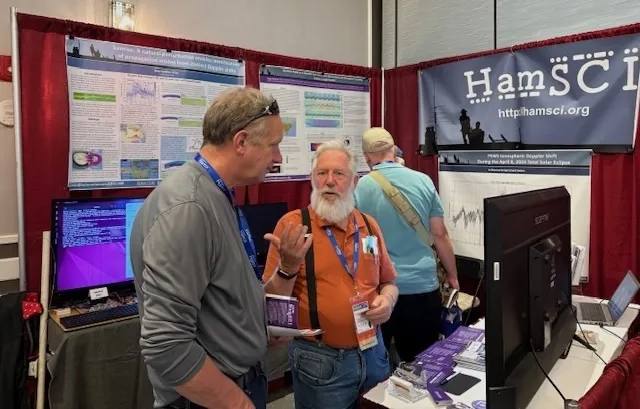
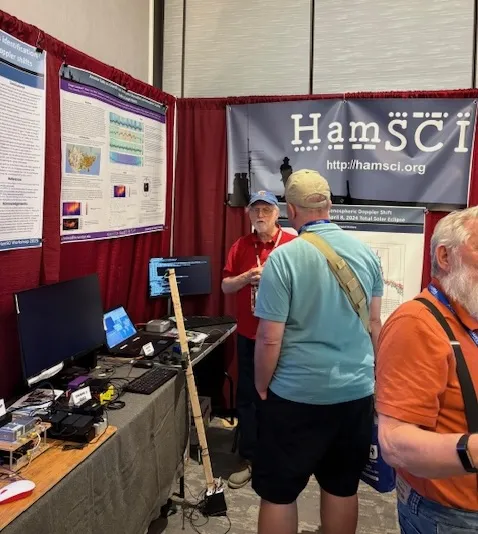
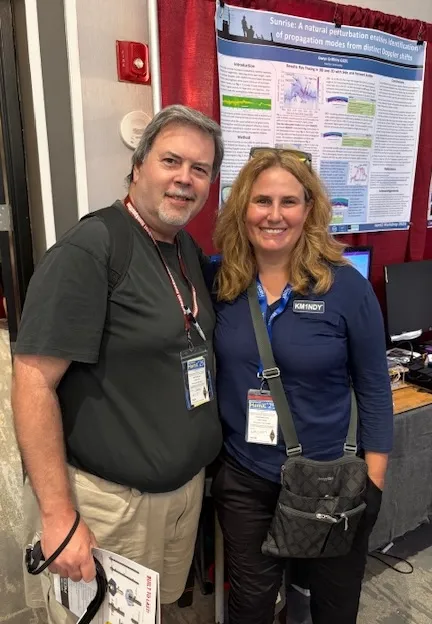
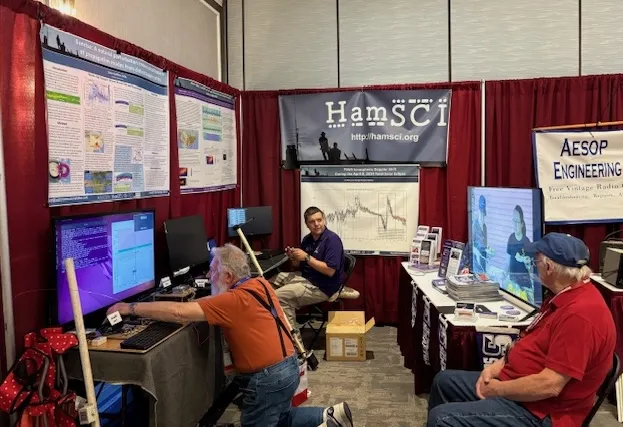
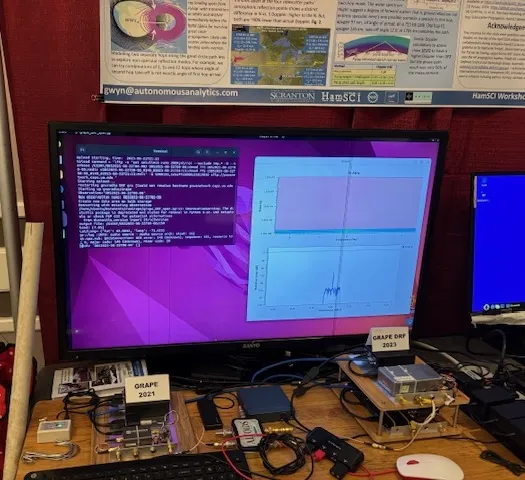
HamSCI was well represented at the 2025 Northeast HamXposition, held 21-24 August, in Marlborough (Boston), Massachusetts. Our booth attracted many visitors armed with questions and a strong fascination for what we do. The booth featured working GRAPE receivers of various 'flavors' (GRAPE 1, GRAPE 1 DRF and GRAPE 2), a live display of the new SDR PSWS installation at K3LR plus an array of posters highlighting both past and active experiments. Overall awareness of our HamSCI efforts appears to be getting better and better!
Dr. Nathaniel Frissell W2NAF was the keynote speaker at the HamX banquet and provided a comprehensive overview of the origins of the group, our past and current experiments such as the SEQP and MSQP and a look into the future.
HamSCI volunteers accompanying Frissell to Marlborough were Bill Blackwell AB1XB, Bob Reif W1XP, Stan Pozerski KD1LE, Mindy Hull KM1NDY and Ed Efchak WX2R.
The full list of HamSCI speakers and their talks:
A Portable Radio Operator's Pivot to Citizen Science: The Ham Path Less Traveled
Mindy Hull, KM1NDY
Mindy Hull, KM1NDY
Contesting - A Little History, and the Future
Tim Duffy, K3LR
Tim Duffy, K3LR
Saturday Evening Grand Banquet
Dr. Nathaniel Frissell, W2NAF
Tnx to Ed, WX2R for reporting on the event and for providing photos.
PSWS Design Charrette
Personal Space Weather Station Design Charrette
Visit hamsci.org/PSWS for more information about the Personal Space Weather Station.
A charrette (American pronunciation: /ʃɑːˈrɛt/; French: [ʃaʁɛt]), often Anglicized to charette or charet and sometimes called a design charrette, is an intense period of design or planning activity.
As the Personal Space Weather Station evolves, we want to collect input from you to inform the design of the data system and analysis tools.
We're developing the PSWS database and Python package to access it according to a waterfall design model, where each design phase— gathering requirements, design, implementation, verification, and maintenance— occurs sequentially. Here's the plan:
1 September 2025 - 31 October 2025: We'll gather your input on this form.
November 2025: The features proposed will be consolidated into a requirements list.
December 2025: The results of the charrette will be presented at the AGU Fall Meeting.
January 2026: The final scoping and project management plan will be designed by the development team.
March 2026: Report to the HamSCI community at the HamSCI workshop.
April 2026—:The features will be implemented, tested, and maintained.
You can submit this form multiple times. Please fill it out once for each feature or comment. Don't worry about features being submitted more than once; we will consolidate them during the review process in November.
HamSCI Field Work at K3LR
A Successful Field Exercise
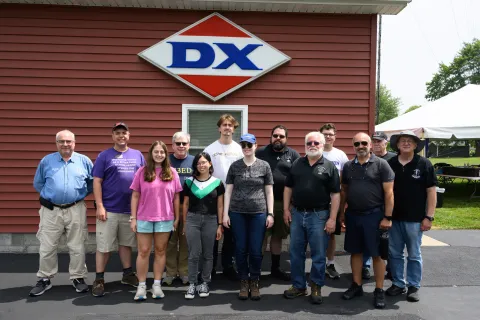
HamSCI just completed its first ever multi-day field exercise, where two components of the Personal Space Weather Station (PSWS) were successfully installed at the world-class ham station K3LR in West Middlesex, PA. Students, professors, research associates and community volunteers were hosted for four days by station owner Tim Duffy, K3LR.
The field exercise had three goals: a) installation of a PSWS ground magnetometer and a WSPR Daemon/RX888 wide band SDR and an active antenna; b) exposure to ham radio and practical applications of the applied physics which make HF communication possible; c) a chance for all attendees, including invited members of the ham community from western PA and eastern Ohio, to enjoy Tim’s special brand of hospitality, including an afternoon operating the K3LR station.
Timeline of Events
Much of the installation work and computer setup was done on Monday evening and Tuesday morning, including assembly of a DX Engineering active vertical receive antenna, insertion of an 8-foot ground rod/antenna mounting point, digging a hole for, and then burying the HamSCI/TAPR designed ground magnetometer (built prior to arrival at Scranton), followed by laying cables between the equipment and the building housing the equipment.
It was “show time” on Tuesday afternoon, when the RX888 spectrum display was fired up. That effort included a Zoom session with HamSCI “spectrum consultant” Rob Robinette, AI6VN. Rob declared the 1-30 MHz spectrum at K3LR, as displayed on the WSPR Daemon/RX888’s waterfall display, to be very clean, with a good opportunity to be one of the top spotters, worldwide, of WSPR signals. This came as little surprise to K3LR, as Tim has spent nearly 40 years perfecting his station, studying the surrounding topography (which, he explained, can greatly influence HF signal paths) and doggedly pursuing and removing every RF noise source in the immediate area. More distant sources, impossible to disable (i.e. commercial AM broadcasters) are well known to Tim, and sure enough, they and their mixing products were observed on the HamSCI equipment. Some tuning and tweaking of the RX888 bandwidth, along with a judicious choice of input filters, left the RX888 happily receiving WSPR and FT8 spots numbering in the hundreds per hour.
Wednesday morning was a two-hour tour of the K3LR antenna farm, with detailed explanations of what, why and how nearly every system functioned. It took two hours because K3LR has 14 towers, 50+ antenna systems (including band-dedicated receiving systems) all designed to eke out every last 0.1 dB of signal when working stations in Europe, Asia and the rest of the globe. The adjective ‘impressive’ doesn’t do it all justice. Consider that two of the towers, each over 200 feet tall, are on aviation maps, painted and lighted to comply with FAA regulations.
Beyond the Work
The week wasn’t all work and no play. Tim and a CWRU alum supplied all the afternoon and evening meals, set up under a large tent, next to the ‘DX Barn’ where some of the male participants overnighted. (The females had a nearby house to themselves). Local caterer Guy Gibbs cooked up piles of chicken, corn on the cob, hamburgers, salads, veggie dishes and all the fixings. Tim and co-host Amy, N8AMY, topped that all with servings of locally made apple pie on Thursday evening. Tim’s friends from the local area, schools and colleges joined the HamSCI bunch to swap operating stories and to discuss HamSCI’s research efforts, mixed with the nerdy banter always heard at ham radio-centric events.
Tim’s hospitality extended to his award-winning ham station, where he invited all in for a tour and operating session. The most recently licensed hams in the group were given seats on four different bands, and paired up with experienced ops in case of questions - and to keep things legal - FCC rules, you know ;-) Over 400 QSOs (contacts) were made on 10, 15, 20 and 40 meters, domestic and DX QSOs with New Zealand, Australia, England, to name a few. Often the stations we worked told us “you are the only signal on the band” and “thanks for the past contest QSOs”. Tim has millions of contacts in his log, going back to 1972, from one of the best known callsigns in the world. Tim credits the success of his station to uncompromising engineering, meticulous maintenance, and a crew of operators dedicated to being the best at what they do. (One particular operating highlight was the brand-new ham we met on 10 meters - it was his very first ham radio contact - and he emailed Tim right afterwards to thank him).
There were other events, almost too numerous to mention. A Monday evening dinner at the local country club, Wednesday evening presentations on HamSCI research topics, N8AMY’s special hot dogs and onions, magnetometer calibration and alignment, breakfasts at the local diner. Perhaps we can reconvene at Tim’s place next year, bringing along another generation of new hams, ready for deep immersion into the wonders of ham radio.
A Hearty Thank You
In summary, a hearty thanks to all who participated, a most enjoyable four days, and we can’t say enough about the support and enthusiasm from station designer/builder/operator Tim Duffy K3LR, and the company he runs, DX Engineering. DXE is a longtime supporter of HamSCI, and we thank them for providing supplies and expertise, helping make the field work highly successful. We are looking forward to gigabytes of data being generated from West Middlesex, PA!
Photos courtesy of Nathaniel Frissell W2NAF (University of Scranton, HamSCI Lead), Gary Mikitin AF8A (author), Harry Bloomberg W3YJ (University of Pittsburgh)
Dr. Nathaniel Frissell, W2NAF, can be seen discussing the field work event on the Q5 Worldwide Ham Radio YouTube podcast, recorded in August, 2025.
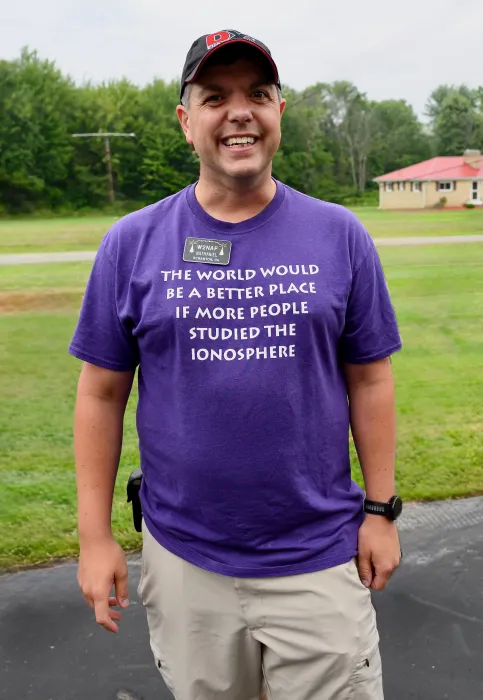
Dr. Nathaniel Frissell, HamSCI Lead
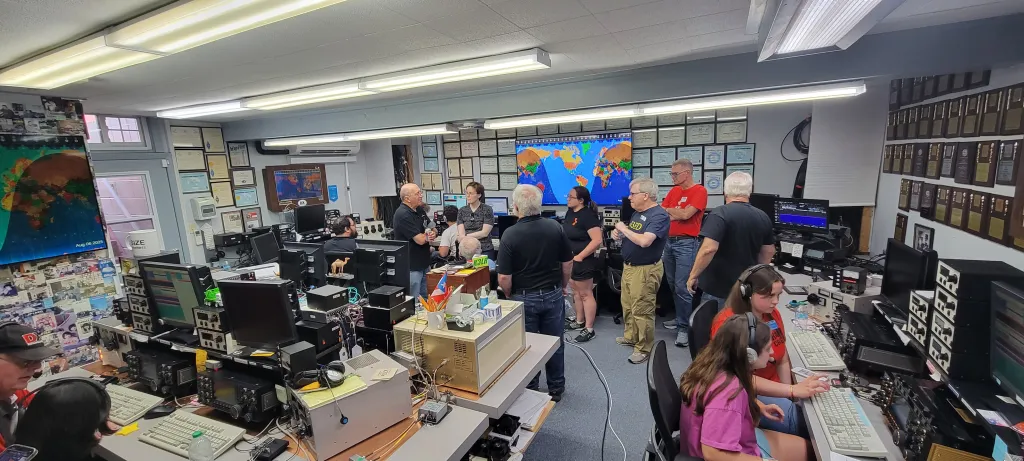
The K3LR Station
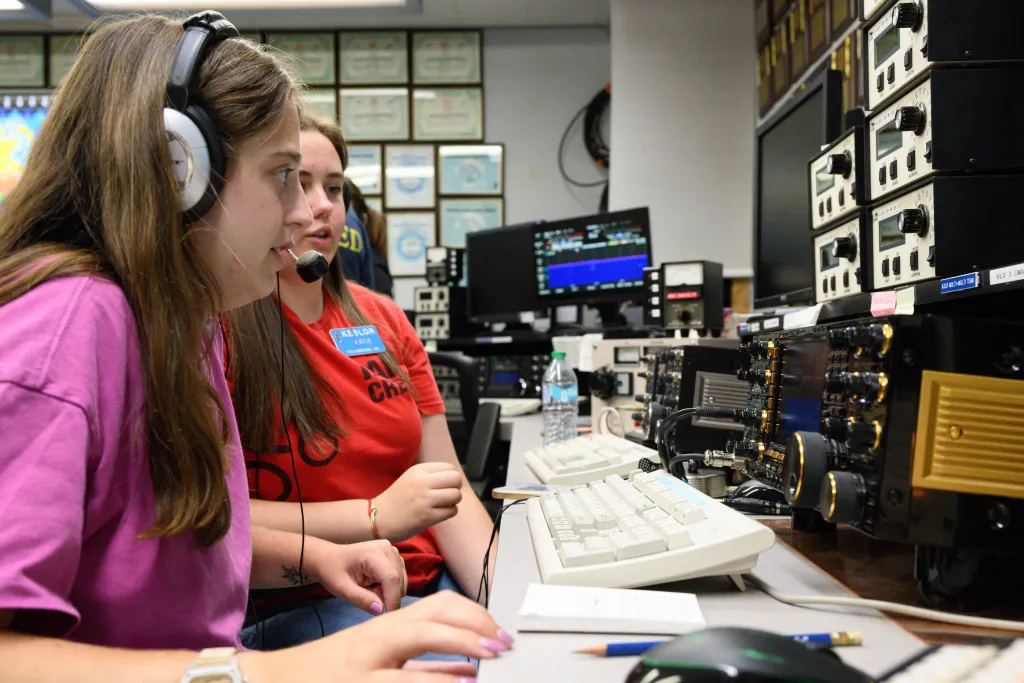
Nina Tormann KD3BJV and Kate Campbell KE8LQR operate K3LR
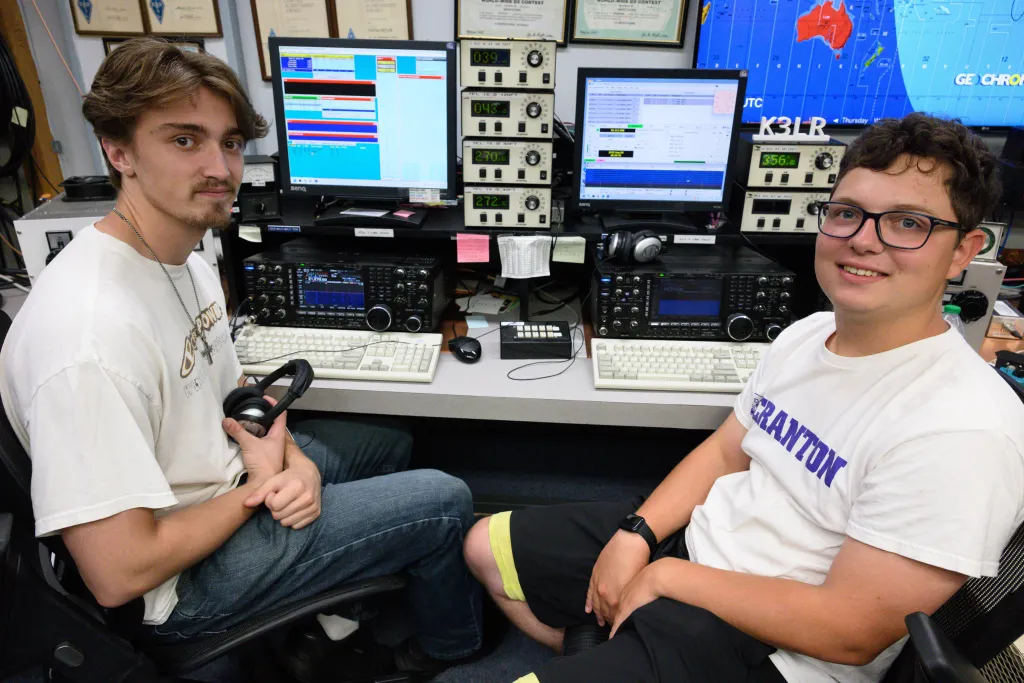
Declan Reavy KD3BMA and Owen Ruzanski KD3ALD operate K3LR
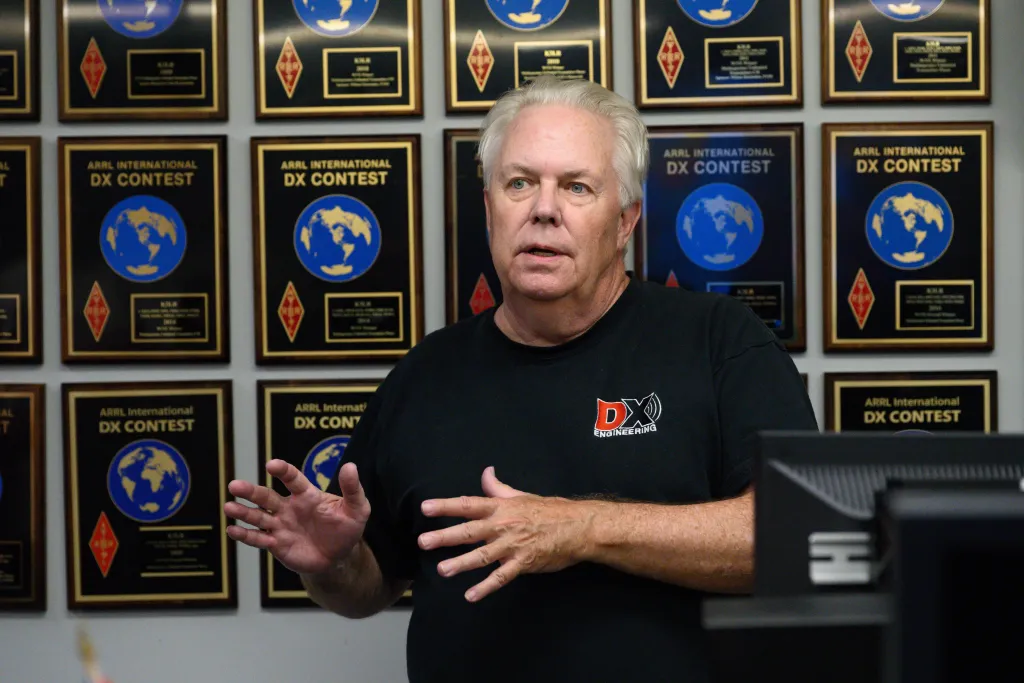
Tim Duffy K3LR
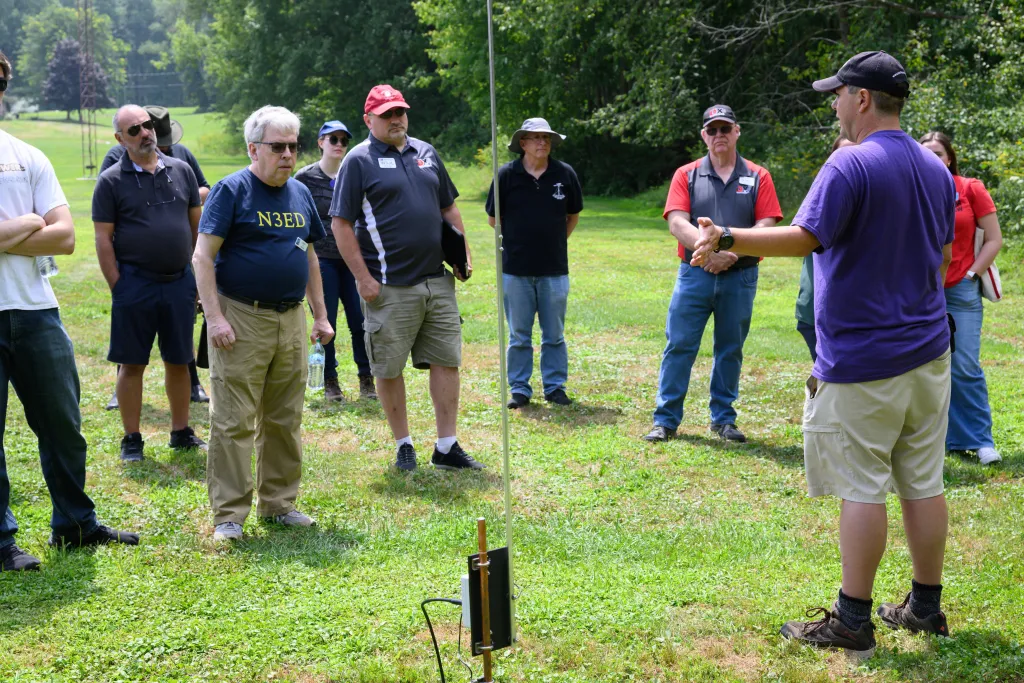
W2NAF addressing the group in front of PSWS antenna
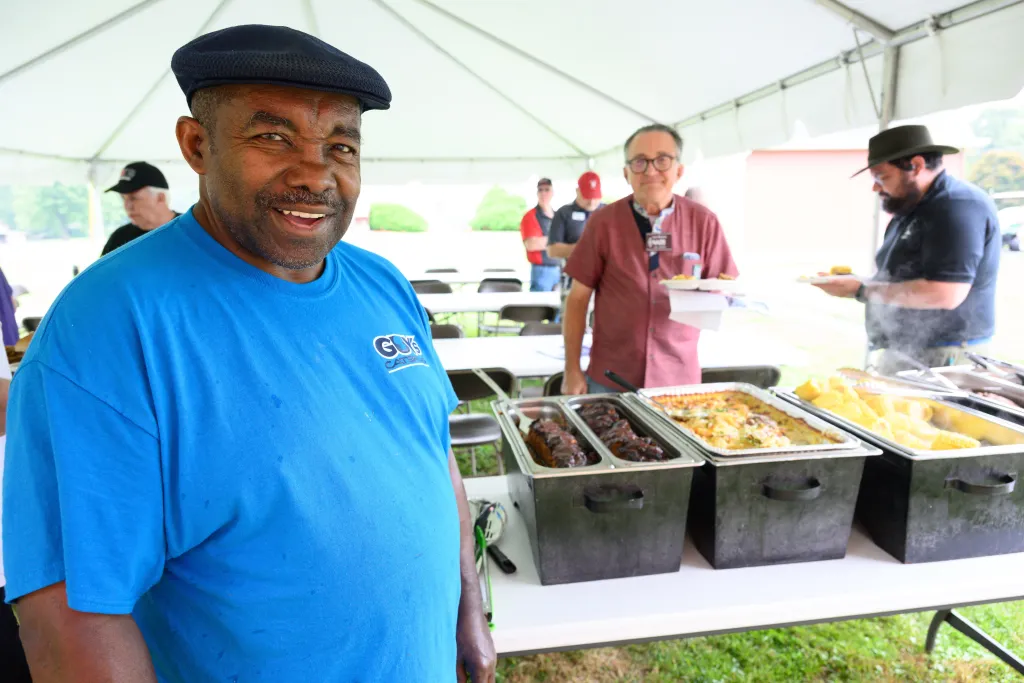
Caterer Guy Gibbs, Hermatige PA
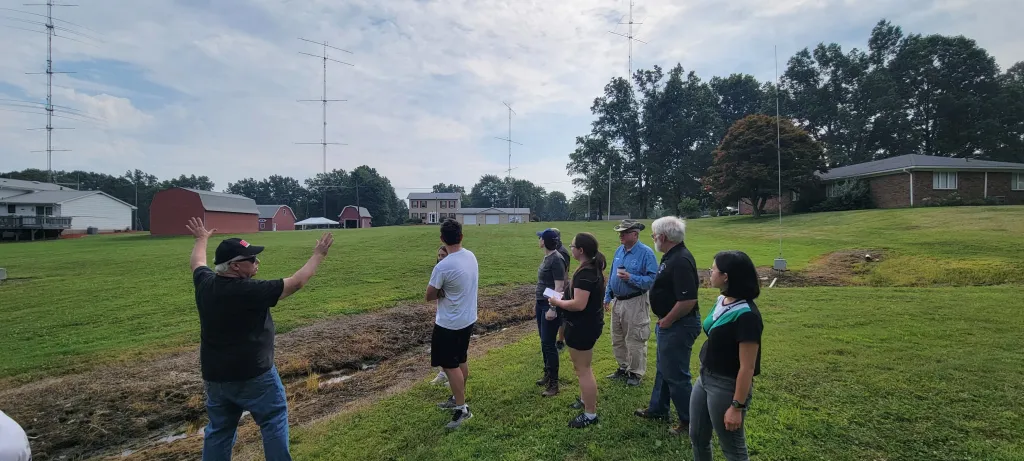
K3LR Antenna Farm (partial view)
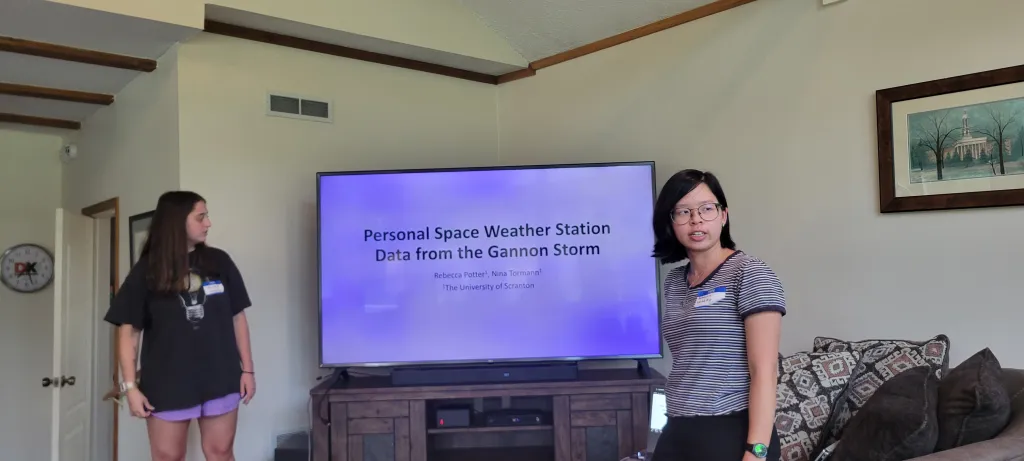
Nina Tormann KD3BJV and Rebecca Potter KE2EBI

DX Engineering - HamSCI Supporter
K3LR Invites HamSCI Community to West Middlesex, PA
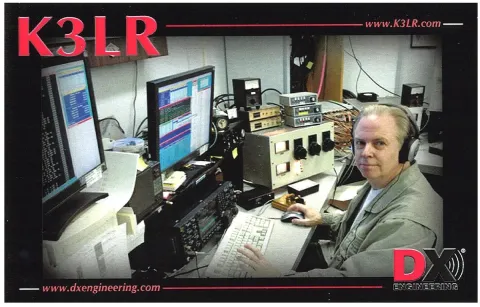
Tim Duffy, K3LR, is inviting the HamSCI community, including local schools and colleges, to a BBQ Picnic and HamSCI Meet & Greet on Wednesday, August 6th (1200 local time) at Tim's QTH in West Middlesex, PA. (RSVP required)
The BBQ picnic is part of a multi-day field work event for HamSCI, where HamSCI students, researchers, and ham radio community volunteers will be installing, configuring and validating a Personal Space Weather Station (hamsci.org/psws) at K3LR. Expected are teams from the U of Scranton, Case Western Reserve and NJIT. Most of the work should be done by noon or so on Wednesday, so that’s a good time to share a meal while meeting others interested in radio wave propagation, space weather, ionospheric physics, contesting, DXing - and how ham radio plays a major role in HamSCI’s research activities. Plus, it is an opportunity to tour K3LR, one of the best equipped amateur radio stations in the world. RSVP details are below.
If Tim's name and callsign sound familiar...
- K3LR is known around the world as a top-tier contesting station, hosting dozens of events throughout the years, winning countless domestic and DX contest awards
- Tim is CEO of DXEngineering, a premier supplier of amateur radio equipment, and a long time supporter of HamSCI
Particularly welcome are local college and high school students, including:
- Carnegie Mellon
- Grove City College
- Penn State
- University of Pittsburgh
- Harborcreek High School
- Case Western Reserve
- University of Scranton
- New Jersey Institute of Technology
31 July 2025: Registration has closed...thanks to all who signed up and who will be attending!
Gary Mikitin, AF8A
HamSCI Amateur Radio Community Coordinator

HamSCI Featured in QST Magazine
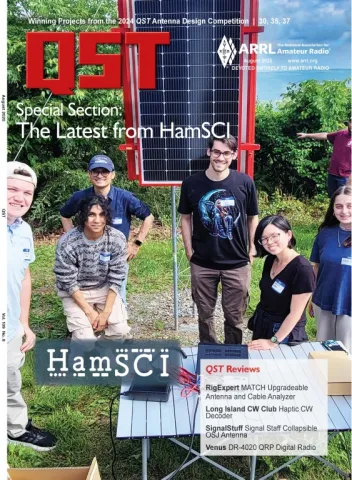
HamSCI has been prominently featured in the August 2025 issue of the ARRL's QST magazine, with fourteen* pages of content, plus the issue's cover photo, devoted to our citizen science initiative. Thanks to the generosity of the ARRL, the cover and the special section can be read here, on the HamSCI website.
The special section begins with articles by Dr. Nathaniel Frissell W2NAF on the background behind HamSCI, and Drs. Ethan Miller K8GU and Frissell on traveling ionospheric disturbances. The section continues with highlights of presentations given at the 2025 HamSCI workshop held in March at New Jersey Institute of Technology. These highlights include Gary Mikitin AF8A on Expanding the HamSCI Personal Space Weather Station network, Dr. V. Lynn Harvey on the role of the polar vortex in atmospheric-ionospheric coupling, Steve Cerwin WA5FRF on radio wave propagation and antenna fundamentals, Mindy J. Hull KM1NDY on an overview of the HamSCI workshop poster session, Owen Ruzanski KD3ALD on the development of a contesting and DXing dashboard, McKenzie Denton KO4GLN on the upcoming HamSCI Meteor Scatter QSO Party (MSQP), and Steve Stroh N8GNJ/Martin Alcock VE6VH on the IP400 networking, and many others.
“We at HamSCI are both honored and excited to collaborate with the ARRL on the advancement of both radio and science. The ARRL and its membership already has more than a century-long tradition of radio science innovation; it is wonderful to have the opportunity to build on that and carry it forward” said HamSCI founder Dr. Nathaniel Frissell W2NAF upon publication.
The HamSCI Community is led by The University of Scranton Department of Physics and Engineering W3USR, in collaboration with Case Western Reserve University W8EDU, the University of Alabama, the New Jersey Institute of Technology Center for Solar Terrestrial Physics K2MFF, the MIT Haystack Observatory, TAPR, additional collaborating universities and institutions, and volunteer members of the amateur radio and citizen science communities. HamSCI receives financial support from the United States National Science Foundation, NASA, the Amateur Radio Digital Communications foundation (ARDC), the Yasme Foundation, and the Frankford Radio Club.
*The print version of QST contains 14 pages, while the digital version, available to ARRL members, has bonus content, totaling 18 pages.
TEC Measurement: Citizen Science Opportunity
Joining the Global TEC Measurement Network: Contributing to Ionospheric Research
The dual frequency radio signals of the Global Navigation Satellite System (GNSS) allow measurement of the ionosphere's Total Electron Content (TEC) along a ray path from GNSS satellite to receiver. Space science researchers make extensive use of TEC data as a fundamental tool to probe ionospheric conditions. TEC values are generated by post-processing data collected from worldwide networks of GNSS receivers via a non-trivial analysis suite. One group processing GNSS data to extract TEC is the MIT Haystack Observatory (funded through a National Science Foundation facility grant). The resulting data is stored in the Madrigal distributed database (also run by MIT Haystack). TEC data from Haystack is being collected from roughly 5000 stations worldwide, and researchers are always interested in adding more stations to the network.
It is not difficult to assemble a TEC monitoring station, which, in the simplest terms, consists of a purpose-built GPS receiver, external antenna and a single board computer for data collection and uploading to a cloud based server. (Note that 'GPS', or Global Positioning System, is the US version of a GNSS. The first GPS satellite was launched in 1978.)
For more information about TEC measurements, how they are collected and used for research on topics such as large scale ionospheric disturbances, equatorial plasma bubbles, solar eclipses, ionospheric modeling and more - search on 'TEC measurements' in Google Scholar. A few quotes from published papers appear below.
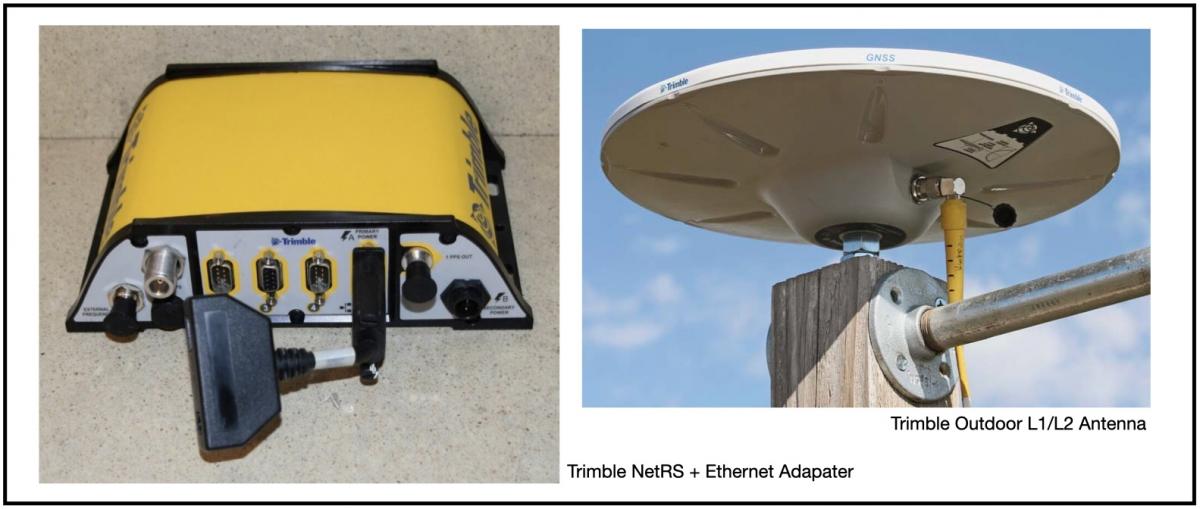
Assembling a TEC Measurement Station
It is not difficult to construct an Earth-based TEC measurement station, sharing data with a globally respected research institution. Thanks to TAPR/HamSCI member John Ackermann N8UR, the task has been made fairly simple, thanks to his SBC (single board computer) programming efforts. John collaborated with members of the MIT Haystack community to develop the code needed to reliably download, process, and then upload TEC data from a commercially available GPS unit/antenna combination.
Hardware:
- Trimble NetRS GPS Reference Station (Dual band, L1/L2 GPS receiver and data logger) (DATASHEET) (USER GUIDE)
- GPS Antenna (SAMPLE DATASHEET)
- Trimble DA-26 to Ethernet/USB/Coaxial power adapter
- Raspberry Pi 3 or 4 SBC, monitor/keyboard/power supply/Ethernet cable
- Misc. items: DC power supply, feedline between NetRS and antenna, cable adapters
Note: All of the above is available on the 'used' market - most often on eBay.com, because the receiver components are commonly used in surveying and marine applications. The system cost? Approximately 250 to 350 USD.
Software & Instructions
*** Special Offer ***
Thanks to the generosity of John N8UR, a very limited number of NetRS receivers and GPS antennas are available to the citizen science community, at no charge for the hardware. Anyone considering this offer should be prepared for the following:
The recipient...
- ...will be responsible for shipping charges, originating from John's Ohio location
- ...will have to obtain, at their own cost, the items noted as 4 and 5 under Hardware, above
- ...should review the antenna placement information in the NetRS User Guide, and be able to reasonably meet the suggestions
- ...should be comfortable with Linux command line work, as required for software installation and configuration
- ...will have to provide an Internet connection so that the data can be uploaded to TAPR servers on a daily basis (once/day, ~0230 local time)
If you are interested, follow this link to a Google Form where we'll gather basic information (name, callsign, grid square, etc.) Note that the selection of recipients will depend on many factors, one of which is geographic dispersion. In other words, we don't want 4 or 5 receivers located within a 50 mile radius. The data will have more scientific value if it is obtained from locations distant from one another. Questions? Email [email protected].
Quotable:
"Ionospheric total electron content (TEC) is one of the key parameters for users of radio-based systems, such as the Global Navigation Satellite System, high-frequency communication systems, and space-based remote sensing systems, since total ionospheric delay is proportional to TEC through the propagation path. It is important to know extreme TEC values in readiness for hazardous ionospheric conditions." (Michi Nishioka et al, Earth, Planets and Space, February, 2021)
"The availability of a large amount of TEC data derived from dual frequency GPS measurements observed by GPS reference networks provides a great opportunity for ionosphere studies." (Zhizhao Liu et al, Earth, Planets and Space, June, 2014)
"Space weather monitoring and forecast require a permanent monitoring of the ionospheric state on global scale. The world-wide use of global navigation satellite systems such as GPS and GLONASS offers the unique chance for a permanent monitoring of the total ionization (total electron content—TEC) of the global ionosphere/plasmasphere up to about 2000km height. Ground-based GPS measurements can effectively be used for detecting large-scale horizontal structures and their motion (up to 30mS time resolution) during perturbation processes" (Geonhwa Jee et al, Journal of Atmospheric and Solar-Terrestrial Physics, July, 2005)
Comments, questions or corrections on this web page? Email [email protected].
Version 2.0, 2025-7-10
WSPRSonde PSWS Transmitter
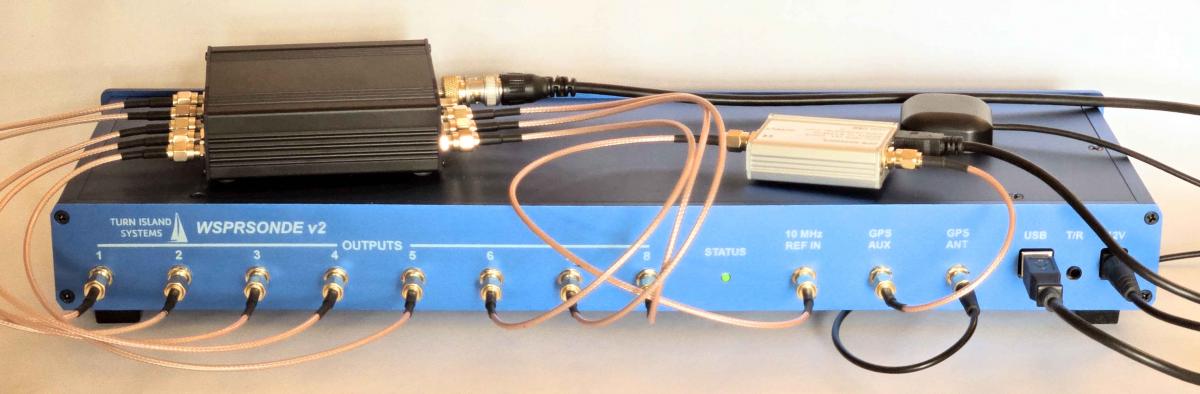
WSPRSonde v2 - An 8-Band WSPR Transmitter
WSPR and FST4w transmissions are playing an ever increasing role in HamSCI's research ( see links 1, 2, 3). In the past, generation of WSPR data was often done with single-band transmitters, with some stations having 2, 4 or even more individual WSPR transmitters running on different bands. Now, there is a product from Turn Island Systems which can transmit simultaneously on 8 bands, and do so with GPS-locked frequency precision. The product is known as the WSPRSonde-8 As of June, 2025, roughly a dozen WSPRSonde-8s (and its predecessor, the 6-band BeaconBlaster) are running 24/7, generating research-worthy data on WSPR frequencies from 160 to 6 meters.
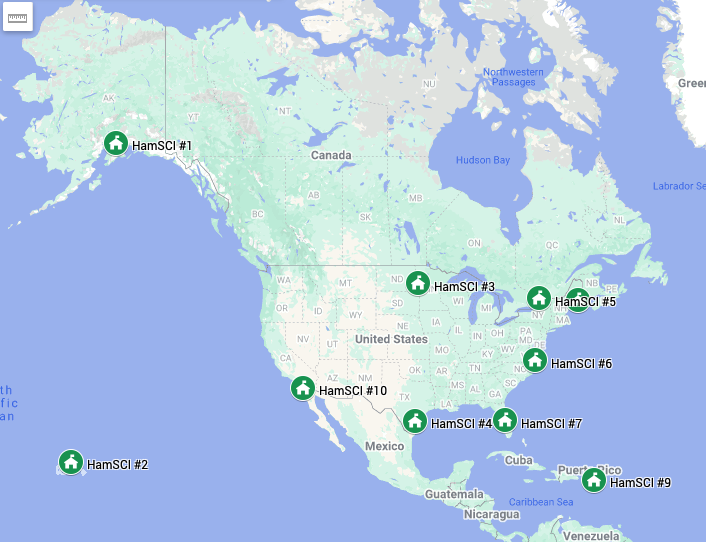
HamSCI, as part of its Personal Space Weather Station project, plans to fund the purchase and installation of ten WSPRSonde stations across North America in 2025.
Each system will consist of the following:
- Turn Island Systems WSPRSonde-8
- 9 Band Filter/Combiner
- Cabling
- Power Supplies
- Leo Bodnar LBE-1420 GPS Disciplined Oscillator w/GPS Antenna
- Multi-band EFHW Antenna for 80-10 meters
Stations interested in participating should be prepared to participate on a long-term basis, for at least a year, preferably longer.
Research needs will dictate where in North America WSPRSondes are needed. Please see the map below for approximate target locations.
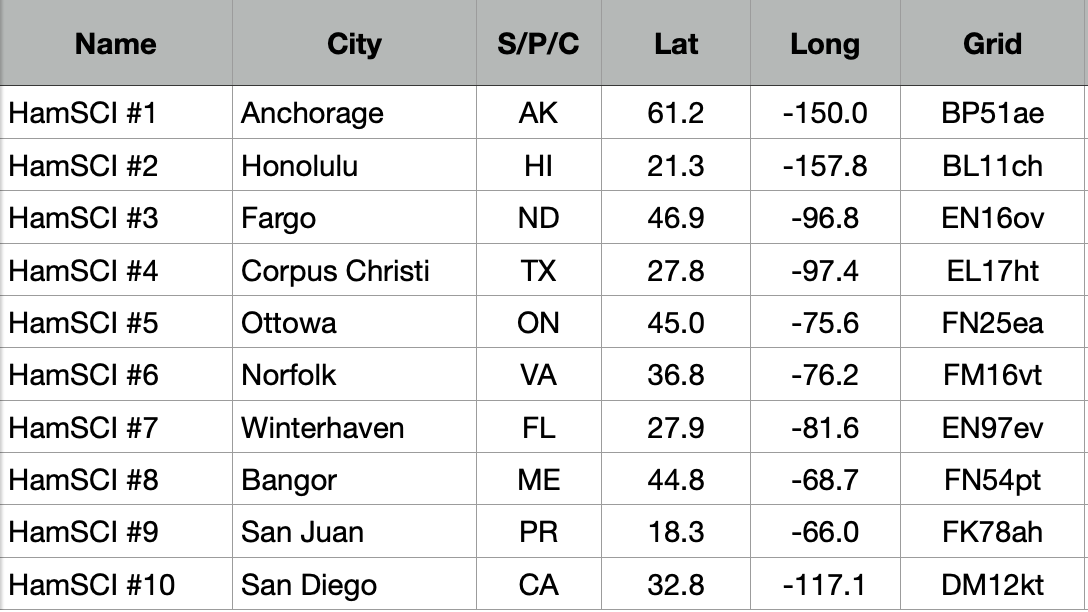
If you are interested, and your QTH (location) is close (+/- 200 miles) to one of the locations shown in the map and chart below, please let us know by filling out the form at the bottom of this page. Questions? Email HamSCI via this link
Research needs will dictate approximately where in North America WSPRSondes are needed. Please see the map and chart below for target locations.
HamSCI Field trip to Jenny Jump NJ
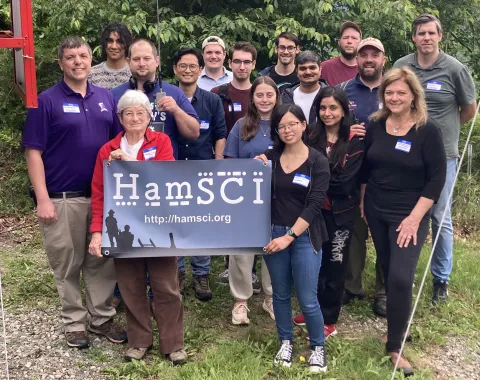
A large HamSCI-led team recently made a field trip to Jenny Jump State Forest (NJ), surveying the United Astronomy Clubs of New Jersey (UACNJ) site. It is located on a rustic, park-like property, where the UACNJ hosts scientific instruments from many US-based institutions, including the New Jersey Institute of Technology (NJIT) and HamSCI. The trip’s primary goals:
1) Assess maintenance needs of the existing Personal Space Weather Station (PSWS) equipment
2) Develop a plan for upgrading to the current generation of PSWS (DASI Track 2)
The findings were mostly positive: The HF receive antennas (a DXEngineering active vertical and a DXE receive loop) are generally in good condition, though animals have done some damage to cabling. The Reverse Beacon Network (RBN) receiver is currently off-line, in need of attention.
As for the PSWS/DASI2 upgrade, plans were made for summer ‘work parties’ to replace computers, install an RX888-based HamSCI HF Receiver, re-site the HamSCI ground magnetometer, and install a new VLF receiver/signal processor. Additionally, the RBN Rx will be brought back on-line and cables repaired as needed. Much of the work will be done by members of the amateur radio clubs from NJIT (K2MFF) and the University of Scranton (W3USR).
The trio of PSWS instruments (GRAPE Rx, VLF Rx and magnetometer) represents the next generation of PSWS. It will be one of approximately 30 such systems to be deployed in 2025/2026. Collectively, the systems will form a space weather data collection network, the first of its kind to simultaneously monitor HF (shortwave), VLF (~8 kHz) and the Earth’s magnetic field. Using data collected by the Network, HamSCI researchers hope to gain a better understanding of the local, regional, and global scale processes that influence the ionosphere. This may lead to improved propagation predictions, new tools to predict radio wave behavior during solar storms, and, perhaps, new insights regarding solar cycles and other heliophysical phenomena.
All efforts at this site, from planning to equipment construction, configuration and installation is a collaboration between the University of Scranton and NJIT. Conveniently, the site is located exactly halfway between the two schools. Beyond station implementation, the schools partner on data collection, data analysis and research efforts.
Photos courtesy of Ann Marie Rogalcheck-Frissell and Nathaniel Frissell
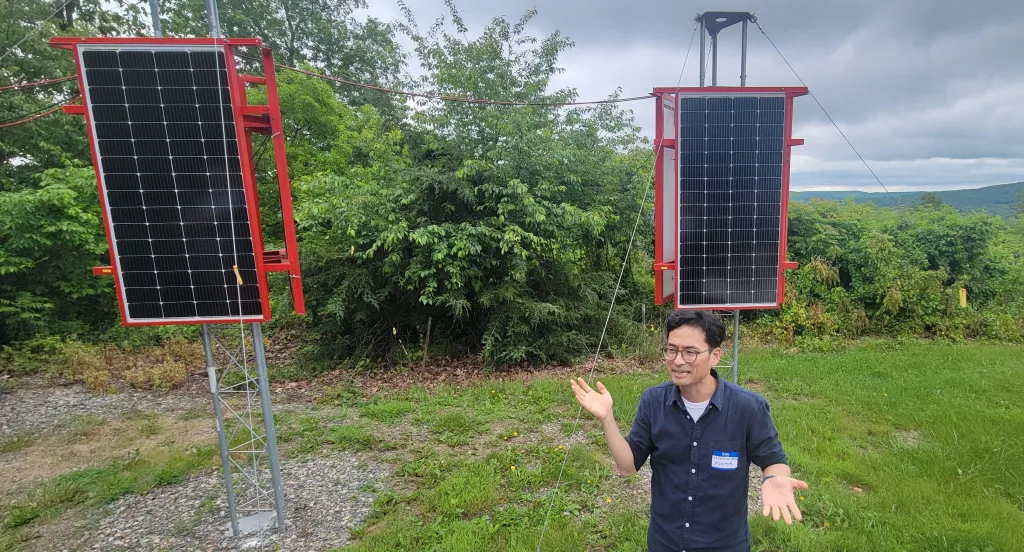
Dr. Hyomin Kim at Jenny Jump NJ
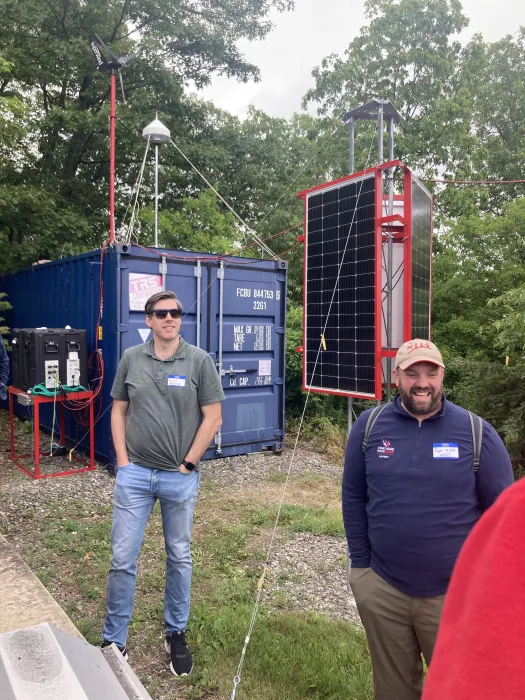
Dr. Gareth Perry and Ryan Tolboom at Jenny Jump NJ
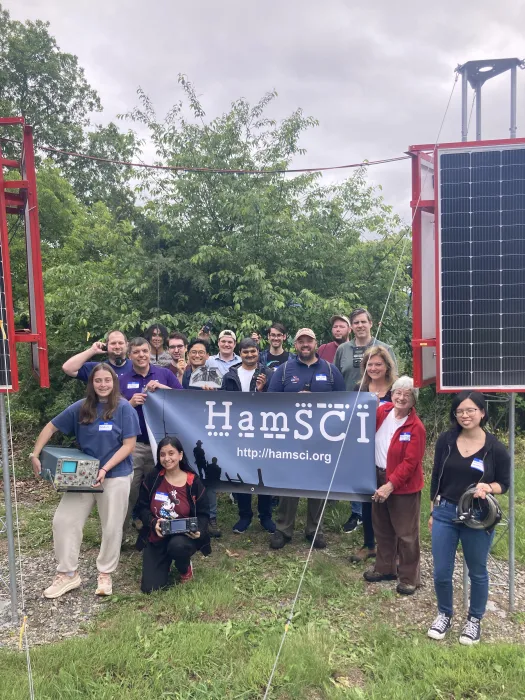
HamSCI Group photo at Jenny Jump NJ
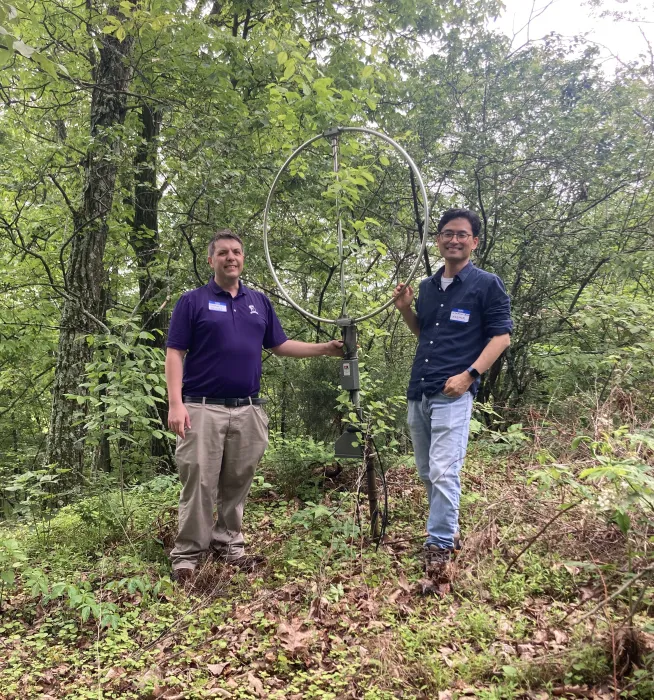
Drs. Nathaniel Frissell and Hyomin Kim at Jenny Jump NJ
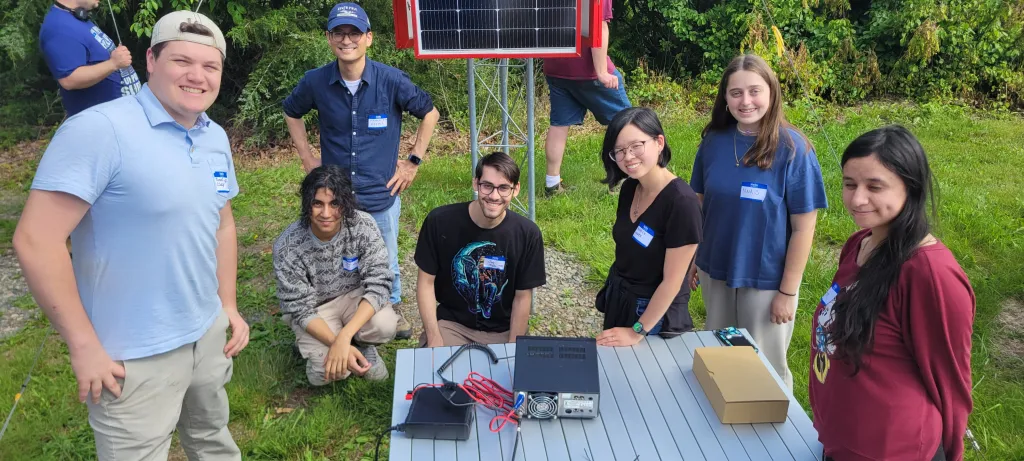
HamSCI Work Party at Jenny Jump NJ
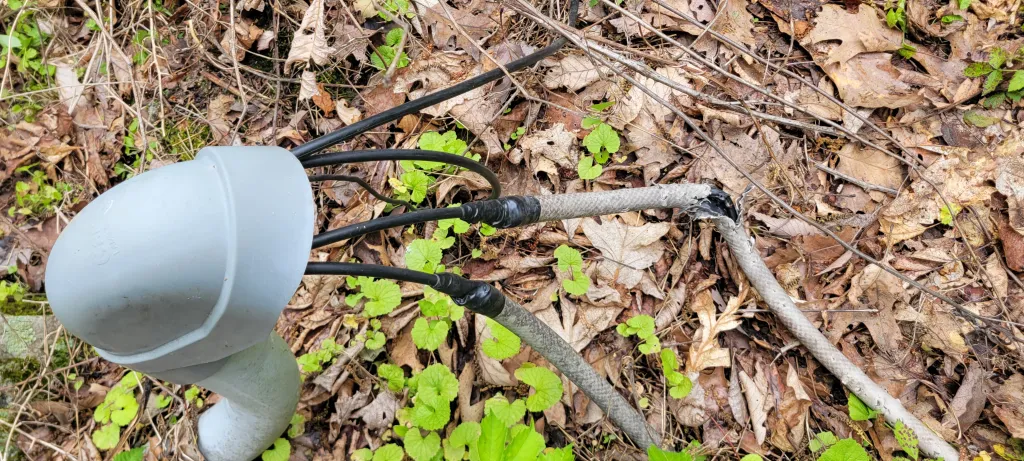
Feedline damage caused by the local wildlife at Jenny Jump
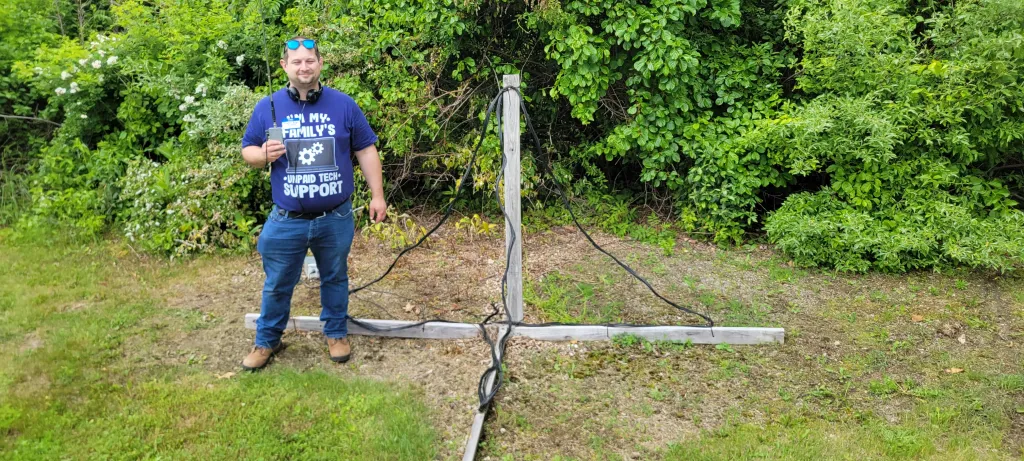
Jonathan Rizzo taking Field Measurements at Jenny Jump NJ
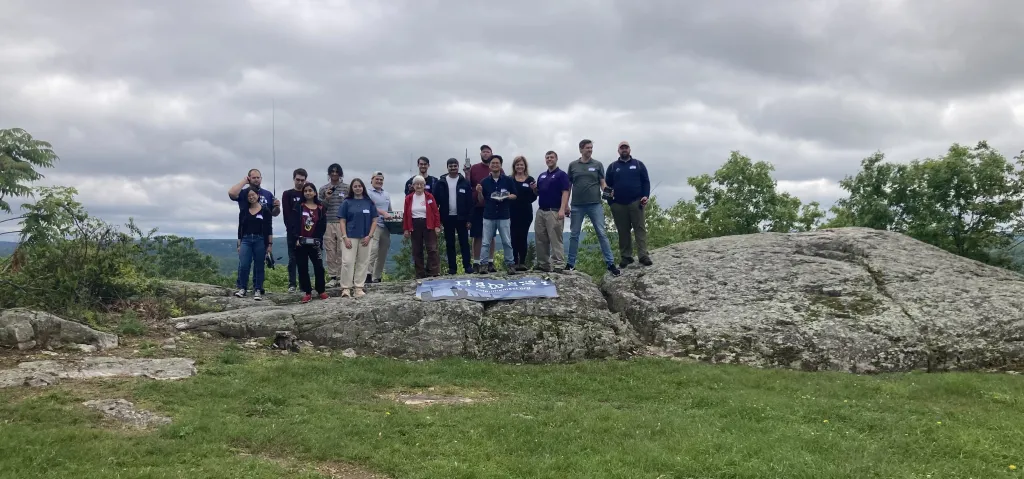
HamSCI Group photo at Jenny Jump NJ
Meteor Scatter QSO Party
Destination Url
/msqp
HamSCI Meteor Scatter QSO Party How to Guide
Work the rocks! Decode the pings!
-
Contribute to science as we strive to uncover the secrets of meteor scatter (MS) propagation
-
Join hundreds of operators on 6 m (50.260 MHz) and 10 m (28.145 MHz) MSK144 during the major meteor showers of 2026
-
Two-Way (transmit/receive) and Monitor (receive only) stations are needed
-
Collecting WAV (audio) files of all decodes is important to the scientists researchers analyzing the results of MS event. See the Audio Recordings instructions, below, for details
- Return to the HamSCI MSQP Home Page , or visit the HamSCI MSQP Operating Guidelines
MSK144 Is Just as Easy as Operating FT8, PSK31 or JT65
A typical meteor scatter (MS) station consists of a modern HF transceiver (IC7300, FT991, K3, Omni VII, etc.), a computer running WSJT-X, and, in some cases, a sound card interface. This is the exact same gear as is used by thousands of hams to run FT8 and the other 'JT modes'. Antennas can be as simple as an attic dipole. Or, use a yagi, Hexbeam, quad or Moxon if you have one. Transmitting stations typically run 100 watts or more (this is not a QRP event!).
MS activity is not limited to the major shower events. Review the materials and suggested web sites below and get on the air (typically in the early morning hours, starting before sunrise though an hour or two after sunrise (soon after the sun rises, other propagation modes, such as E-skip or F2, often dominate the bands). Activity will be found on 50.260 and 28.145 MHz, using the MSK144 mode. Saturday mornings are often the busiest times, outside of the major meteor shower events.
Software Setup: WSJT-X (Windows, Linux and Mac OS)
If you've never run WSJT or the other 'JT' modes: Download WSJT-X from the SourceForge website . Install per the User Documentation.
Once it is up and running, you should be able to modify the settings (configuration) according to your needs. Simply 'accept' many of the checkboxes on the setup screens. Particularly important settings are noted below. Note that there is a groups.io forum dedicated to WSJT-X. That's the best place to ask questions, get help, etc. In fact, most questions may already have been answered and can be found by using the 'Search' function once you are on that groups.io page. The WSJTGROUP is friendly and they are especially good at solving connection issues to various radios.
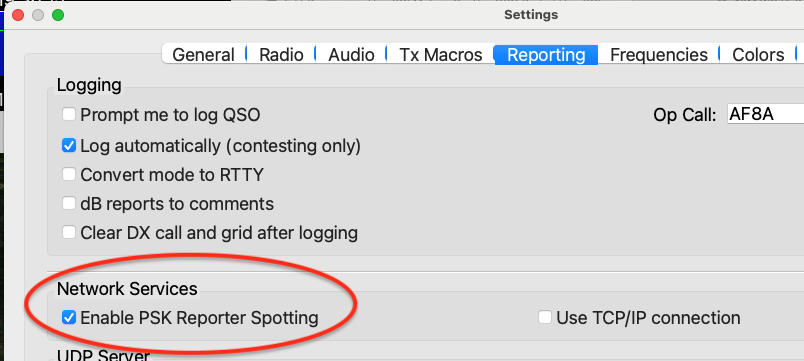
Of particular importance to the MSQP event (especially for Monitors, those entering the event as receive-only) is enabling PSKReporter Spotting. Turning on this functionality sends all of your reception reports to the PSKReporter.info website. Why? Because after the MS events, HamSCI researchers will be downloading data from PSKReporter, looking for interesting patterns in the reception data. Their efforts will be most worthwhile if everyone who is on the air, whether transmitting or receiving, uploads their MS 'spots'. Hint: Don't forget to find and click on the 'OK' button before leaving this screen, to make sure your new settings are saved.
Other WSJT-X settings unique to the MSK144 mode:
- Special operating activity (NA VHF) Yes/No? NO
- Mode: MSK144
- Decode (Fast, Normal, Deep) DEEP if your CPU can handle it
- Tx even/1st (marked or unmarked) CQing to the West unmarked, CQing to the East marked
- Tx F Tol (number) 200 if your CPU can handle it
- Rx Hz (number) Rx 1500 Hz
- Report (number) Will be filled in automatically when you call someone
- T/R seconds (number) 15 s
- Sh (marked or unmarked) Unmarked
- Auto Seq (marked or unmarked) User preference
Note that as it is delivered out of the box, WSJT does not contain 28.145 MSK144 in the Frequencies list - but you can add it: Go to the Frequencies chart, right click and select Insert. Fill in the details, hit OK and then hit OK again, and now it will be saved.

Audio Recordings of Decoded Pings
HamSCI is all about research - and doing good research requires good data - the more, the better. HamSCI is very interested in collecting WAV files of decoded pings. It is very easy to save WAV files when you are running WSJT-X: Simply pull down the Save menu from the top of the screen, choose Save Decoded. WAV files will now be stored in your local hard drive. (You can find them by using the File - Open Log Directory menu path.) Section IV of the MSQP Operating Guidelines explains how, after the MS events, you can transfer the files from your computer to a secure storage area on Zenodo.org for later use by researchers.
Very Important: Please turn off the receiver AGC (automatic gain control) to enable measurements of the decay time of the meteor pings. Adjust your RF gain so the noise level reads around 30-40 dB on the WSJT-X audio level meter. That should allow sufficient headroom to avoid saturation of the meteor pings.
HamSCI strongly suggests creating a unique directory for MSQP WAV files: In WSJT-X, open the Settings or Preferences pane and just before the event create a directory called MSQP WAV Files and call it out. Be sure to change to another directory after the event. Following these steps will ensure that only decoded MSQP files are in the 'MSQP WAV Files' directory. Also, save your changes by hitting the 'OK' button on any Settings or Preferences pane before you close it.

Operating Hints and Additional Resources from Experienced MS Operators
Visit MS oriented websites, such as K5ND.net. Check out meteorshowers.org and the VIRGO.EXE application for meteor sky view visualization.
Set your receiver's AGC to OFF, as MS signals can rapidly change in amplitude. AGC action can 'cover' pings that should be decoded.
Be sure your computer's clock is accurate. Run NTP, or any equivalent Internet based clock synchronization scheme (if you have been successfully running FT8, chances are, you clock is plenty accurate).
Listen anytime to practice decoding meteor scatter pings via the MSK144 mode. Listen on 28.145 MHz and 50.260 MHz, especially before and after your local sunrise on Saturday mornings.
On your transceiver, set your USB data filters as wide as possible; 3000 Hz works well.
When running MSK144 in the WSJT-X software package, the Fast Graph MSK144 window shows a 15 second time slot (see images below).
The bottom MSK144 window is the normal decode and control window, showing callsigns, grades, CQs and so on (very similar to FT8).
Use the World Wide Web: Visit Ping Jockey Central, and listen for stations announcing their CQs, on which bands, and who might be copying them via meteor scatter. When two stations are in process of trying to make a QSO, they will post their status as “running”.
If possible, use a directional antenna and between 100 and 500 watts output on 6M and 10M. Note: If you have a very high gain directional antenna, like an EME setup, the beamwidth may be too narrow.
That said, many operators are successful making MSK144 meteor scatter QSOs using a dipole and 100 watts. The basic idea? A broad directional beam with low to mid power will succeed at catching multiple meteor trails.
- If you have a directional transmit antenna pointed East, check the Tx even/1st box so you transmit on the even minutes (0, 2, 4, 6, etc). It is on the main WSJT screen.
- If you have a directional transmit antenna pointed West, uncheck the Tx even/1st box. You will transmit on the odd minutes (1, 3 ,5, etc).
If you and another station nearby will be transmitting on the same band, coordinate your even/odd timing. You should both transmit in the same time slots (even or odd) so your transmissions don't blanket your neighbor's receiver, and vice versa. Chances are good that given your different locations, antennas, etc. both of your transmissions will be reflected back to Earth off different meteor trails - so you both have QSO opportunities.
On DXMaps.com, go to your area and band, and look for blue QSO path lines – these are meteor scatter contacts. It gives an idea how many QSOs are happening. During a meteor shower, there will be many blue lines.
When a ping is detected, it will just look like a fast spike in the MSK144 Fast Graph window and it should decode immediately in the lower MSK144 window. Unlike modes like FT8 that need the almost full 15 seconds to transmit and then decode, MSK144 sends brief, 73ms long binary message, over and over again, in the 15 second window. When successful, one or more of those transmissions will reflect off of a meteor ionized trail, and many others will copy your signal.
Folks follow a convention so as to not to QRM other local stations and so multiple stations can operate on the same frequency, let’s say, 50.260 MHz. WSJT-X has a setting when you can call CQ on the calling frequency (28.145 or 50.260) and listen and make the QSO on another frequency. To do that: Put a frequency into WSJT-X for MSK144, let’s say at 50.270 MHz. Then go to that frequency. Then check the box that says Tx CQ 260. Then enable transmit. Your CQ will then also show the 270 in the CQ when transmitting on 260 and when another station double clicks on you, they will call you on 270 even though they heard you on 260 and you will reply back on 270.
For good meteor scatter conditions, you will only see pings in the MSK144 Fast Graph window when listening in your Rx time slot. If you also listen in your Tx time slot, you will see a full 15 second buzz signal fill the time slot from any other local stations. If you see a full buzz signal in your Rx time slot – it is most likely a farther out station being seen via tropospheric or E-skip propagation. Or, it could be another local station in the wrong time slot. Sporadic-E and tropo are sources of QRM when doing meteor scatter communications.
Now what if you are not decoding any pings? For MSK144 you must be VERY FREQUENCY ACCURATE, within 200 Hz, The widest FTOL you can use is 200 Hz.
Hopefully the above info will be of use as you start to get into meteor scatter. One side note – unlike FT8, when you call back a station, you have to double click on that station and under sparse meteor conditions, a QSO could take a half hour or more. Under those conditions, patience is definitely a virtue for the meteor scatter operator!
Thanks to experienced MS Operators K1YOW, KN4GDX and K1HTV for their input.
Sample Signals
Copied on 10 meters, 5 Apr 2025, at 10:37:15 and 10:43:15 UTC by a minimalist MSK144 station (Ten-Tec Omni VII, indoor attic dipole, WSJT-X).
Note that the WSJT-X User Documentation has information on how to download, and listen to, sample MSK144 signals.
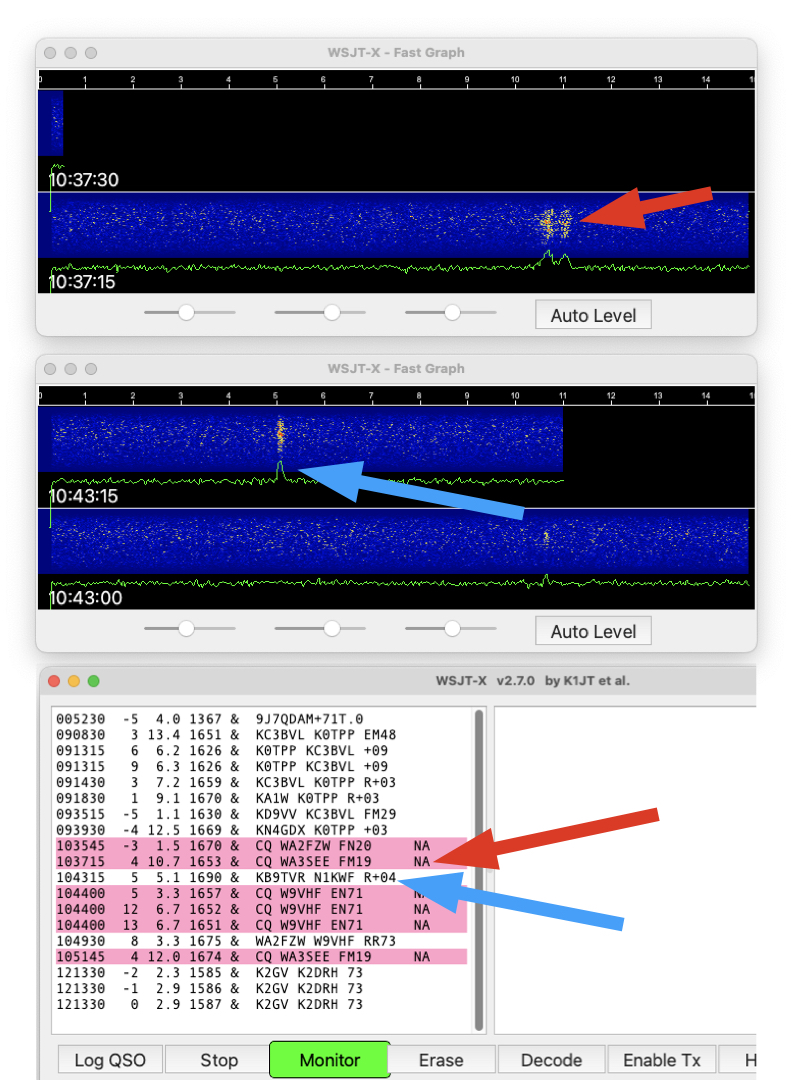
Image credits: Microsoft Designer and Gary Mikitin, AF8A