Publications

Personal Space Weather Station (PSWS) (deprecated page)

Overview

The Personal Space Weather Station project goal is the creation of a geographically distributed, multi-instrument system capable of making ground-based measurements of the space environment. The observations from this project will be useful to the owner of each system, but, more importantly, they will be aggregated into a central database for space science and space weather research purposes. The systems are designed to be relatively low cost (between 100 and 1000 US dollars), easily constructed and deployed by science professionals, educational institutions and citizen scientists.   As of mid-2024, HamSCI members and their supporting institutions have designed and deployed numerous GRAPE* WWV Doppler Monitors, WSPR^ receivers and ground magnetometers.  HamSCI and its partners are constantly at work on expanding the network,  improving the PSWS data collection hardware and software, growing the network infrastructure for data storage and retrieval, as well as meeting HamSCI's ultimate goal, analysis of the collected data.  This project is led by the The University of Scranton, in collaboration with the Tucson Amateur Packet Radio, Inc. (TAPR), Case Western Reserve University,  the University of Alabama, the New Jersey Institute of Technology Center for Solar Terrestrial Research (NJIT-CSTR), and the Massachusetts Institute of Technology Haystack Observatory. 2026-07-04 PSWS Logo.png

*GRAPE = Great Radio Amateur Propagation Experiment, GPS disciplined frequency measurements of standard time signal stations, such as WWV, WWVH and CHU

^WSPR = Weak Signal Propagation Reporter, a method of transmitting and receiving digital signals, uniquely suited to the study of radio wave propagation (wsjt.sourceforge.io)

Getting Involved

HamSCI welcomes involvement from anyone interested in space weather - the physical processes, daily variations and occasionally spectacular events which affect the Earth's ionosphere.  HamSCI members consist of citizen scientists (ordinary folks volunteering their time, resources and knowledge towards HamSCI's primary missions of research, education and technology development), educators, university researchers, and professional space scientists - a broad spectrum of interests, educational experiences and practical backgrounds.  HamSCI has a Get Involved page, listing resources such as Google Groups and regular telecons on various subjects.

HamSCI highly encourages all readers to explore the components of the PSWS.  Consider building or sourcing one or more components, so that you may put your own Personal Space Weather Station 'on the air', receiving and contributing valuable data in the name of space physics research.

Note:  HamSCI occasionally receives grant monies for deploying PSWS components at little or no cost to a volunteer willing to host the component(s) (such as a Grape receiver, ground magnetometer, or VLF receiving system) .  Depending on which component is hosted, the host may be expected to erect a simple antenna, bury a magenetometer sensor, and, in all cases, provide an Internet connection.  Requirements are spelled out, in some detail, on each PSWS component web page.  Announcements regarding grant funded equipment are generally made via the main HamSCI Google Group.  Questions are welcomed at HamSCI's general email address.  

Components

The Personal Space Weather Station is a modular system, with each module being developed by a different team. Visit the links or see the photos below to learn about the modules.  Some can be assembled and programmed in a home workshop, while others consist mainly of commercially available components.  All require some degree of 'systems integration' to assure the components are connected/programmed properly, and sending data to aggregation servers via the Internet.  HamSCI strives to provide information and instructions for all modules here on the website.  

The most basic PSWS would consist of just a single module - such as one of the WWV Doppler Monitors or a Ground Magnetometer.  More ambitious PSWS hosts may wish to install and operate multiple instruments, eg WWV Doppler Monitor + Ground Magnetometer, or, in the future, adding a VLF Receiving System.    

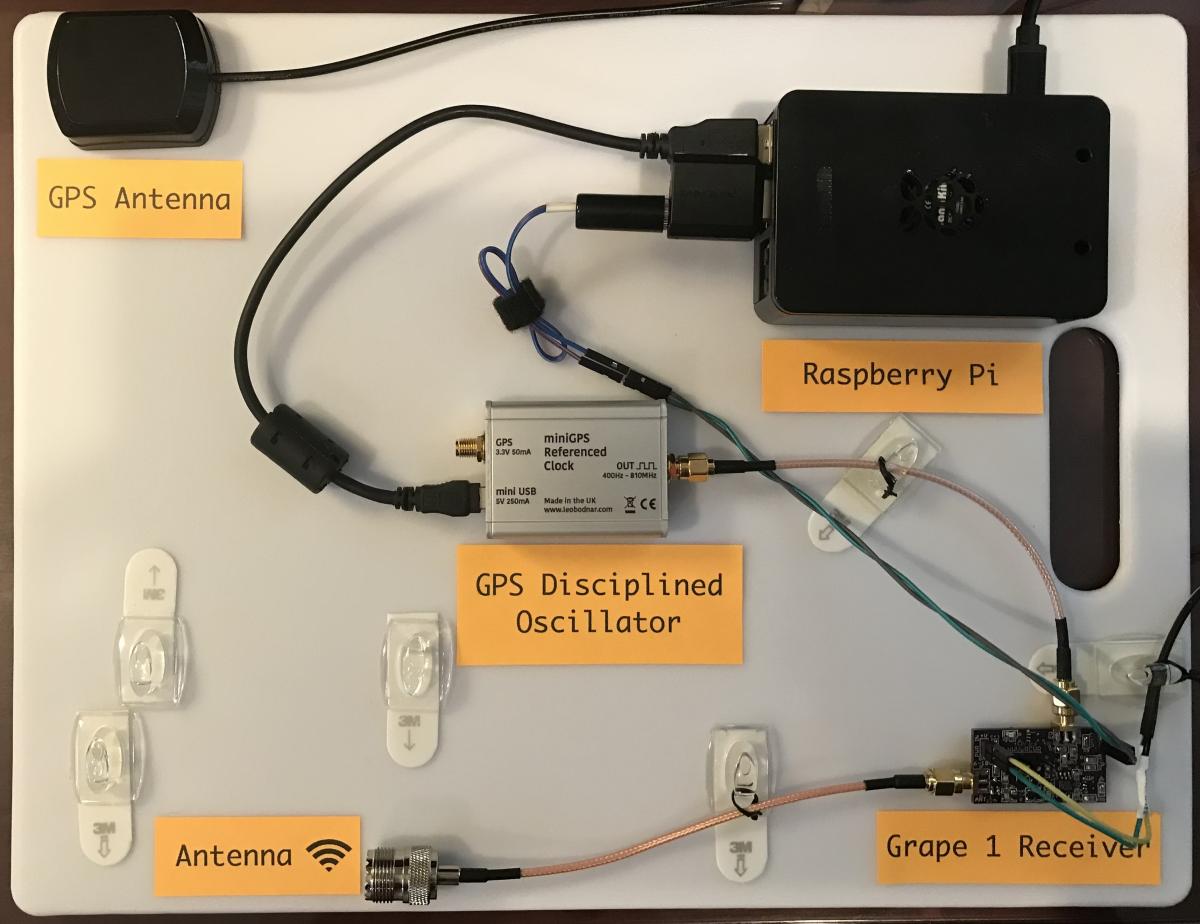
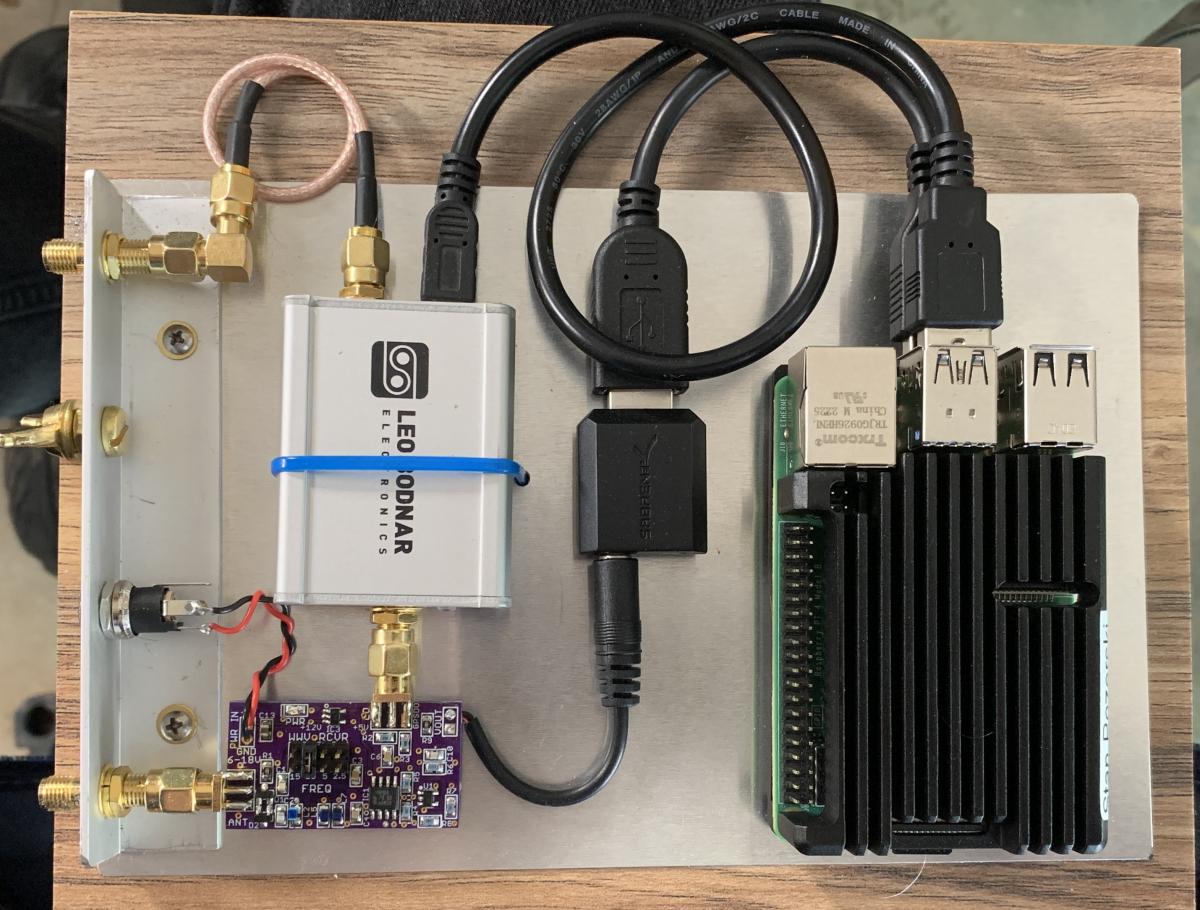
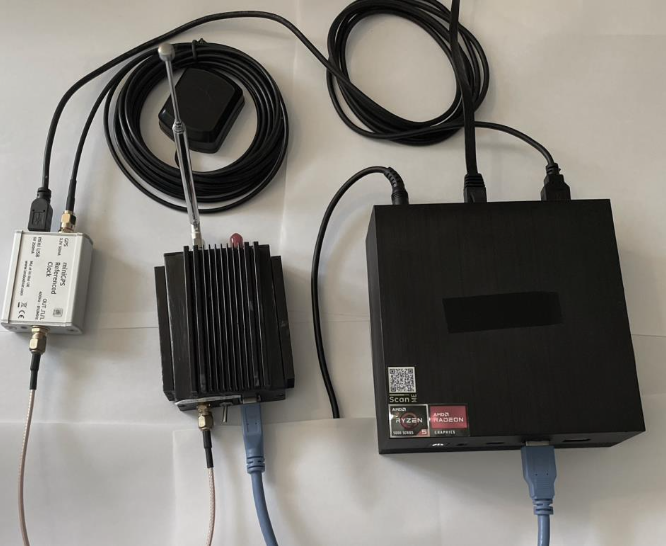
Grape 1 AF8A System with placards cropped.jpg NEGG Grape 1-DRF  Photo.jpeg Grape:WSPR RX888.png
GRAPE 1 - fldigi GRAPE 1 - DRF WSPRDaemon - SDR Full Spectrum Receiver


G2 Complete Asbly 2024-02-15 copy.jpg Mag_Sensor_Installation_full.png
GRAPE 2 Ground Magnetometer

Research Questions

The PSWS project is motivated by questions from both from the science and amateur radio communities:

Science Questions

  • How does the ionosphere respond to inputs from space and from the neutral atmosphere?
  • How does the ionosphere couple with the neutral atmosphere and with space?
  • What are the sources of medium and large scale traveling ionospheric disturbances?
  • What are the causes of Sporadic E?

Amateur Radio Questions

  • How do disturbances such as solar flares, geomagnetic storms, and traveling ionospheric disturbances affect radio wave propagation?
  • How does ionospheric science help amateur radio operators improve communications?
  • How can I make measurements in my own backyard that will help improve my amateur radio operations?

Further Information

Most terms and topics relevant to the PSWS can be explored via the Search Page here on the HamSCI website.  (The search function can be a bit buggy - if you receive an error message, reload and try again.) A few suggested links: 


hamsci_collaboration.png

HamSCI WSPR Enthusiast Files Comments with FCC

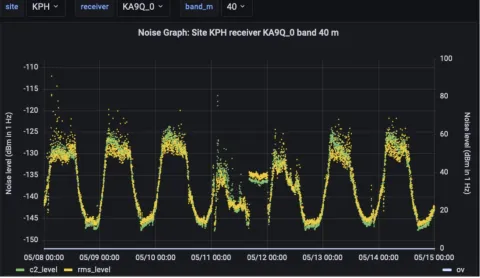
Noise graph of HF bands at station KPH

Long time HamSCI contributor, propagation analyst and (to put it mildly) WSPR enthusiast Gwyn Griffiths, G3ZIL, recently authored a response to the Federal Communication Commission's Request for Comments on the May 10, 2024 geomagnetic storm, regarding its effects on the US communication sector.  The paper's focus was on the HF bands, for the period of 10-14 May, 2024.

Gwyn began by giving a thorough explanation of the why's and wherefore's of Weak Signal Propagation Reporter (WSPR) data generation and collection, including the WSPRDaemon database which holds terrabytes of WSPR reception reports.  

Not one to simply explain his findings, via colorful graphs and succinct text, Gwyn created a series of dashboards specifically for use by the FCC, by providing the FCC with their own unique login and password in the Grafana data visualization tool, available on the WSPR Daemon website.  Rather than simply giving the FCC bureaucrats and engineers a document to read, he gave them opportunity to visualize the data, delving in as deeply as they desire, via their own mice and keyboards.

Gwyn's conclusions, best viewed directly in the Response to Comments, covered subjects such as HF noise measurements, propagation disturbances, signal-to-noise ratio and frequency spread of HF signals.

Gwyn noted that the response was from WsprDaemon - a US-led, international group of radio amateurs making, reporting, archiving, interpreting and publishing data and information on radio propagation. 

The full paper can be viewed here.

Well done, Gwyn, and the entire WsprDaemon community! 

2024 GSSC Contest Results Announced

HamSCI is pleased to announce the results from the second running of the Gladstone Signal Spotting Challenge (GSSC). Held during the April 8, 2024 North American total solar eclipse, the competition was designed to recognize operators of digital mode stations who contribute valuable data to ionospheric research. Receiving stations upload their records to sites such as PSKreporter.info, WSPRnet.org and reversebeacon.net. Transmitting stations are received by stations worldwide who upload to those same databases, creating records of the transmitting stations’ activity.... Link to full results (All participant scores, sampling of entrants' comments, station design details and photographs.)

Congratulations to all who entered. HamSCI appreciates your contribution to space physics and citizen science via on-air amateur radio competition. 

If you have any questions on the results, please email [email protected] .


Top 3 WSPR/FST4W Receive-Only Stations for 2024.  Link to Full Results

Callsign

Grid Square

WSPR Rx Bands

WSPR Rx Reports

FST4W Rx Bands

FST4W Rx Reports

Final Rx Score

N2YCH

FN31jg

160,80,40,30,20,17,15,12,10,6

31,179

80,40,30,20,15,12,10

623

39,753

NJ0U

EN71ib

40,30,20,17,15,12

26,002


0

26,002

VE3KI

FN25ce

80,40,20,15

16,544

80,40,20,15

392

23,287

Final Scores are calculated from Rx reports and bonus multipliers...see the GSSC rules for full details.


Top 3 WSPR/FST4W/ Transmit-Only Stations for 2024.  Link to Full Results

Callsign

Grid Square

WSPR Tx Bands

WSPR Tx Reports

FST4W Tx Bands

FST4W Tx Reports

Final Tx Score

K6XX

CM87vd

160,80,40,30,20,17,15,12,10,6

144,323


0

166,693

N1QM

EM79xr

80,40,30,20,17,15, 12,10,6

128,575


0

128,575

VA2CY

FN46lw

40,20,17,15,12,10

49,056

80

3,156

75,381

Final Scores are calculated from Tx reports and bonus multipliers...see the GSSC rules for full details.


Top 3 Stations who both Received and Transmitted in 2024.  Link to Full Results

Callsign

Grid Square

Final Rx Score

Final Tx Score

Final Combined Score

PT2FHC

GH64cg

20,934

7,018

27,952

AI5MM

EM34NP

59

26,655

26,714

K7NC

CN87sm

164

26,067

26,231

Final Scores are calculated from Rx+Tx reports and bonus multipliers...see the GSSC rules for full details.


Link to all FoEIS results

2023 GSSC Contest Results Announced

Results for the Gladstone Signal Spotting Challenge 2023

HamSCI is pleased to announce the results from the inaugural running of the Gladstone Signal Spotting Challenge (GSSC). Held during the October, 14, 2023 North American annular solar eclipse, the competition was designed to recognize operators of digital mode stations who contribute valuable data to ionospheric research. Receiving stations upload their records to sites such as PSKreporter.info, WSPRnet.org and reversebeacon.net. Transmitting stations are received by stations worldwide who upload to those same databases, creating records of the transmitting stations’ activity.... Link to full results (All particpant scores, sampling of station design details and station photographs.)

Congratulations to all who entered. HamSCI appreciates your contribution to space physics and citizen science via on-air amateur radio competition. 

If you have any questions on the results, please email [email protected] .


The Top 3 WSPR/FST4W/CW Receiving Stations for 2023 are shown below.  Link to Full Results

Callsign

Grid

Square

WSPR Rx Reports

FST4W-120

Rx Reports

FST4W Rx Multiplier

CW Rx Reports

Station Photos Multiplier

Station
Design
Mulitplier

Final  Rx Score

W1WRA

FN42fx

20,406


1


1

1.1

22,447

HB9TMC

JN46lj

21,335


1


1

1

21,335

PT2FHC

GH64cg

9,025

254

1.25


1

1.1

10,277


The Top 3 WSPR/FST4W/ Transmitting Stations for 2023 are shown below.  Link to Full Results

Callsign

Grid

Square

WSPR Tx Reports

FST4W-120

Tx Reports

FST4W Tx

Multiplier


Station Photos Multiplier

Station
Design
Mulitplier

Final  Tx Score

KG5JEN

FN33cf

67,089


1

1

1.1

73,798

K6XX

CM87vd

39,695

231

1.25

1.05

1.1

46,181

AE4PE

EM85mm

40,184


1

1

1

40,184


The Top 3 FT4 Transmitting and Receiving Stations for 2023 are shown below.  Link to Full Results

Callsign

Grid

Square

FT4/8 Rx Reports

FT4/8 Tx Reports

Photos

(x1.05)

Station
Design
(x1.10)

Final FT4/8 Score

HB9TMC

CM99df

224,550


1

1

224,550

CT7ANO

FM19gh

13,989


1

1

13,989

PS7JN/P

DN07ds


1,127

1

1

1,127


Link to all FoEIS results

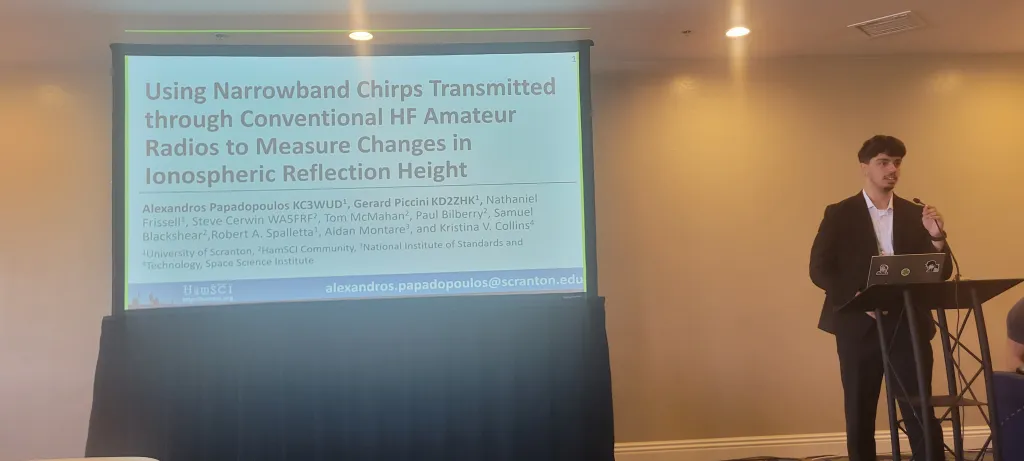
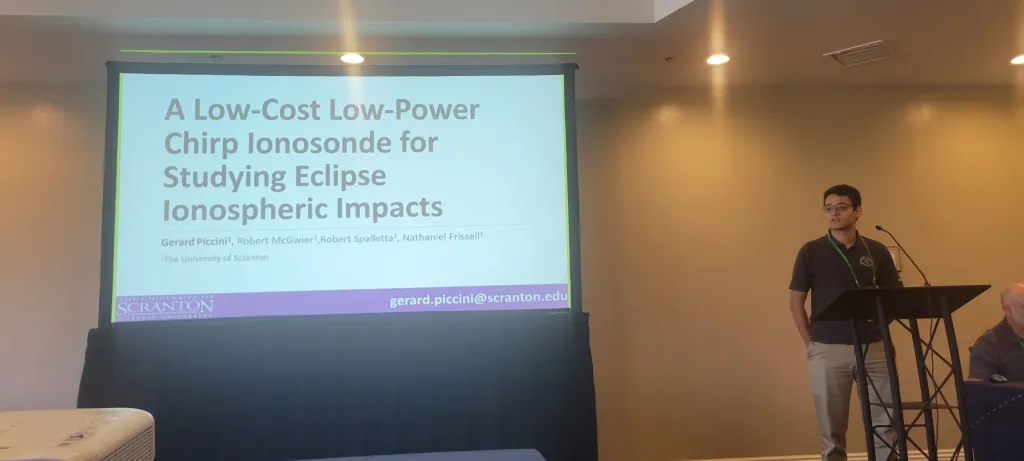
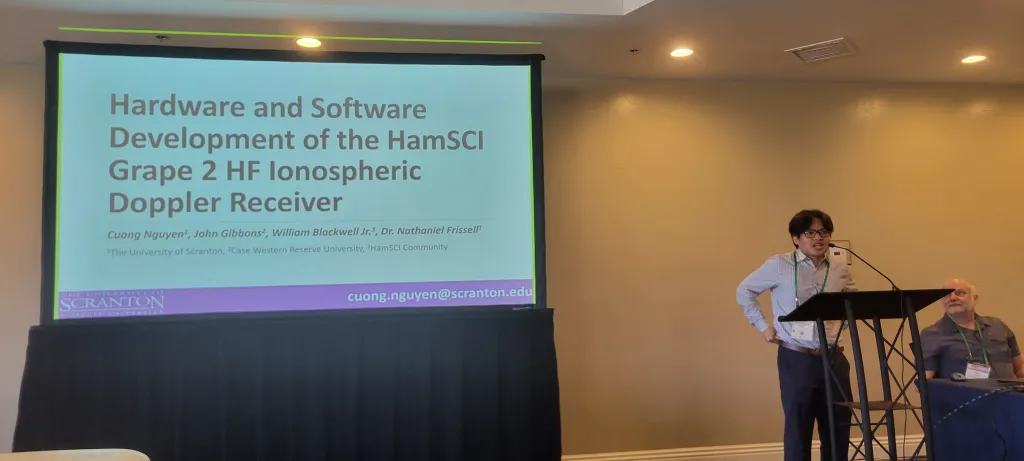
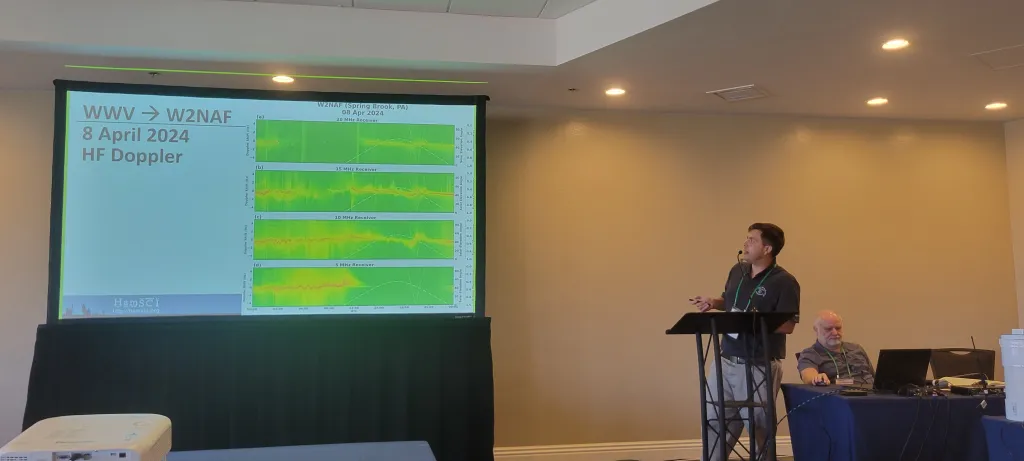
HamSCI at CEDAR 2024 Workshop

CEDAR 2024 logo

HamSCI at the National Science Foundation's CEDAR Workshop: A Thriving Collaboration in Ionospheric Science

The National Science Foundation’s annual Coupling, Energetics, and Dynamics of Atmospheric Regions (CEDAR) Workshop, was held June 9-14 in San Diego, CA.  It was once again been a focal point for groundbreaking research and collaboration in ionospheric science. This year, the HamSCI community has been exceptionally active, showcasing their significant contributions to the field.
 

A Strong HamSCI Presence

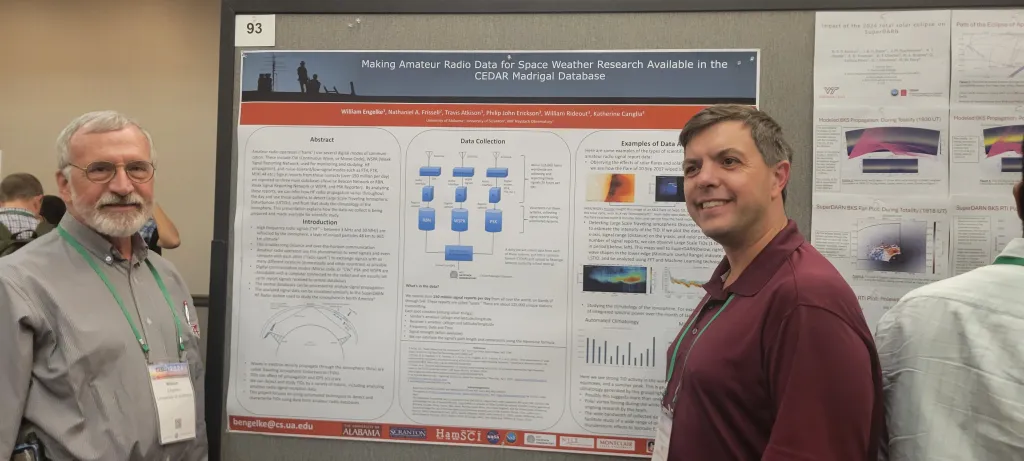
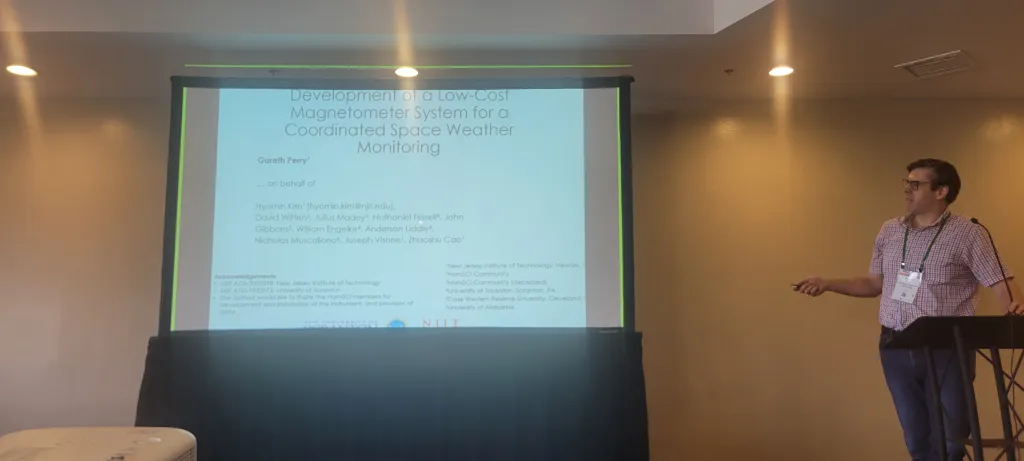
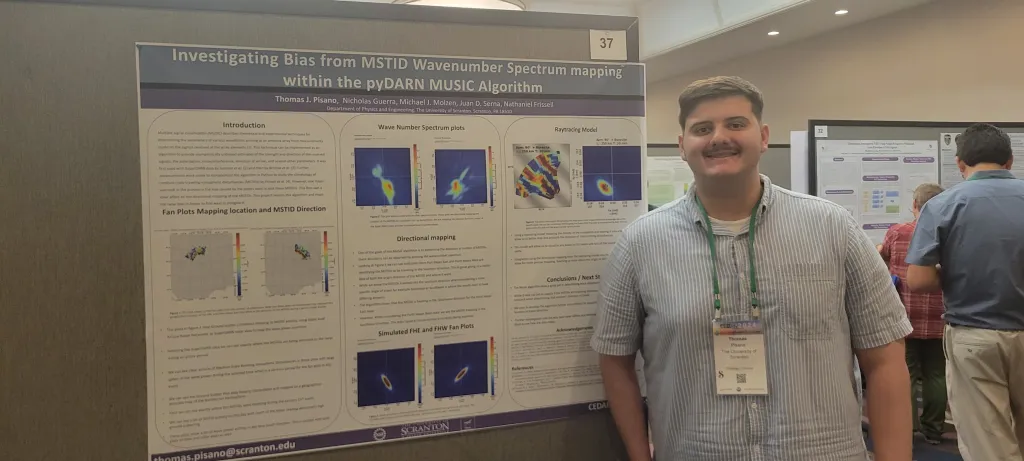
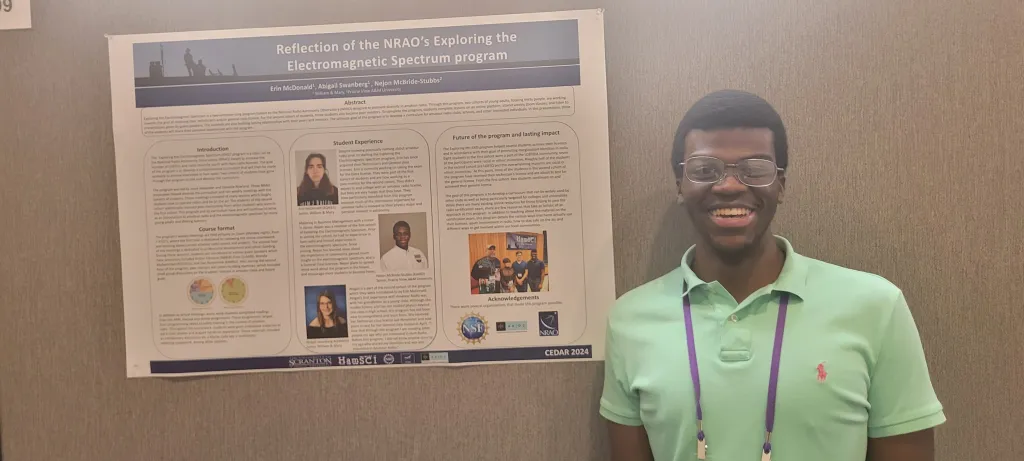
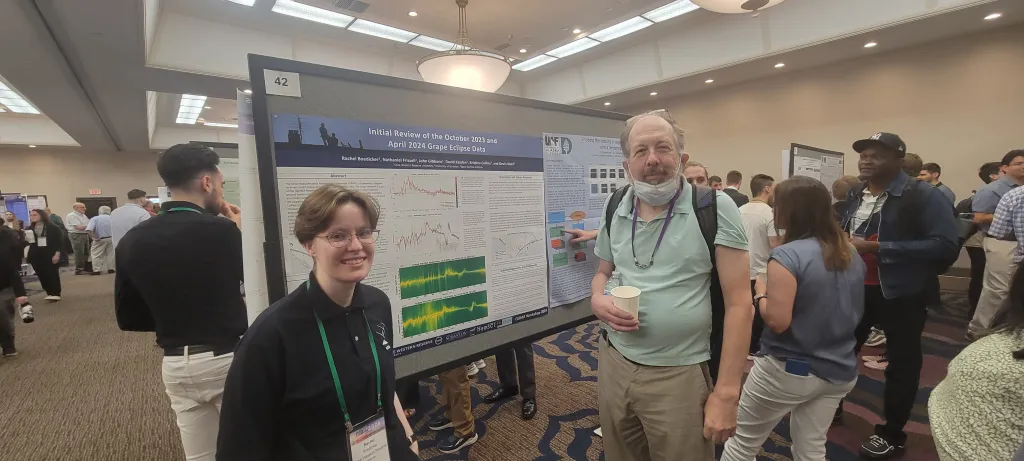
Many members of the HamSCI community were in attendance, with those listed here giving six oral presentations and eleven research posters. Their contributions covered a range of topics, demonstrating the wide range of research being conducted within the HamSCI community.  
 
Cuong Nguyen KC3UAX
Alex Papadopoulos KC3WUD
Gerard Piccini KD2ZHK
Tom Pisano KE2BAC
JP Fox KE2ANL
Michael Molzen
Nicholas Guerra AC3LB
Diego Sanchez KD2RLM
Rachel Boedicker AC8XY
Kristina Collins KD8OXT
Bill Engelke AB4EJ
Gareth Perry KD2SAK
Jesse Alexander WB2IFS
Nejon McBride-Stubbs KJ5AXD
Nathaniel Frissell W2NAF
Phil Karn KA9Q

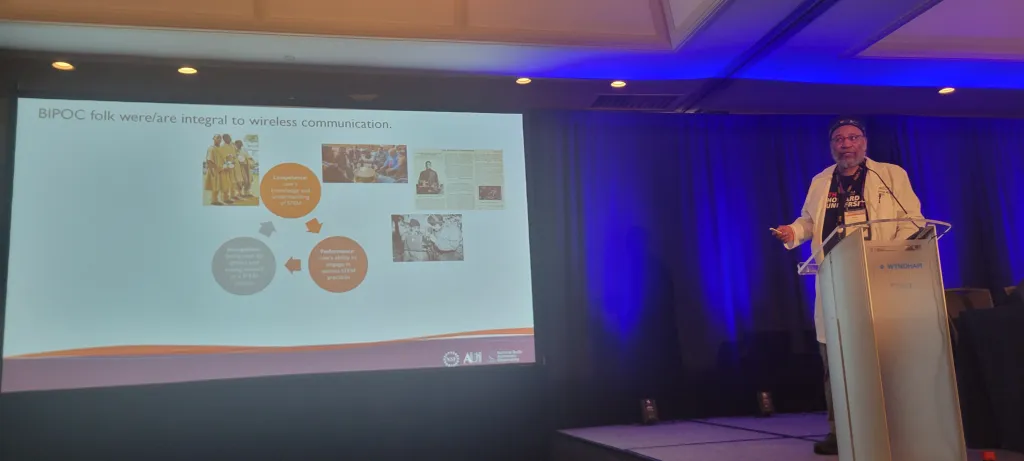
Jesse Alexander's Plenary DEI Talk

One of the workshop's high points was Jesse Alexander, WB2IFS's invited plenary talk on Diversity, Equity, and Inclusion (DEI). His talk not only reflected on the ongoing efforts to enhance inclusivity within the scientific community but also powerfully called to action to develop an equitable framework for geoscience projects.
 

Phil Karn KA9Q

Phil Karn, KA9Q, a well-known figure in the amateur radio and communication technology communities, attended this event. His participation provided him an opportunity to see how his latest project , KA9Q Radio, contributes directly to ionospheric research. It is likely that Phil came away from the Workshop with numerous ideas for further development of his software defined radio platform.
 

Engagement and Networking

The CEDAR workshop is more than presentations and scientific sessions; it’s a platform for budding scientists and seasoned researchers to interact, share ideas, and build collaborations. We are proud of the robust participation from HamSCI members, who engaged actively in discussions, shared insights, and widened their professional networks.
 

Looking Forward

The  HamSCI community continues to actively foster opportunities for interaction between the amateur radio and professional space physics communities. The enthusiasm and commitment of HamSCI volunteers and researchers to advancing our understanding of the Earth’s ionosphere and magnetosphere through collaborative science serve to highlight the unique role that amateur radio operators play along side the scientific community.
Please visit the official workshop website for more details:  CEDAR Workshop
 
- Article submitted by McKenzie Denton, KO4GLN
- Photos courtesy Nathaniel Frissell, W2NAF
 

2023 SEQP Contest Results Announced

The complete results for the October 14, 2023 running of the SEQP have been published.  They contain participants' scores and a sampling of photos, soapbox comments and station diagrams.  Finally, credits appear for those who helped make the SEQP possible.

Download the Complete October 14, 2023 SEQP Results

Download certificates for winners and participants

Visit the SEQP home page

A hearty 'Thank You' to all who participated and made it a successful event!

2023 SEQP Winners

 
  Single Op Total Score Multi-Op Total Score
1 WP3R
Angel Vasquez
Arecibo, PR
163,340 K0PZH
University of Iowa ARC
Iowa City, IA
(K0PZH, N0GJW)
74,185
2 N7RCS
Jim Smallwood
Palm Bay, FL
98.062

W2NPT
Fairlawn ARC
(KD2BRV, KD2GKA, KD2KLN, KD2SOG, N2JLF, N2SU, NP4H, W2JC, W2MSA, WX2R)

34,876
3 W0DTM
Travis Hambach
Warrenton, MO
69,432 W2OW
Binghamton ARA
Vestal, NY
(KE2BKW, KD2YSN, NE2B, N2ENG, AB2HS, KA1M, KA2YRA, KU2O, WM2R, KE2BON)
6,665


Link to all FoEIS Results


HamSCI Searching for Instrumentation Sites and Hosts

Searching for Sites Website Slider 2.001_0.png

Project Goals

The Personal Space Weather Station project aims to create a geographically diverse, multi-instrument network (consisting of 15 to 30 sites) that will make ground-based measurements of the space environment.  The observations from this project will not only be useful to the owner of the system, but also aggregated into a central database for space science and space weather research purposes.  Much of HamSCI’s research to date has been on the Earth’s ionosphere and magnetosphere, there is a strong desire in the research community, and from the participating institutions (see below), for an expanded network featuring co-located instruments noted below.  It is believed this approach will be a ‘first’ in space weather research.

The Need for Receiving Sites

HamSCI is making plans to deploy roughly 30 multi-instrument Personal Space Weather Stations across the US and possibly into Canada.  ‘RF quiet’ sites are needed where the hosts would be willing to install and operate the following:

  1. HamSCI PSWS HF Receiver (HFRx)  - GPS disciplined HF SDR receiver, covering 160-6 meters, using an active vertical antenna
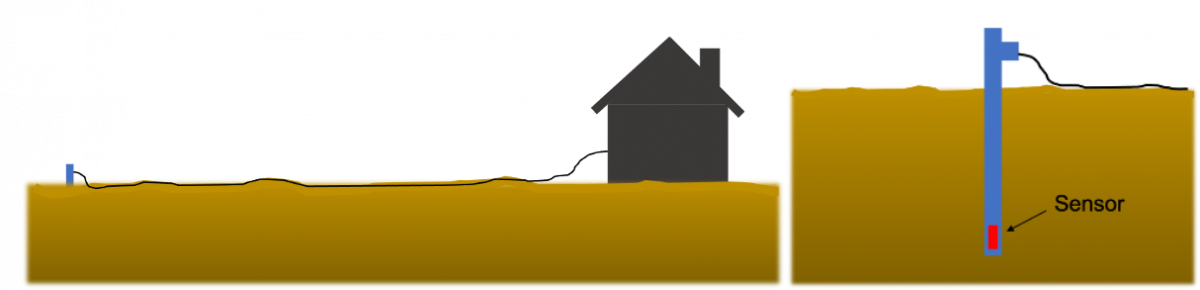
  2. Ground Magnetometer (GMag) - Magnetic field detector, buried in PVC pipe, cabling from the field to a building, Raspberry Pi or PC
  3. Whistler Catcher VLF Receiver (VLF-WC) - VLF receiver at ~8kHz, ground mounted active antenna, cabling from the field to a building, Raspberry Pi

The Need for WSPR Transmitting Sites Across North America

Update:   25 June, 2025: HamSCI is making plans to deploy ten WSPRSonde Transmitters all around the US.  They are 8-band, GPS frequency disciplined, low power (~1 watt/band) transmitters, designed to make WSPR and FST4w transmissions on a 24/7/365 basis.  

Project Status - Receiving Equipment

 Update:   1 July, 2026:  HamSCI has received a grant to deploy ~30 stations, thanks to The National Science Foundation's DASI2 (Distributed Array of Small Instruments, Track 2) program. 

The HamSCI PSWS HF Receiver is a stable design, having been deployed to over a twenty sites, from northern Canada to the Antarctic continent.  Both documentation and testing for further deployments are underway.

The Ground Magnetometer is a stable design.  HamSCI is producing the hardware needed for DASI2 deployment.  Software development and testing are underway.

The VLF Receiving System is in the prototype phase.  Some issues with system compatibility have arisen.  At this time, it is not recommend to site an HFRx antenna and a VLF-WC in close proximity.

Grant monies grants will cover the costs of the project hardware, thus expenses incurred by hosts should be minimal (but we can’t guarantee that they will be zero).  We are asking for a commitment of time and place.  HamSCI intends this project to be an example of citizen science at its very best.  Of course, if any hosts wants to self-fund some or all of the equipment, HamSCI would be most appreciative.

Site Selection Criteria - Receiving Sites (revised 27 Apr 2024)

Long term commitment, 1 year or more

Hamshack or workshop with spare monitors, keyboards, mice, cables, hand tools, etc.

Host (operator) of reasonable technical competence - familiar with simple wire antenna construction and installation, single board computer (Raspberry Pi) software configuration, Ethernet connectivity, outdoor cabling (weatherproofing, protection from animals, mowers, cultivators, etc.)

Stable Internet connection for sending data to the Cloud

Time to participate in virtual meetings with project leaders, other hosts and the general HamSCI community (most HamSCI project teams meet weekly - but that is not a requirement!)

Rural or semi-rural location for both the VLF Rx’s active antenna and the buried Ground Magnetometer (which can be co-located):

​Ground Magnetometer Site Considerations

  • should be at least 200 ft away from any type of aerial, underground, or structures with power wiring.
  • should be at least 200 ft away from any underground ground wire (for example, used to tie an antenna site ground to the main shack ground)

VLF Receiver Site Considerations

  • 200 ft separation from above/below ground aerials, wiring, ground wires to a home or other source of mains harmonics (same as magnetometer considerations, see above)
  • should be at least 30 ft away from a tree's farthest overhanging branch
  • cannot be installed in brush, bushes, or under trees, but tall grasses are acceptable
  • should have an earth ground connection at all times
  • open fields are usually the best locations if the above conditions could be satisfied
If you have questions regarding the Personal Space Weather Station, please send them to [email protected]

2024-04-30 LH-HF-Mag Location Chart.jpg

Interested Participant Form - HF/VLF/Ground Mag and WSPRSonde Transmitter

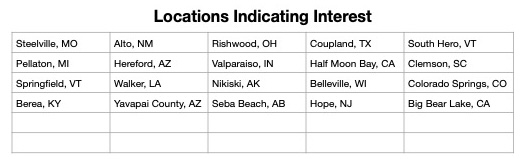
Please complete this form if you are interested in providing a site and hosting the next generation of the Personal Space Weather Station.  Doing so will enable the project team to see 'the big picture' and reach out to you with comments, questions, etc.


Supporting Institutions

FIve Grape Institutions.jpeg

April 8, 2024 Solar Eclipse QSO Party First Results

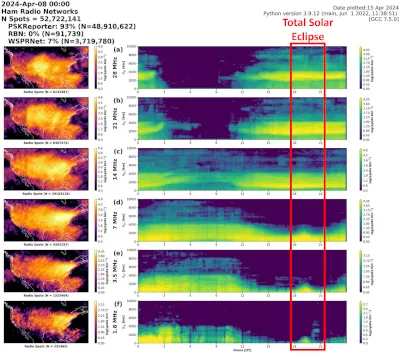
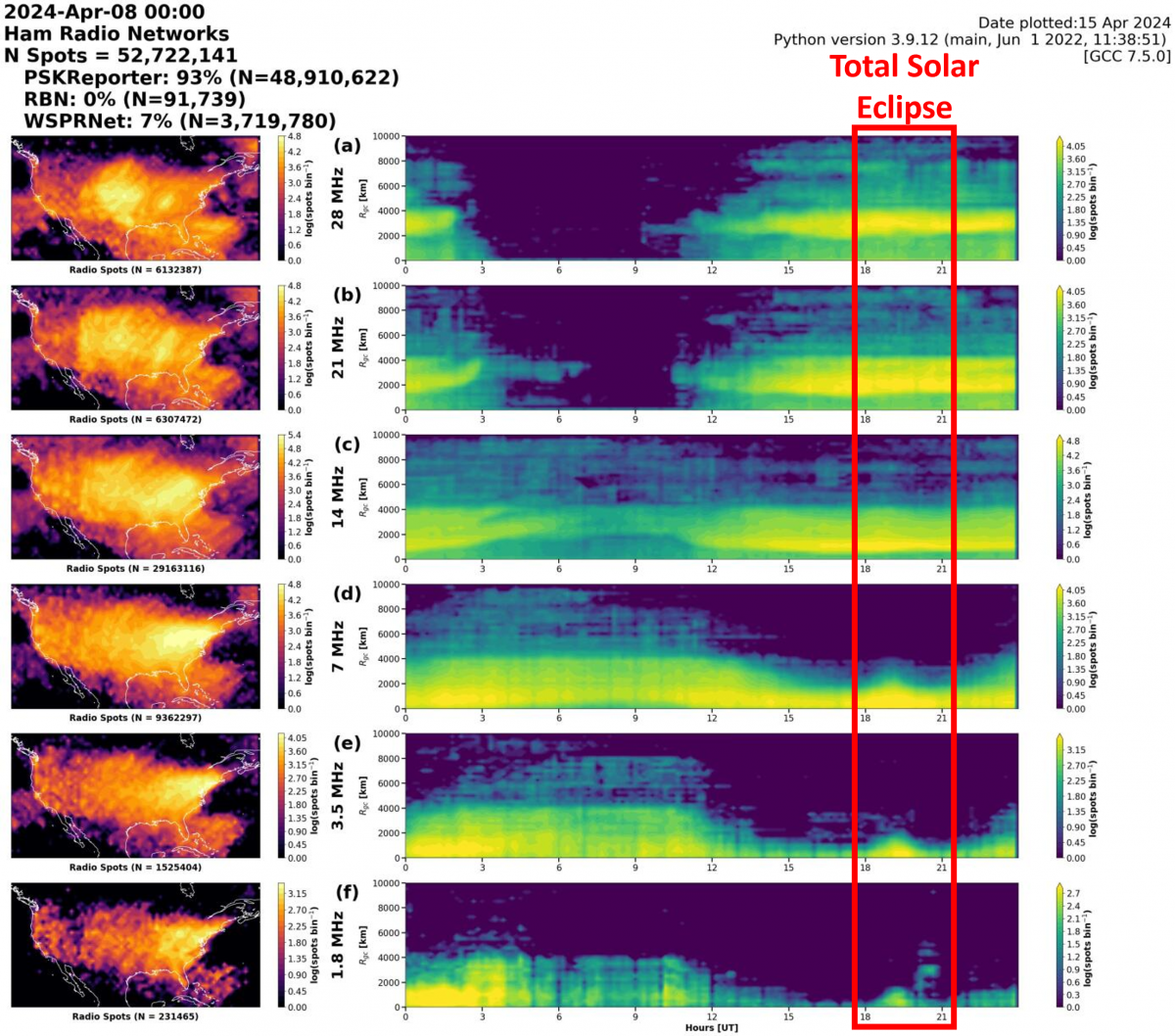
The April 8, 2024 HamSCI Total Solar Eclipse QSO Party (SEQP) first results are in! Over 52.7 million radio communications were observed over the continental United States using the PSKReporter, WSPRNet, and Reverse Beacon Network networks. Eclipse effects were observed between 18 to 21 UTC, particularly on the 1.8, 3.5, and 7 MHz bands. These bands all showed enhancement in propagation resulting from the eclipse, suggestive of a reduction in D region absorption. The 14, 21, and 28 MHz bands also showed hints of eclipse impacts. A reduction in communications observed at near-ranges during the eclipse likely results from a reduction in ionospheric electron densities during this time. More analysis to be done in the future!

Special thanks to all the team members and volunteers who made this possible! This work was supported by the U.S. National Science Foundation and NASA.


20240408_SEQP_FirstResults.png

HamSCI Workshop Wins 'Best Event' Award

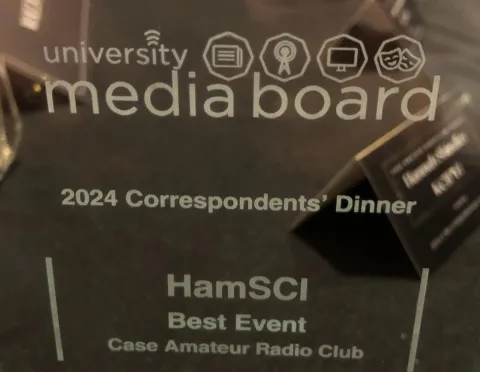
HamSCI's 2024 Workshop was awarded 'Best Event of the 2023-2024 Academic Year' by Case Western Reserve University's Media Board.  The Case Amateur Radio Club (CARC), W8EDU, hosted this year's HamSCI Workshop.

"The University Media Board fosters responsible forums of student expression through a variety of media covering writing, photography, cinematography, film, and radio. Groups that fall under the University Media Board include The Athenian, Case Reserve Review, Discussions, Film Society, CWRU Footlighters, LUX, The Observer, Studio 300, SPARC[conversations], WRUW-91.1FM, and Young Writers of Cleveland."  The CARC is also represented on the University Media Board.

Congratulations to all involved, and especially to the 2024 Workshop Committees:

Local Organizing Committee

  • Mr. Nathaniel Vishner, KB1QHX, Chair
  • Mr. Matthew Canel, KE8NZR
  • Dr. Kristina Collins, KD8OXT
  • Mr. John Gibbons, N8OBJ
  • Dr. David Kazdan, AD8Y
  • Mr. Gary Mikitin, AF8A

Science/Program Committee

  • Dr. Nathaniel Frissell, W2NAF, Chair, The University of Scranton (Assistant Professor)
  • Dr. Kristina Collins, KD8OXT, Space Science Institute
  • Mr. Jesse Alexander WB2IFS, NRAO
  • Ms. Rachel Boedicker AC8XY, Case Western Reserve University
  • Dr. Gareth Perry, KD2SAK, New Jersey Institute of Technology
  • Mr. Bill Liles, NQ6Z, HamSCI Community (Diversity Recruitment Chair)
  • Dr. Phil Erickson, W1PJE, MIT Haystack Observatory (Director of MIT Haystack Observatory)
  • Mr. Gary Mikitin, AF8A

Save The Dates: HamSCI at Hamvention

HamSCI will be playing a major role at the 2024 Dayton Hamvention. It will be held in Xenia, Ohio May 17-18-19, 2024 at the Greene County Fairgrounds. Hamvention is the world's largest ham radio gathering, recently scoring over 30,000 attendees per year. The Hamvention, sponsored by the Dayton Amateur Radio Association (DARA), is an extremely important event for engaging with the amateur radio community, sharing ideas, developing collaborations, and sharing scientific results.

The Hamvention 2024 theme is Expanding Our Community, an excellent fit for HamSCI's goals. HamSCI will be hosting Booth 5008 in the Hertz Building, giving presentations in the ARISS/YOTA area and hosting the HamSCI Forum. Support for the 2024 HamSCI Hamvention activities comes from The University of Scranton, the Yasme FoundationTAPR, the National Science FoundationNASA, and volunteers like you. 

Details and a presentation schedule are available here.


As always, we welcome HamSCI booth volunteers.  As a volunteer, we ask that you be present in the HamSCI booth during your scheduled time slot, welcoming visitors, talking with them about HamSCI in general, HamSCI projects and your specific research interests. Feel free to bring demonstration items and materials and to talk about what you know best. The goal of HamSCI is to connect ham radio with scientific research. So, any topic that supports this goal is a good topic to talk about. The booth uniforms, are, by tradition, HamSCI labcoats.  The 2024 HamSCI Booth Volunteer Page is viewable now.

HamSCI at 2024 Hamvention

HamSCI will be playing a major role at the 2024 Dayton Hamvention.  It will be held in Xenia, Ohio May 17-18-19, 2024 at the Greene County Fairgrounds.  It is the world's largest ham radio gathering, having over 30,000 attendees in 2023. The Hamvention, sponsored by the Dayton Amateur Radio Association (DARA), is an extremely important event for engaging with the amateur radio community, sharing ideas, developing collaborations, and sharing scientific results. The Hamvention 2024 theme is Expanding Our Community, an excellent fit for HamSCI's goals.  HamSCI will be hosting Booth 5008 in the Hertz Building, giving presentations in the ARISS/YOTA area and hosting the HamSCI Forum..  Support for the 2024 HamSCI Hamvention activities comes from The University of Scranton, the Yasme FoundationTAPR, the National Science FoundationNASA, and volunteers like you. 

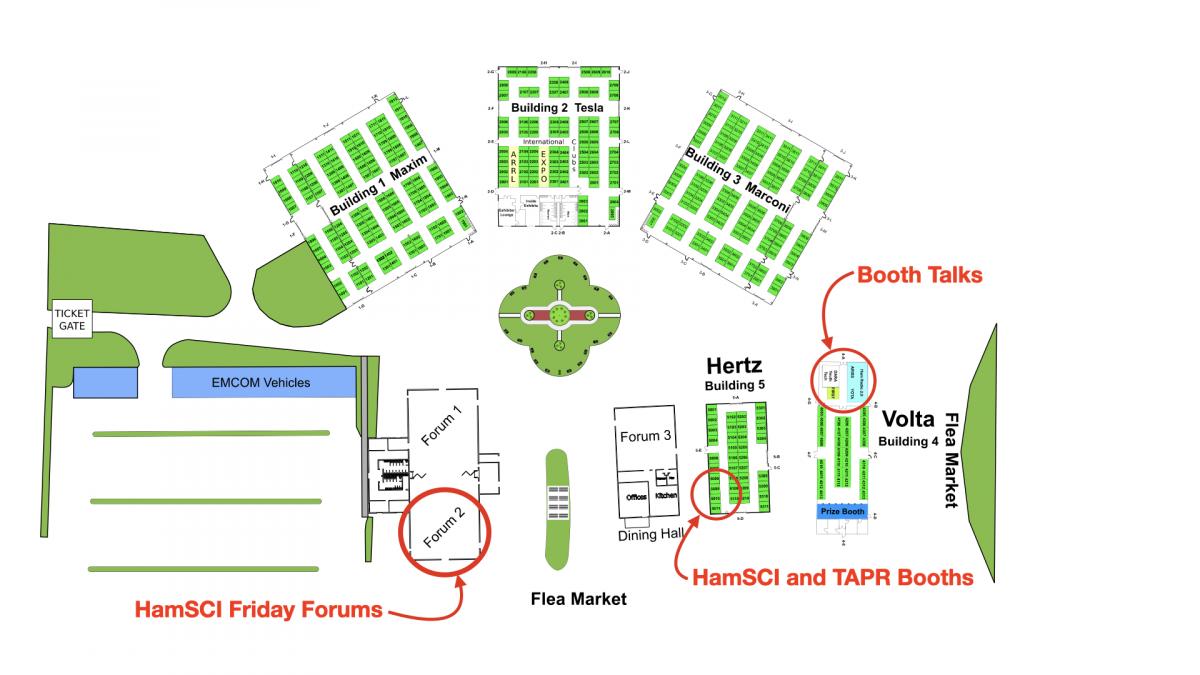
HamSCI will be in Booth 5008, next to TAPR, in Building 5, the Hertz Building (map below).  Stop by to learn about HamSCI's mission, our space weather projects and how you can play a role in our citizen science activities.  HamSCI members will be hard to miss - just look for our white lab coats!

HamSCI Presentations  

Members of HamSCI will be speaking and taking questions at various forums throughout Hamvention Weekend.  Consult the links below, your Hamvention program or  Hamvention phone app for details on how and where to attend.

Date & Time Sponsor/Venue Title Presenter(s) Organization Home QTH(s)
Friday, May 17th
2:00 PM
Hamvention Antenna Forum First Results of the HamSCI 2023-2024 Festivals of Eclipse Ionospheric Science Nathaniel Frissell
W2NAF
HamSCI-50x11.png Scranton, PA

HamSCI Forum  

Date & Time Sponsor/Venue Title Presenter(s) Organization Home QTH(s)
Friday, May 17th
3:55 PM
HamSCI-50x11.png
Forum Room 2
HamSCI: Bringing the Amateur Radio and Professional Scientific Communities Together Nathaniel A. Frissell, W2NAF HamSCI-50x11.png Scranton, PA

Friday, May 17th
4:00 PM

HamSCI-50x11.png
Forum Room 2
Results from the 2023/2024 Festivals of Eclipse Ionospheric Science and Solar Eclipse QSO Parties Gary Mikitin AF8A HamSCI-50x11.png
 
Cleveland, OH

Friday, May 17th
4:15 PM

HamSCI-50x11.png
Forum Room 2

Solar Eclipse Observations Using the HamSCI Grape Personal Space Weather  Network Rachel Boedicker AC8XY   CWRU Cleveland, OH
 
Friday, May 17th
4:30 PM
HamSCI-50x11.png
Forum Room 2
WSPRDaemon, KA9Q Radio, and the HamSCI Personal Space Weather Station

Rob Robinett AI6VN

HamSCI-50x11.png

Half Moon Bay, CA

Friday, May 17th
4:45 PM
HamSCI-50x11.png
Forum Room 2
The NRAO Exploring the EMS/Ham Radio Project: Progress and the Way Ahead

Jesse Alexander WB2IFS

    NRAO Clinton, MD

Booth Talks:  ARISS, HamSCI and YOTA

Booth talks, social hours and demonstrations will be given by ARISS (Amateur Radio on the International Space Station), HamSCI and YOTA (Youth on the Air).  They will take place at Booth 4303 in the Building 4, the Volta Building (map below). 

Date & Time Sponsor Title Presenter(s) Organization Home QTH(s)
Friday, May 17th
10:00 AM
ARISS* Ham TV from ISS Randy Berger WA0D ARISS-USA Ft. Worth, TX
Friday, May 17th
11:00 AM
HamSCI-50x11.png MUF Observations Using Personal Space Weather Stations Gary Mikitin AF8A HamSCI-50x11.png Cleveland, OH
Friday, May 17th
12:00 PM
YOTA* Youth Social Hour YOTA  team YOTA Americas
Friday, May 17th
1:00 PM
HamSCI-50x11.png Observations of Traveling Ionospheric Disturbances with SuperDARN Radars JP Fox KE2ANL University of Scranton Scranton, PA
Friday, May 17th
2:00 PM
ARISS

ARISS 2.0 Education: STEREO/SPARKI and STAR

Tanya Anderson KD9BQZ ARISS-USA Lisle, IL
Friday, May 17th
3:00 PM
HamSCI-50x11.png Ionospheric Science Using AM Broadcast Signals David McGaw N1HAC Dartmouth College Hanover, NH
Saturday, May 18th
10:00 AM
ARISS How to Develop a Winning ARISS Contact Proposal Tanya Anderson KD9BQZ ARISS-USA Lisle, IL
Saturday, May 18th
11:00 AM
HamSCI-50x11.png In-Depth:  WSPRDaemon, KA9Q Radio, and the HamSCI Personal Space Weather Station

Rob Robinette AI6VN, Paul Elliott WB6CXC

HamSCI Half Moon Bay, Occidental CA
Saturday, May 18th
12:00 PM
YOTA Youth Social Hour YOTA  team YOTA Americas
Saturday, May 18th
1:00 PM
HamSCI-50x11.png KA9Q Radio: Software Defined Radio System Phil Karn KA9Q ARDC San Diego, CA
Saturday, May 18th
2:00 PM
ARISS Amateur Radio Demo of Lunar Operations Randy Berger WA0D ARISS-USA Ft. Worth, TX

*YOTA = Youth On The Air (youthontheair.org), ARISS = Amateur Radio on the International Space Station (ariss.org)


Booth Location

HamSCI will be at Booth 5008, next to TAPR, in the Building 5, the Hertz Building.

2024 Hamvention Map.002.jpeg


HamventionGroup2022.jpg

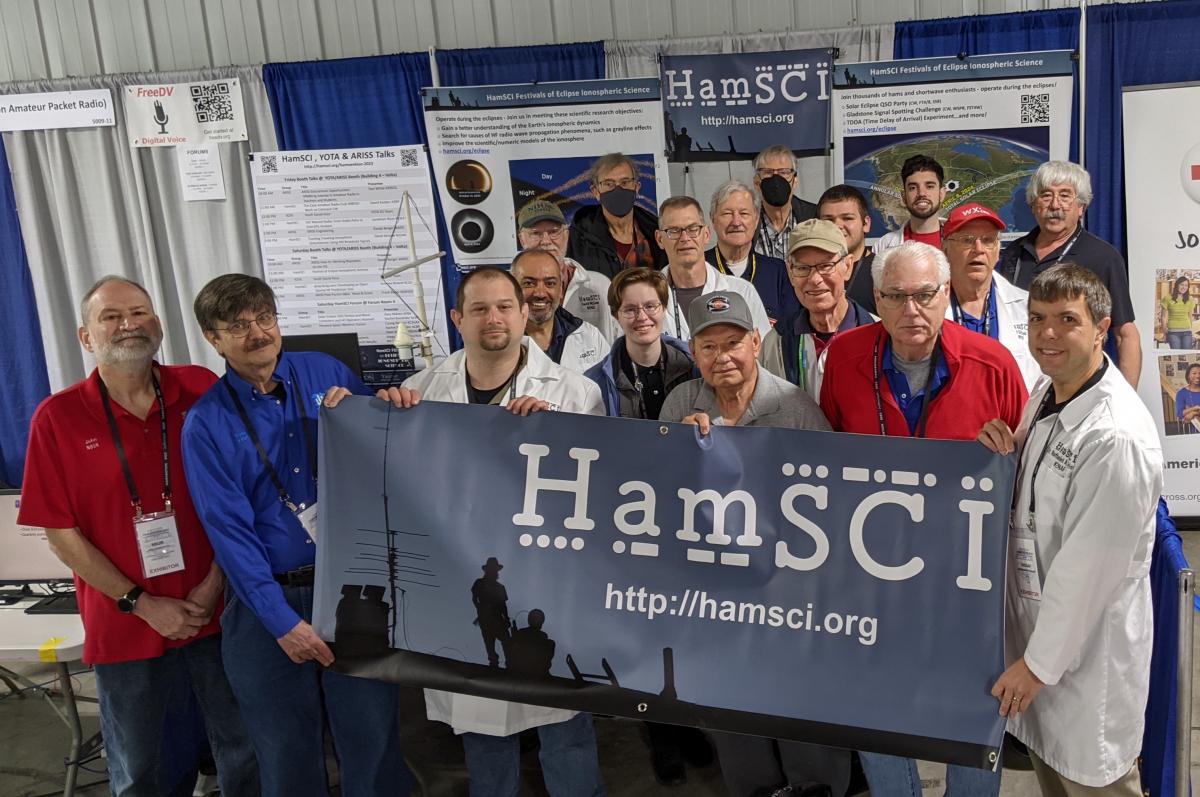
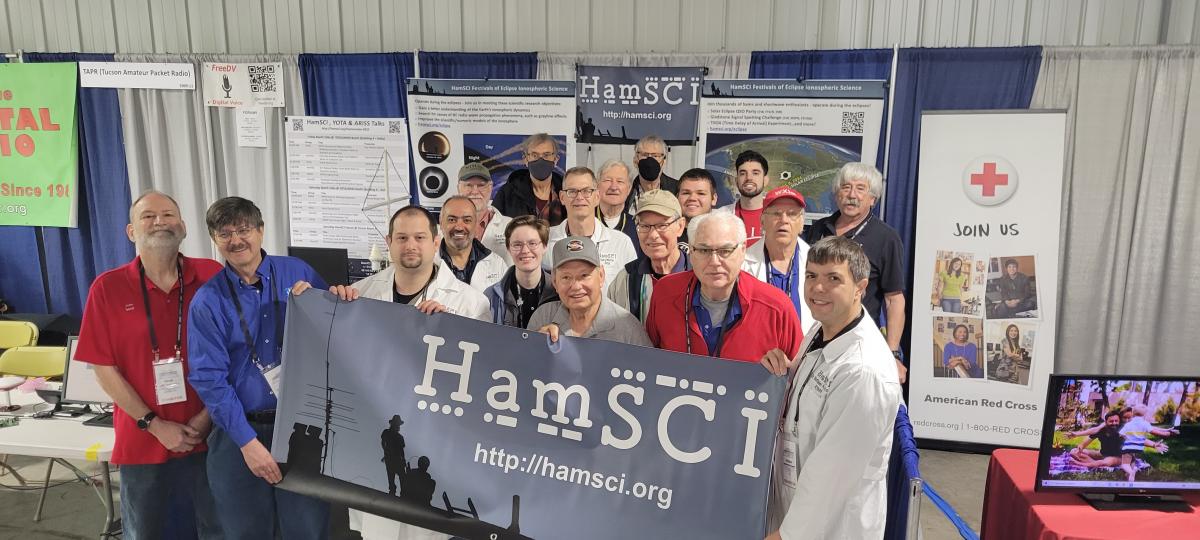
HamSCI Booth Photo 2023


Hamvention 2024

HamVention_2023.jpg

HamSCI at Hamvention 2023

Overview

HamSCI will be present at the 2024 Dayton/Xenia Hamvention in order to further its goal of connecting the ham radio and scientific communities. Support for the 2024 HamSCI Hamvention activities comes from The University of Scranton, The Yasme FoundationTAPRThe National Science Foundation, NASA, and volunteers like you. Per long standing tradition, HamSCI will be hosting booth  5008 (next to TAPR in Building 5, the Hertz Building, map below), hosting the HamSCI Forum and giving booth talks in the ARISS/YOTA area (map below). To help out, please sign up to volunteer at the booth.

Booth Volunteering

The 2024 HamSCI booth location will be in Building 5, the Hertz Building, same as in years past. Please use the button below to sign up as a booth volunteer using NeedToMeet. (NOTE:  NeedToMeet adjusts its calendars to your time zone based on your web browser settings.  Please be aware that the HamSCI booth will be staffed from 9AM-5PM Friday and Saturday, and 9AM-1PM on Sunday.  If you are in the Western time zone, the NeedToMeet calendar will probably show the days as starting at 6AM.  Please know that translates to an actual Hamvention start time of 9AM.) (That's a NeedToMeet feature, not a bug!) As a volunteer, we ask that you be present in the HamSCI booth during your scheduled time slot, welcoming visitors, talking with them about HamSCI in general, HamSCI projects and your specific research interests. Feel free to bring demonstration items and materials and to talk about what you know best. The goal of HamSCI is to connect ham radio with scientific research. So, any topic that supports this goal is a good topic to talk about. The booth uniforms, are, by tradition, HamSCI labcoats.  Purchase details below.


Volunteer Sign-Up

Lab Coats

HamSCI labcoats may be ordered from https://www.allheart.com/lab-coats. Please use custom logo code C_5163_Q5D and place the logo on the left chest. Put your whole name on Line 1, and your call sign on Line 2. Use block style lettering.

Recommended Styles for 2024

Note that allheart.com changes their available styles on a regular basis. The important thing is to pick a white lab coat that fits you and put the custom logo code C_5163_Q5D and place the logo on the left chest.

Sample Order - Information confirmed April, 2024

Natural Uniforms Unisex 41" Lab Coat
Item #: AH-8200---WHTLGE
Color: WHT White
Size: LGE
Personalization - Left Chest
  Embroidery Style: Block Style
  Thread Color: Black
  Letter Height: 1/2 inch (25 characters)
  Text Line #1: Dr. Nathaniel A. Frissell
  Custom Emblem: C_5163_Q5D
  Text Line #2: W2NAF


Exhibitor Badges

If you are volunteering at the booth or giving a talk, HamSCI will supply an exhibitor badge. These badges give you full access to the Hamvention, including the set-up and break-down times. However, these badges will not enter you in the prize drawings the way a normal Hamvention ticket will. Please coordinate requests for exhibitor badges with Gary Mikitin AF8A via [email protected].  

Group Photo 

A HamSCI group photo will be taken during the Hamvention on Saturday at 9:30 AM (1330 UTC) at the HamSCI booth. Wear your labcoats!

HamSCI Presentations, Talks and Demonstrations

Members of HamSCI will be presenting at many events throughout the Hamvention weekend, beginning Thursday evening.  Some talks will be at offsite events, while others will be held on the Hamvention grounds.  A complete list of talks, presenters and dates/times can be found by visiting the 2024 HamSCI Hamvention Schedule.

Questions?

If you have questions about HamSCI's 2024 Hamvention plans, please contact the HamSCI Team at [email protected].

Booth Location

HamSCI will be at Booth 5008, next to TAPR, in Building 5, the Hertz Building.

2024 Hamvention Map.002.jpeg

SEQP, GSSC and TDOA Logs Are Rolling In

Have you submitted your log? 

HamSCI's Festivals of Eclipse Ionospheric Science events are experiencing a tremendous response from the ham radio community. Only 4 days past the total solar eclipse over North America:

  • We’ve already received well over 350 logs for our signature event, the Solar Eclipse QSO Party (SEQP). That number is 50% ahead of last October's event, and the log submission window is open until May 7th.
  • Participation in the Gladstone Signal Spotting Challenge (GSSC), where our radio wave propagation enthusiast entries number 110 so far, is running about 25% ahead of last October.
  • The third operating event, the Time Delay of Arrival Event, drew interest from over 50 HamSCI members and non-members alike. Files of received audio transmissions are still being collected.

Our reach has been far and wide, with participants not only across the US, but in Canada, the UK, Reunion Island (Africa), India and more.

If you participated in any of the above, please submit a log (SEQP) complete an entry form (GSSC), or provide your recordings (TDOA). Your results can be submitted as follows (details on these pages):

SEQP

GSSC

TDOA (Look for links to the Pre-Event Checklist - Contact information on the last page)

Reports are expected soon from the organizers of the other FoEIS Events:  VLF Reception, MW Recordings Event, Grape 1 and Grape 2 Doppler Receiver Experiments, and the CWRU/CHU Reception Experiment. 


HamSCI FoEIS Roundtable

HamSCI Festivals of the Eclipse e-banner.jpg

HamSCI Members Hold an FoEIS Roundtable: Q&A on Eclipse-Related Ham Radio Events

Watch the video and learn how you can participate as a citizen-scientist during the North American Total Eclipse, April 8, 2024

HamSCI members AF8A, W2NAF and WX2R met with curious hams on Wednesday, March 27 for a Zoom presentation on HamSCI's Festivals of Eclipse Ionospheric Science.  

Click here to view the presentation (40 minutes, on YouTube) -->  HamSCI FoEIS Zoom Roundtable

The presentation began by covering HamSCI's basis and purpose, quickly moving into why we are holding the FoEIS, how hams and SWLS can participate, what we hope to learn from the event.  Along the way, we discussed why the science behind the events is important to users of the high frequency radio spectrum - including amateur radio operators!

Learn about the FoEIS's eclipse-focused operating events:


seqp_logo.png

HamSCI Receives Multiple Mentions in NCJ

National Contest Journal magazine masthead

The March/April, 2024 issue of the National Contest Journal (NCJ) spotlights HamSCI members and activities across three different articles.

Most prominent is the cover photo and three-page column 'Next Gen Contesters',  which features McKenzie Denton, KO4GLN.  McKenzie shares her essay 'What Attracted me to Amateur Radio'. The column is a regular feature written by Youth On The Air director (and HamSCI member) Neil Rapp, WB9VPG.
 
The lead article, written by HamSCI member and supporter Tim Duffy, K3LR, is entitled '15 Years of Contest University' .  CTU is major event, held annually at the Dayton (Xenia) Hamvention.  The talk by Dr. Nathaniel Frissell, W2NAF, 'Contesting for Ionospheric Science During the 2023 and 2024 North American Solar Eclipses', was mentioned in the 2023 rundown of instructors and sessions.
 
Finally, the results of the Gladstone Signal Spotting Challenge were presented in an article authored by Gary Mikitin, AF8A.  It is hoped that by publishing last October's results only weeks before the 2024 North American solar eclipse that NCJ readers will be inspired to participate in the next running of the GSSC.
 
NCJ is published bi-monthly by the ARRL, an on-line benefit to all ARRL members.  A hard copy subscription is available from the ARRL.  NCJ masthead image c. 2024 by the ARRL.

Case Radio Club Solicits Help with Eclipse Research

The Case Amateur Radio Club, W8EDU, is asking for hams and SWLs to participate in a research project being run during the April 8, 2024, solar eclipse.

W8EDU club member Adam Goodman, W7OKE, said the project centers around studying the effects of the eclipse on propagation to better understand the recombination time of the ionosphere.  

"To do this, we are recruiting North American amateur stations interested in recording the Canadian time standard station CHU (Canada's WWV) for two weeks surrounding the eclipse," added Goodman. "Anyone with a KiwiSDR or a rig that can interface with analysis/recording software such as Fldigi is encouraged to reach out to us to participate."  

W8EDU club member and project software manager Maris Usis, KE8TXG, said that while the software is simple to use, there is some detailed work involved. "We can help make it easier and there are good online instructions as well," said Usis.  

All of the participation details are on the club's website.

W8EDU club faculty advisor David Kazdan, AD8Y, said the research project has received positive attention from the ARRL Collegiate Amateur Radio Program, the HamSCI community and Case Western Reserve University's engineering deans. "It is already a truly international effort, and we are collaborating with more than 20 stations across the continent, from collegiate and high school stations, to a representative from the Radio Amateurs of Canada, to a station in Mexico," said Kazdan.  

2024 Workshop Program and Registration Links Announced

The agenda for the March 22-23, 2024 HamSCI workshop at Case Western Reserve University in Cleveland, Ohio has been published and can be viewed here! The workshop will focus on the theme of Alignments - between the Sun, Moon and Earth; between collegiate amateur radio recreation and STEM curriculum; between data collection and analysis; between professional and citizen science.

The HamSCI Workshop is a hybrid workshop with both in-person and virtual components.  The registration link for virtual attendance (via Zoom)  is available on the 2024 Workshop home page.  A link to in-person registration is available on the same page, though in-person attendance slots are nearly filled, and may be closed.

Full details can be found on the 2024 Workshop home page


HamSCI 2024 Program

Posters and presentations at the HamSCI workshop are made for community discussion and for exploration of new possibilities. Please note that these materials are not peer-reviewed.

Main workshop page: http://hamsci.org/hamsci2024
HamSCI Glossary
YouTube Playlist of 2024 HamSCI Workshop Recordings by Ham Radio 2.0

Friday, March 22, 2024

Eastern Daylight Time UTC NR Title Presenter Modality Location
7:15 AM EDT 1115z   Registration & Continental Breakfast     Eldred Hall
8:15 AM EDT 1215z   Day 1 Welcome & Opening Remarks

Dr. Nathaniel Frissell W2NAF
HamSCI Lead
Associate Professor of Physics and Engineering
University of Scranton

Dr. Chris Zorman
Associate Dean, Research
Case School of Engineering

  Eldred Hall

ORAL SESSION I - Personal Space Weather Station
Chair: Gary Mikitin AF8A

8:30 AM EDT 1230z O1 Personal Space Weather Network, Status Report William Engelke AB4EJ
The University of Alabama
In-Person Eldred Hall
8:50 AM EDT 1250z O2 Grape 2 - The Finalized Version John Gibbons N8OBJ
Case Western Reserve University
In-Person Eldred Hall
9:10 AM EDT 1310z O3 The WsprDaemon GRAPE reporting network Rob Robinett AI6VN & Paul Elliot WB6CXC
WSPRDaemon / HamSCI Community
In-Person Eldred Hall
9:30 AM EDT 1330z O4 The W2NAF-KC3EEY VLF Observatory: Building Exciting New Developments from a Solid Foundation

Jonathan Rizzo KC3EEY
HamSCI Community / University of Scranton Alumnus

In-Person Eldred Hall
9:50 AM EDT 1350z O5 Citizen Science: Development of a Low-Cost Magnetometer System for a Coordinated Space Weather Monitoring Joseph Visone
New Jersey Institute of Technology
In-Person Eldred Hall
10:10 AM EDT 1410z   COFFEE BREAK     Eldred Hall

ORAL SESSION II
Chair: Dr. Philip Erickson W1PJE

10:30 AM EDT 1430z O6 Five Years of prop.kc2g.com: Evolution of an HF Forecasting Tool Andrew Rodland KC2G
prop.kc2g.com
In-Person Eldred Hall
10:50 AM EDT 1450z O7 Considering the Sudden Loss of WWV's signal as seen by HamSCI Grape Stations George Kavanagh KB1HFT
New England Grape Group
Virtual Eldred Hall
11:10 AM EDT 1510z O8 Exploring Ionospheric Variability Through Doppler Residuals: A Study Utilizing the HamSCI Grape V1 Receiver Sabastian Fernandes
New Jersey Institute of Technology
In-Person Eldred Hall
11:30 AM EDT 1530z O9 Initial Review of the October 2023 Grape Eclipse Data Rachel Boedicker AC8XY
Case Western Reserve University
In-Person Eldred Hall
11:50 AM EDT 1550z O10 Ions and Beacons and Flares: Examining HF Propagation Along the 8 April 2024 Total Solar Eclipse Path

Adam Goodman W7OKE
Laura Schwartz AC1PW
Maris Usis KE8TXG
Case Western Reserve University

In-Person Eldred Hall
12:10 PM EDT 1610z O11 Analysis of changes to propagation and refraction height on specific paths induced by the 14 October 2023 eclipse Gwyn Griffiths G3ZIL
WSPRDaemon / HamSCI Community
In-Person Eldred Hall
12:30 PM EDT 1630z   LUNCH     Eldred Hall

ORAL SESSION III
Chair: Jesse Alexander WB2IFS

1:30 PM EDT 1730z O12 Early Results from the 2023 Eclipse Medium Wave Recordings Nick Hall-Patch VE7DXR
HamSCI Community
In-Person Eldred Hall
1:50 PM EDT 1750z O13 EclipseNB: A network of low-cost GNSS receivers to study ionospheric response to April 2024 solar eclipse Dr. Anton Kashcheyev
University of New Brunswick
Virtual Eldred Hall
2:10 PM EDT 1810z O14 Plans to Observe Changes to the Ionosphere During the April 8 Eclipse Using Doppler Shifts of AM Broadcast Stations David McGaw N1HAC
Dartmouth College
In-Person Eldred Hall
2:30 PM EDT 1830z O15 Operating GBO's 20m Radio Telescope with Ham Radio Students Mia Bridges, KQ4MGZ
The College of William & Mary / The Ham Radio Project
In-Person Eldred Hall
2:50 PM EDT 1850z O16 Student Reflections of NRAO's Exploring the Electromagnetic Spectrum - Ham Radio Program

Erin McDonald, KQ4IES
The College of William & Mary / The Ham Radio Project
In-Person Eldred Hall
3:10 PM EDT 1910z O17

"And Science will Know To-morrow": An Exploration of Rudyard Kipling's "Wireless"(Read "Wireless" here)

Leah Davydov In-Person Eldred Hall
3:30 PM EDT 1930z   COFFEE BREAK WITH SNACKS     Eldred Hall

ORAL SESSION IV
Chair: Rachel Boedicker AC8XY

3:50 PM EDT 1950z O18 When Life isn't Gaussian: The Allan Deviation Family of Statistics Aidan Montare KB3UMD
National Institute of Standards and Technology
In-Person Eldred Hall
4:10 PM EDT 2010z O19 Extreme Values in Short-Term 20 m Sequential Matched WSPR Observations

Bob Gerzoff, WK2Y
HamSCI Community

Virtual Eldred Hall
4:30 PM EDT 2030z O20 Comparative Analysis of Medium Scale Travelling Ionospheric Disturbances: Grape PSWS vs. SuperDARN Veronica Romanek KD2UHN
Virginia Tech
In-Person Eldred Hall
4:50 PM EDT 2050z O21 Possible Drivers of Large Scale Traveling Ionospheric Disturbances by Analysis of Aggregated Ham Radio Contacts Diego Sanchez KD2RLM and Dr. Mary Lou West KC2NMC
New Jersey Institute of Technology & Montclair State University
In-Person Eldred Hall
5:10 PM EDT 2110z F01 Forum: How Ham Radio Can Further Help Ionospheric Research   In-Person Eldred Hall
5:50 PM EDT 2150z   Day 1 Closing Remarks Dr. Nathaniel Frissell W2NAF
The University of Scranton
In-Person Eldred Hall

Friday Night Banquet
Cleveland History Center

Chairs: Nathaniel Frissell W2NAF & Kristina Collins KD8OXT

6:30 PM EDT 2230z   Banquet Begins     Cleveland History Center
7:30 PM EDT 2330z   Results from the 2023 SEQP and GSSC Gary Mikitin, AF8A
HamSCI Community
In-Person Cleveland History Center
7:45 PM EDT 2345z   Keynote: On Final Approach To Solar Maximum: Testing A Hypothesis In Real Time Dr. Scott McIntosh
National Center for Atmospheric Research
In-Person Cleveland History Center

Saturday, March 23, 2024

Eastern Daylight Time UTC NR Title Presenter Modality Location
7:15 AM EDT 1115z   Registration & Continental Breakfast      
8:30 AM EDT 1230z   Welcome & Opening Remarks   In-Person Eldred Hall
9:00 AM EDT 1300z T1 INVITED TUTORIAL: The ka9q-radio SDR package

Phil Karn KA9Q
TAPR / HamSCI Community / ARDC

In-Person Eldred Hall
9:45 AM EDT 1345z T2 INVITED TUTORIAL: HF Ray Tracing Dr. Kate Zawdie
Naval Research Laboratory
In-Person Eldred Hall
10:30 AM EDT 1430z   COFFEE BREAK      

ORAL SESSION V
Chair: Nathaniel Vishner KB1QHX

11:00 AM EDT 1500z O22 Why is sporadic-E propagation so weird? Dr. Chris Deacon G4IFX
The University of Bath
In-Person Eldred Hall
11:20 AM EDT 1520z O23 Sensitivity analysis of ray-tracing techniques to ionospheric electron density profiles

Dr. Ana G. Elias
Universidad Nacional de Tucumán

Virtual Eldred Hall
11:40 AM EDT 1540z O24 On the ray tracing block of a sky wave over-the-horizon radar simulation tool Zenon Saavedra
Universidad Nacional de Tucumán
Virtual Eldred Hall
12:00 PM EDT 1600z O25 Trial of applying PHaRLAP raytracing to reproduce HAM spot data Dr. Kornyanat Hozumi
NASA CCMC & Catholic University of America
Virtual Eldred Hall
12:20 PM EDT 1620z   LUNCH      

ORAL SESSION VI
Chair: Bill Liles NQ6Z

1:30 PM EDT 1730z O26 CatSat: CubeSat Engineering and Communication Technologies Shae Henley & Walter Rahmer
University of Arizona
In-Person Eldred Hall
1:50 PM EDT 1750z O27 Earth's Magnetic Field Migration and Its Effects on HF Propagation

Dr. Phil Erickson W1PJE
MIT Haystack Observatory

In-Person Eldred Hall

POSTER / DEMO / BREAKOUT SESSION

2:15 PM EDT 1815z   POSTER / DEMO SESSION BREAKOUT SESSSION BEGINS     think[box]
3:00 PM EDT 1900z   COFFEE BREAK WITH SNACKS      
      BREAKOUT Sessions / Special Programs      
    B1 ARDC - 44Net and Grants John Hays K7VE
Amateur Radio Digital Communications
In-Person think[box]
    B2 Collegiate Amateur Radio Program (CARP) Panel Nathaniel Vishner KB1QHX
Case Western Reserve University
In-Person think[box]
    B3 W8EDU Open Station Hours / GOTA Station   In-Person W8EDU Shack (Glennan 709)
4pm   B4 VE Session - Ham Radio Exam Glennan 458 In-Person think[box] 
             
             
      POSTERS AND DEMOS      
    P01 Why you should attend the Youth on the Air camp! Jack Roberts W9RFT and Dylan Romero KN6IVW
Youth on the Air
In-Person think[box]
    P02 Operating GBO's 20m Radio Telescope with Ham Radio Students
Mia Bridges, KQ4MGZ
The College of William & Mary / The Ham Radio Project
In-Person think[box]
    P03 Student Reflections of NRAO's Exploring the Electromagnetic Spectrum - Ham Radio Program Erin McDonald, KQ4IES
The College of William & Mary / The Ham Radio Project
In-Person think[box]
    P04        
    P05 A Low-Cost Low-Power Chirp Ionosonde for Studying Eclipse Ionospheric Impacts Gerard Piccini KD2ZHK & Dr. Robert W. McGwier N4HY
The University of Scranton
In-Person think[box]
    P06 Analysis of the HamSCI Solar Eclipse High Frequency Time Difference of Arrival Experiment Observations Using Automated Techniques Alex Papadopoulos KC3WUD, Gerard Piccini KD2ZHK, & Steve Cerwin WA5FRF
The University of Scranton
In-Person think[box]
    P07 Estimation of Ionospheric Layer Height by Measuring the Time Difference of Arrival (TDOA) Between 1 and 2 Hop Propagation Modes: 2023 Annular Eclipse Observations Steve Cerwin WA5FRF
HamSCI Community
In-Person think[box]
    P08 Construction of a Table-Top Antenna Range for Learning Electromagnetics Concepts Augustine Brapoh KC3YNE, Matthew Dittmar KC3WAV, Aidan Szabo, Robert Troy KC3VJC, Dr. Nathaniel Frissell W2NAF, & Steve Cerwin WA5FRF
The University of Scranton
In-Person think[box]
    P09 Learning Communications Systems Using Amateur Radio Satellites Augustine Brapoh KC3YNE, James Hankee KC3YND, Aidan Szabo, Robert Troy KC3VJC, Robert W. McGwier N4HY, & Dr. Nathaniel Frissell W2NAF
The University of Scranton
In-Person think[box]
    P10 Incorporating HamSCI Project into a College Physics Course Dr. Hyomin Kim KD2MCR
New Jersey Institute of Technology
In-Person think[box]
    P11 University of Michigan Space Weather Sensor Package Theodore Masterson
University of Michigan
In-Person think[box]
    P12 3D Printing of the Grape 2 Enclosure Majid Mokhtari
The University of Scranton
In-Person think[box]
    P13 Development of Back-End Software for the Grape 2 Cuong Nguyen KC3UAX
The University of Scranton
In-Person think[box]
    P14 The Grape III: Pondering new varietals for the RF vineyard Dr. David Kazdan AD8Y
Case Western Reserve University
In-Person think[box]
    P15 PyLap/PHaRLAP HF Ray Tracing and SAMI3: Integration and Refactoring Devin Diehl
The University of Scranton
In-Person think[box]
    P16 Ray-trace modelling of diurnal variation in two-hop sidescatter propagation Gwyn Griffiths G3ZIL
WSPRDaemon / HamSCI Community
In-Person think[box]
    P17 High Resolution WSPR Transmissions for Ionospheric Research Rob Robinett AI6VN & Paul Elliott WB6CXC
WSPRDaemon / HamSCI Community
In-Person think[box]
    P18 The ka9q-radio SDR package Phil Karn KA9Q
TAPR / HamSCI Community / ARDC
In-Person think[box]
    P19 Three-Channel VLF Reception System using a Raspberry Pi, Soundcard, and GNSS Receiver Jonathan Rizzo KC3EEY
HamSCI Community
In-Person think[box]
    P20 Signatures of Space Weather in the NJIT V1 Grape Low-IF Receiver Tiago Trigo
New Jersey Institute of Technology
Virtual think[box]
    P21 Ionospheric response to geomagnetic storm Samuel Abaidoo Virtual think[box]
    P22 Statistical Study of the Magnetospheric Open-Closed Boundary (OCB) using ULF Wave Observations from Antarctic Ground Magnetometers As Compared to the Tsyganenko Model Prof. Rachel Frissell W2RUF
The University of Scranton
In-Person think[box]
    P23 Reexamining the Characteristics of Flare-Driven Doppler Flash using multipoint HF Observations Dr. Kristina Collins KD8OXT
Space Science Institute
In-Person think[box]
    P24 Effect of X-class Solar Flare on 40 Meter Propagation Vincent Leveque KF6FLJ
HamSCI Community
In-Person think[box]
    P25 Wave Activity in Thermospheric Vertical Winds and Temperatures at Subauroral Latitudes Anneliese Schmidt
New Jersey Institute of Technology
In-Person think[box]
    P26 Reworking the MUSIC Algorithm to Mitigate MSTID Direction Estimation Bias Associated with SuperDARN Radar Field-of-View Geometry Michael Molzen, Thomas Pisano KE2BAC, and Nicholas Guerra AC3LB
The University of Scranton
In-Person think[box]
    P27 Detection of SuperDARN-Observed Medium Scale Traveling Ionospheric Disturbances in the Southern Hemisphere James P. Fox KE2ANL
The University of Scranton
In-Person think[box]
    P28 Automated Methods for Studying Long Scale Ionospheric Disturbances and Climatology William Engelke AB4EJ
The University of Alabama
In-Person think[box]
    P29 Quality of AM Radio Reception at Night and Daytime for Future Use in Natural Disaster Situations

Alexandre Takio Kitagawa
Department of Education of Indaial

Virtual think[box]
    P30 Optimizing Location Estimation with Novel Numerical Solution using Real-Time Transmitting Beacons WSPRlive, Weak Signal Propagation Reporter Protocol, and Friis Propagation Model Gamal Zayed Virtual think[box]
             
6:15 PM EDT 2215z   DINNER and CLOSING REMARKS Dewey's Pizza  In-Person think[box]
7:00 PM EDT     First Showing of Frequency on 35mm CWRU Film Society - films.case.edu In-Person Strosacker Auditorium
9:00 PM EDT     Second Showing of Frequency on 35mm CWRU Film Society - films.case.edu In-Person Strosacker Auditorium

Grape 2 Case Printing

If you have 3D printing capabilities, the HamSCI Grape 2 Team needs your assistance!

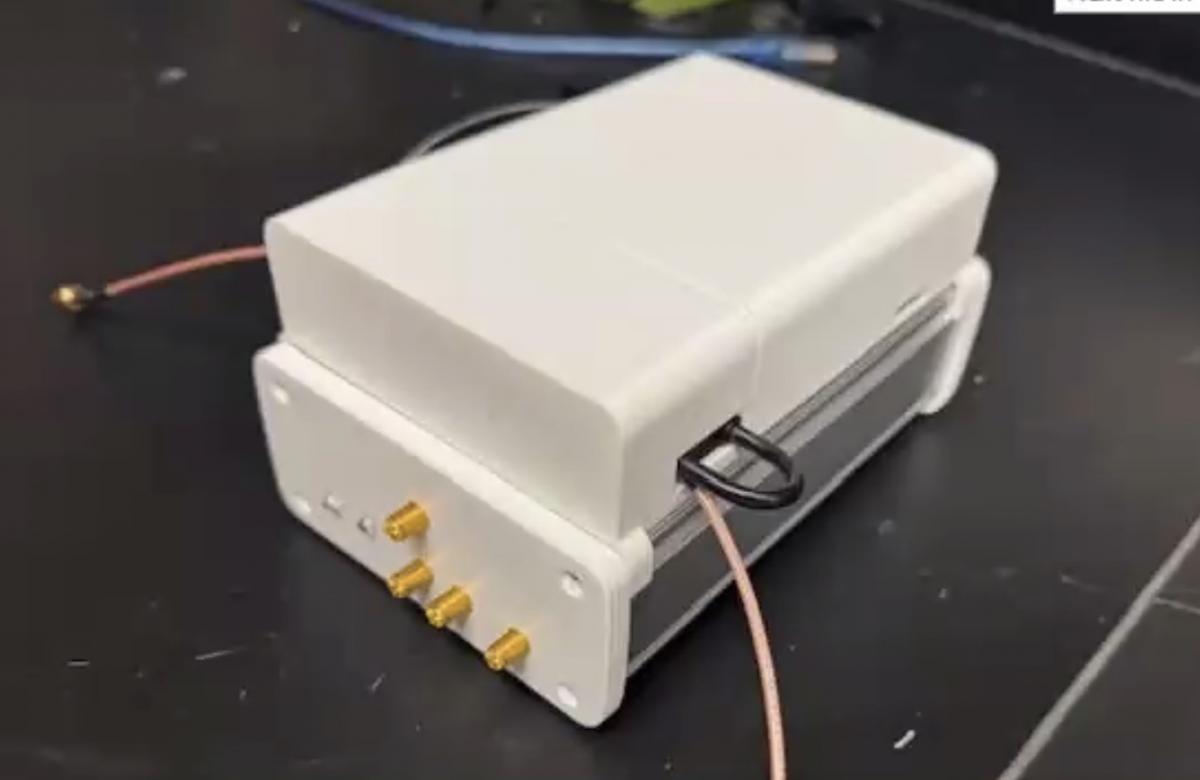
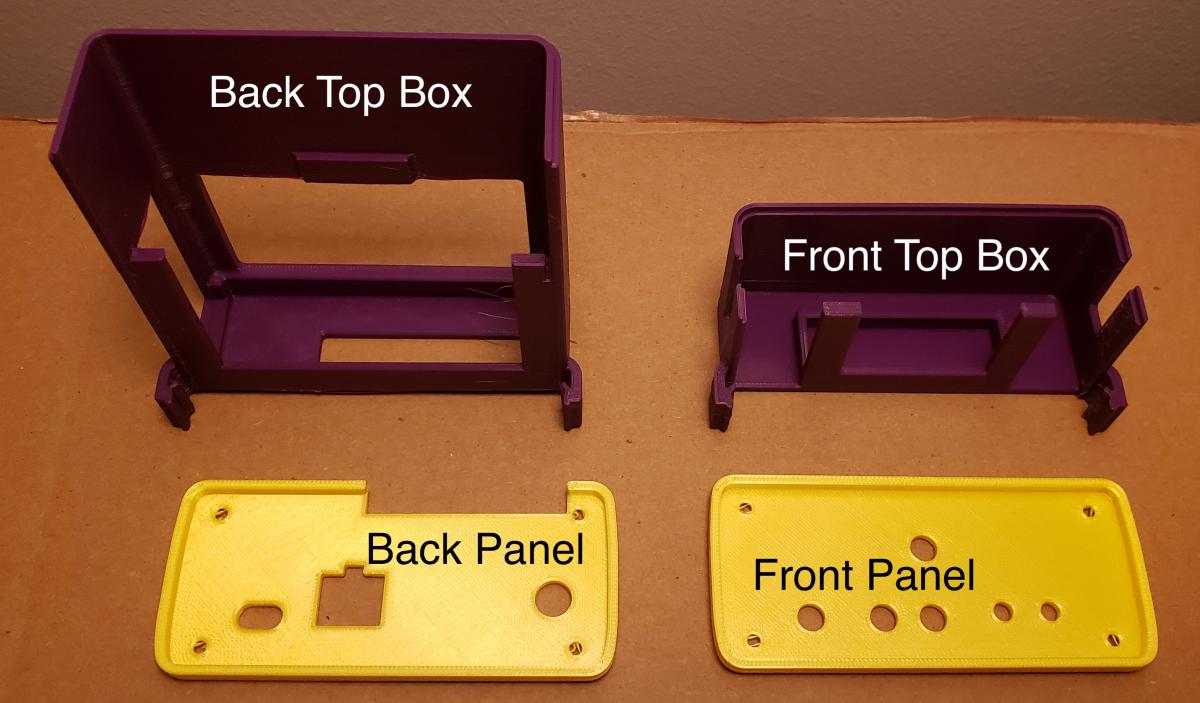
The Grape 2 is close to being ready for release, but there is still some 'manufacturing' to be done.  Specifically, the Grape 2 Team needs help printing (4) case parts for the Grape 2 assembly.

We are looking for volunteers to provide materials and printer time to make about 22 sets. Shown below are the final products.  After printing, we'll ask you to ship them to the final assembly location (Cleveland, OH).

Suggested material and print specs:  1.75 MM PLA filament.  Quality set to 0.2mm and infill set to 15%.  Color?  What do you have available?  While we'd prefer the purple (it is a Grape receiver, after all) and yellow shown below, but we realize volunteers are donating material, so we don't want to dictate requirements.

Print time (varies by printer, of course):  Front/Back panels, about 1.5 hours each, or 2.5 hrs. if printed together.  Back Top Box:  About 5 hrs.  Front Top Box: About 2.5 hrs.

The (4) STL files are located here

The (3) gcode files for a Prusa MK3S+ printer are here (the gcode prints the Front and Back Panels as one piece, which are then broken apart.)

Time frame?  Start now, if possible (Feb 22) for delivery to Cleveland, OH, some time during the week of Feb 26th.  Shipping address:

John C. Gibbons - CWRU
10900 Euclid Ave, Glennan 321
Cleveland, OH 44106-7071

2024-02-17 G2All4PrintedParts.jpg  

Grape 2 Case Printing

If you have 3D printing capabilities, the HamSCI Grape 2 Team needs your assistance!

The Grape 2 is close to being ready for release, but there is still some 'manufacturing' to be done.  Specifically, the Grape 2 Team needs help printing case fronts and case backs for the Grape 2 assembly.

We are looking for volunteers to provide materials and printer time to make a total of 35 of each piece shown. Here's what the final products should look like, approximately 4 inches wide x 2 inches tall x 0.25 inches thick.

Material Specs:  White (???) polymer

Print time (varies by printer, of course):  About 1.5 hours per piece.

G2 Case Front 3D View.png  G2 Case Back 3D View.png

HamSCI Workshop 2024 Abstract Submission Open

HamSCI Workshop Logo image of a carousel horse and an eclipse

We are looking for presenters for the March 22-23, 2024 HamSCI workshop at Case Western Reserve University in Cleveland, Ohio! The workshop will focus on the theme of Alignments - between the Sun, Moon and Earth; between collegiate amateur radio recreation and STEM curriculum; between data collection and analysis; between professional and citizen science. We are preparing for the solar eclipse of 8 April 2024, for which Cleveland will be in totality. If you would like to present, please visit https://hamsci.org/hamsci2024 to submit an abstract. Abstracts are due by February 10, 2024. Presenters will be notified by March 1, 2024.

HamSCI at HamCation (Orlando, FL) in February

Orland HamCation logo

HamSCI will have a booth at the Orlando HamCation, February 9, 10 and 11, 2024

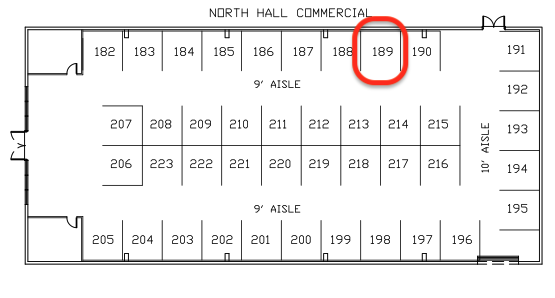
Central Florida Fairgrounds and Expo Park in Orlando, Florida, Booth 189, in the North Hall.

If you are at the event, be sure and stop by to say hello.  Even better, spend as much time as you'd like in the booth, talking about HamSCI with the HamCation attendees.

Visitors will see HamSCI banners and posters promoting our projects.  We'll be handing out flyers and SEQP (Solar Eclipse QSO Party) cards as souvenirs (sure to be in much demand - after all, the next major eclipse in North America won't be until 2044!).  Top of mind will be the Festivals of Eclipse Ionospheric Science - the events and activities occurring around the April 8, 2024 total solar eclipse in North America.

We hope to meet quite a few hams, SWLs and those interested in radio technology.  Attendance is usually in the 20,000 range, making it the second biggest ham radio gathering in the world.

More details, including a scheduling tool for those who want to 'work the booth', are available on the HamSCI website

HamSCI at the 2024 Orlando Hamcation

HamCation Booth Logo.png

HamSCI will be at the Orlando HamCation, February 9, 10 and 11, 2024

We will be in Booth 189, in the North Hall

If you are at the event, be sure and stop by to say hello.  Even better, spend as much time as you'd like in the booth, talking about HamSCI with the HamCation attendees.

Ed, WX2R and Gary, AF8A will be setting up the booth with HamSCI banners and posters promoting our projects.  

Top of mind will be the Festivals of Eclipse Ionospheric Science - the events and activities occurring around the April 8, 2024 total solar eclipse in North America.

We'll be handing out flyers and SEQP (Solar Eclipse QSO Party) cards as souvenirs (sure to be in much demand - after all, the next major eclipse in North America won't be until 2044!).

if you'd like to schedule your time in the booth, that's easy to do via Need to Meet.   We hope to see you there!


HamCation Booth 2024.png