News Articles

HAARP Open House 19 August, September campaign

Friday, July 28, 2017 - 12:38
By Dr. Chris Fallen, KL3WX
Geophysical Institute - University of Alaska, Fairbanks
 
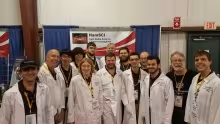
The next HAARP open house will occur on 19 August 2017 and include round-trip bus transportation from Fairbanks for $45 which will help bring costs down for individuals, particularly for those from out of town. Throughout the day there will be talks by Geophysical Institute researchers on-site about the HAARP facility and research, and other research topics pursued at the UAF Geophysical Institute. As in the previous year, tours of the main transmitter array, control center, and power generation plant will be offered throughout the day. Hams and radio enthusiasts are encouraged to bring their equipment for photo opportunities or even to make contacts from the site. 

Listen to the Arecibo Observatory on HF

Tuesday, July 25, 2017 - 11:00

By Dr. Chris Fallen, KL3WX
Geophysical Institute - Uniervsity of Alaska, Fairbanks

The Arecibo ionospheric HF heating facility will be operational for a research campaign from 24 to 31 July 2017. Because the facility transmits on the HF frequencies 5.125 and 8.175 MHz, it is possible that its signals can be heard world-wide. QSL cards are available for interested SWLThe new Arecibo ionosphere HF heater nominally transmits 600 kilowatts net power (100 to 200 megawatts effective radiated power) and has a unique Cassegrain dual-array antenna design that increases the gain of three crossed dipoles for each band using the signature 1000 ft spherical dish reflector.

SEQP and JT-Modes; Rules Update

Monday, July 24, 2017 - 17:01
I’ve received community feedback that people want more guidance on running JT-modes during the SEQP. As a result, we have revised rules. There are some also changes to provide guidance in other areas as well, including using SNRs or RSQs for digital mode signal reports.

APRS and the Total Solar Eclipse

Thursday, July 13, 2017 - 19:41

By Bob Bruninga, WB4APR

The real time packet communications system APRS will be used during the day of the eclipse as a national communications network for those involved in ham radio and eclipse observations to be able to track each other and see where other nearby ham observers are located.  Imagine the APRS map that day showing a clustering of mobile and portable positions all along the totality line.  Please use the station symbol SUNNY for this event so these stations will stand out among all others on the national tracking page http://aprs.fi.

Non-Ham Participation in Observing the Eclipse's RF Effects

Friday, July 7, 2017 - 16:17

By Ward Silver, N0AX

If you are not a ham radio licensee - how can you participate in monitoring the eclipse?  Perhaps you are looking for a demonstration of the impact the eclipse will have on radio signals.  Maybe you are looking for an experiment that a group can perform without specialized equipment.  Regardless of your background, this article from the July issue of Nuts and Volts magazine explains the eclipse's effect on radio propagation without too much technical detail.  You can use an AM radio or World Band radio in several ways that are sure to demonstrate what happens when the Sun's ray are blocked from the Earth's atmosphere.  You can log the observed effect on signals or you can just listen while you're watching the eclipse unfold.  The article shows you easy ways to experience the eclipse in a whole new way and it may pique your interest in getting involved with radio science as a career or a hobby.

Link to Nuts & Volts article: http://www.nutsvolts.com/magazine/article/the-solar-eclipse-and-ham-radio

Eclipse AM Broadcast Reception Experiment

Thursday, July 6, 2017 - 14:11

Contributing author Joe Rao of Sky & Telescope Magazine is asking readers to submit reception reports of AM broadcast stations heard during the upcoming August 21, 2017 Total Solar Eclipse. The shadow of the moon is expected to cause a depletion in the D region of the ionosphere, thereby reducing ionospheric absorption in the AM broadcast band (540 - 1700 kHz) and allowing for long-distance skywave propagation. This same mechanism allows for long-distance propagation of AM broadcast stations at night. This is an excellent eclipse radio experiment for people who do not have ham radio licenses or access to specialized equipment. For more information, please see Joe's Sky & Telescope article.

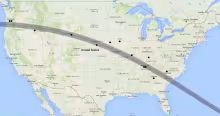
Figure: Map of clear channel AM broadcast stations in or near the August 21, 2017 eclipse totality. Eclipse map by Xavier Jubier.

MIT Haystack Observatory Releases Software Toolkit for Scientific SDR Use

Wednesday, June 21, 2017 - 01:17

Editor's note: This toolkit can be used to record SDR data to a standard format for scientific use.

MIT Haystack Observatory is pleased to announce the formal open source release of Digital RF version 2.5 under a BSD license. The software implements a data recording format for scientific radio frequency (RF) instrumentation using the HDF5 scientific data format. The implementation is designed for the management of highly time-dependent data from a large number of radio sensors. Applications include radio science (e.g., radio astronomy, geospace radar) and any project requiring the capture and use of RF data as raw digital samples.

e-POP Spacecraft to Participate in 2017 ARRL Field Day

Wednesday, June 14, 2017 - 11:28

By G. W. Perry, N. A. Frissell, E. S. Miller, and J. D. Katz

The Enhanced Polar Outflow Probe (e-POP) onboard the Canadian CAScade Smallsat and Ionospheric Polar Explorer (CASSIOPE) satellite will once again be supporting ham radio citizen science by participating in the 2017 American Radio Relay League Field Day, on June 24 and 25, 2017. On an annual basis, the ham radio community participates in the ARRL Field Day to exercise and hone their skills in the field.  In essence, it is an emergency preparedness exercise – one of the largest anywhere – with several thousand hams taking part across the world.  From a radio science perspective, Field Day is an ideal time for e-POP to study the structure of the Earth’s ionosphere using Field Day participants’ transmissions.


Dayton Hamvention HamSCI Photos and Videos

Tuesday, May 23, 2017 - 15:22

The HamSCI team completed a successful weekend presenting at the 2017 Dayton Hamvention in Xenia, Ohio. From May 19-21, the HamSCI team ran a booth in the ARRL Expo area where they discussed the HamSCI mission, upcoming experiments, and ways ham radio operators could participate in HamSCI activities. The HamSCI team included members from the New Jersey Institute of TechnologyVirginia Tech, the MIT Haystack Observatory, and Citizen Scientists from the general amateur radio community. This includes the upcoming Solar Eclipse QSO Party (SEQP), participation in the EclipseMob Project, and a live demonstration of both Red Pitaya and Rabbit S-9C based Reverse Beacon Network receive nodes. On Saturday morning, HamSCI presented an ARRL-sponsored forum where members gave oral presentations about HamSCI research and activities. Photos, videos of the presentations, and PDFs of presentation slides are included in this post.