The Ham Radio Science Citizen Investigation (HamSCI) wishes to emphasize the significant scientific value of National Research Council (NRC) Canada’s time standard HF radio beacons at station CHU in Ottawa. NRC Canada recently announced a plan to cease CHU operations on 22 June 2026. As active scientific users of CHU’s signals, we urge the NRC to reverse this decision.
By way of introduction, HamSCI provides an active platform for citizen and professional scientific collaborations that advance research and understanding of near-Earth space dynamics and space weather through amateur radio activities. HamSCI encourages the development of new technologies and methods for advanced radio-based remote sensing.
Through its provision of a strong, time-standards locked, and highly-coherent HF radio beacon source, CHU provides a unique and valuable remote sensing capability for Canadian and international space science that is not replicated by other professional networks. CHU signals, as they propagate toward ever-expanding radio receiver networks distributed across the US and Canada, experience significant variations in frequency, amplitude, and phase. These variations are driven by the large complexities of ionospheric dynamics in both the subauroral and auroral ionosphere. Remote sensing of the behavior of these variations allows better understanding of their physical drivers, and advances space weather knowledge with direct benefits for both Canadians and the international geospace research community.
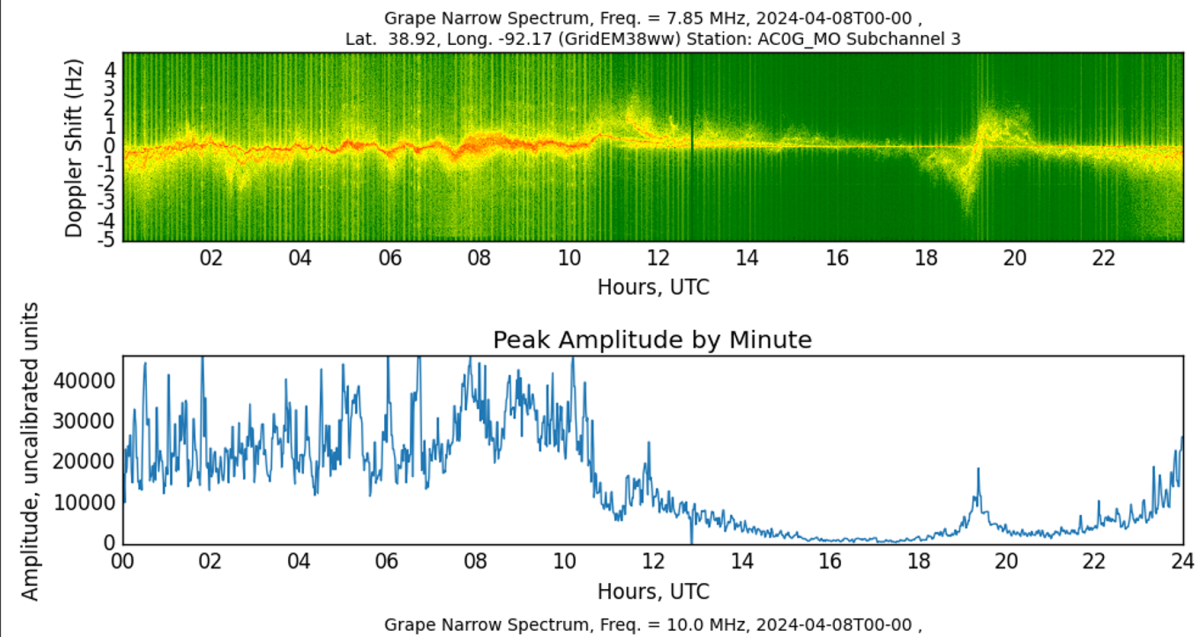
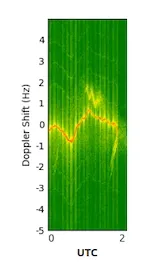
Large anomalous variations in the frequency spectrum (upper panel) and amplitude (lower panel) of CHU signals as received in the US as received by citizen scientist Michael Hauan AC0G-MO in the state of Missouri during the total solar eclipse of April 8, 2024. A clear s-shaped variation in apparent frequency of CHU, triggered by the eclipse, occurred at about 19 UTC. The shape of the curve near that time, and the temporary increase in received signal amplitude, provides unique remote sensing information on upper atmosphere thermal and chemical variations during the passage of the eclipse shadow.
CHU is in daily community science use as a technical enabler of advanced remote sensing
The use of time standard beacons as ionospheric signals of opportunity dates back more than a century to the earliest days of radio science. Today, this time-tested approach is supercharged by inexpensive single-board computers, software defined radios, and the participation of the global amateur radio and shortwave listener community, who have built a growing meta-instrument that spans the continent of North America and points beyond.
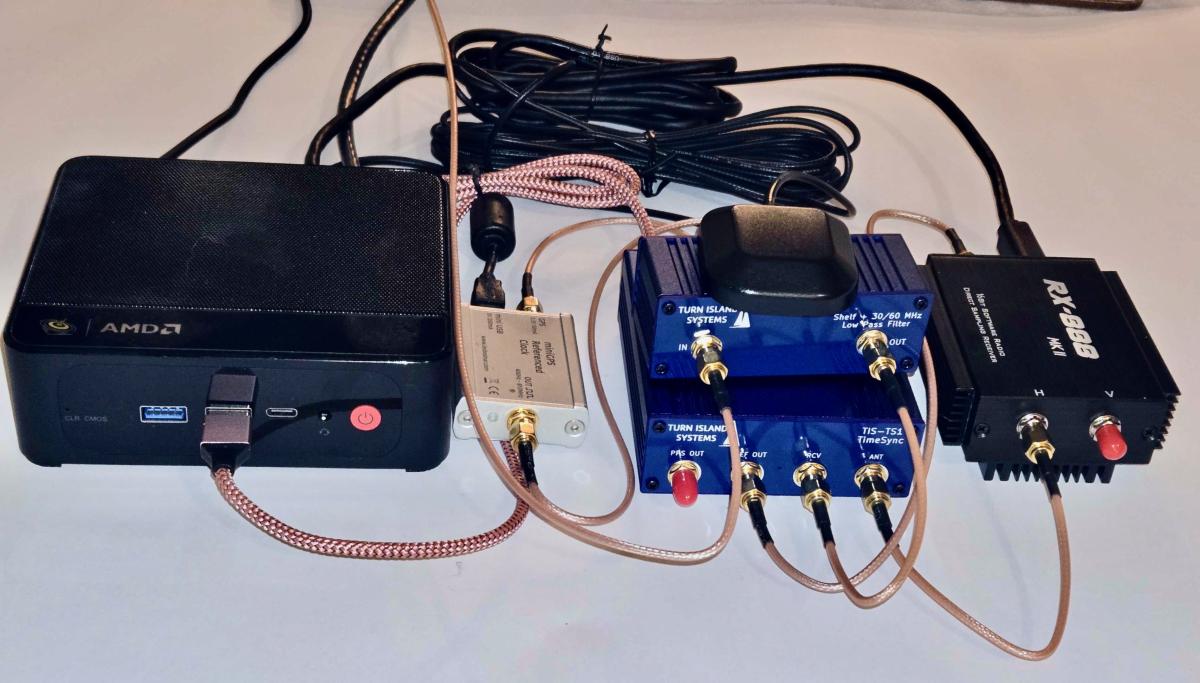
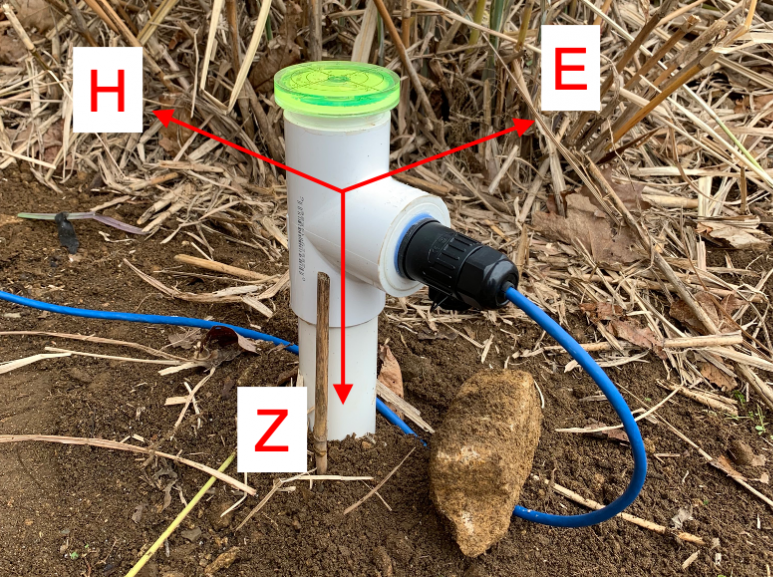
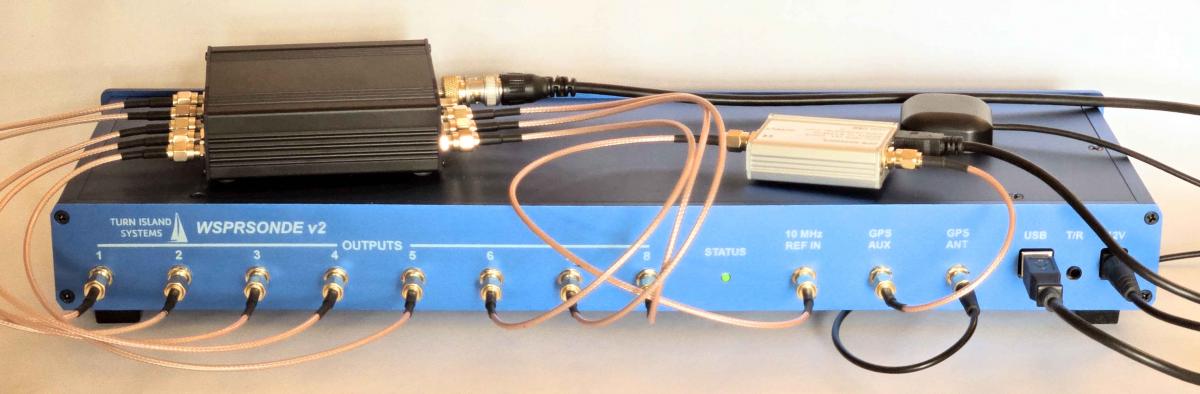
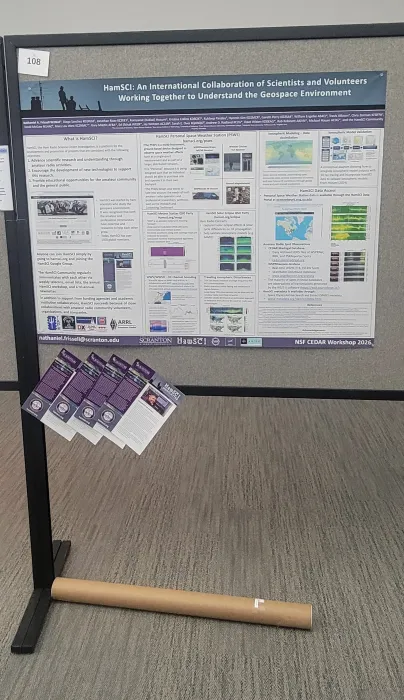
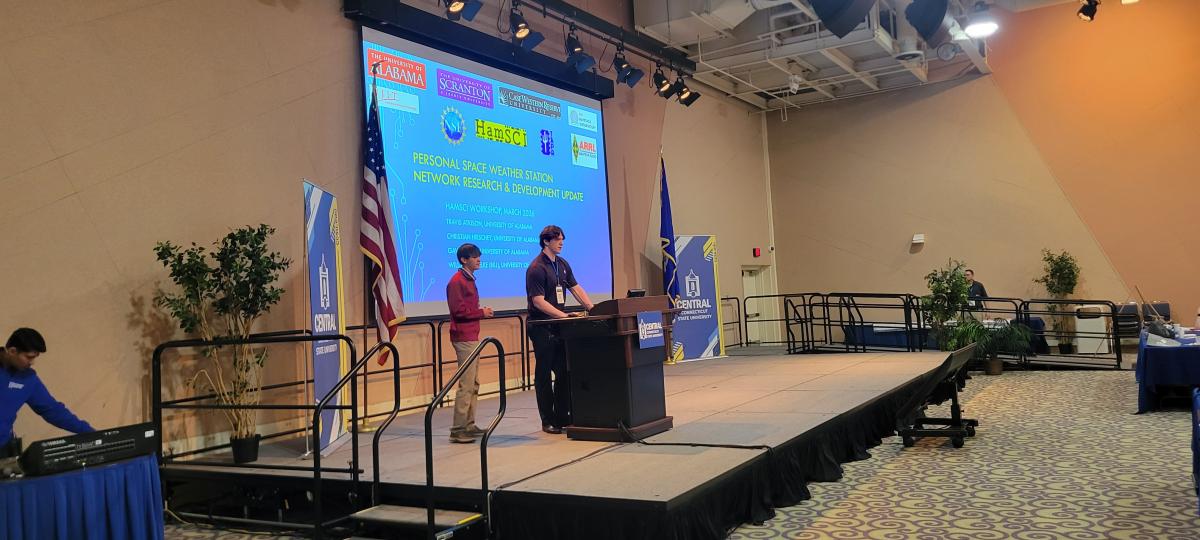
HamSCI’s implementation of this advanced remote sensing technique takes the form of its flagship project, the Personal Space Weather Station Network (PSWS). PSWS efforts have collected over 25000 observations of CHU’s signals to date. Each day, some 40 software-defined radio stations distributed throughout the world archive all three of CHU’s signals and upload them to a central database. These signals provide important information alongside the signals of US operated time stations WWV and WWVH, and generate valuable data for the improvement of ionospheric raytracing with benefit to commercial transionospheric communications systems. The network is poised to grow further this summer, as twenty additional PSWS nodes are deployed around the United States with support from the US National Science Foundation.
Having begun experiments in 2019 and continuing to add stations in following years, HamSCI seeks to build a propagation record that encompasses Solar Cycle 25 and its wide variety of geophysical variability. These results have a direct impact on the development of improved, practical ionospheric raytracing algorithms and on applied research focusing on the radio propagation impacts of solar flares.
At a larger scope, other citizen science teams such as Aurorasaurus continue to work closely with HamSCI for studies of the interactions between aspects of the geospace system. These studies greatly benefit from multiple distributed ionospheric observations including CHU enabled remote sensing.
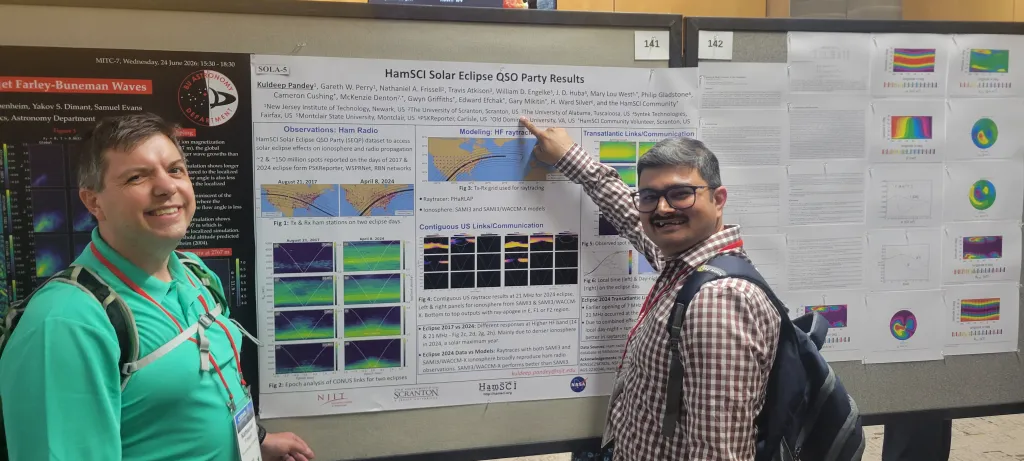
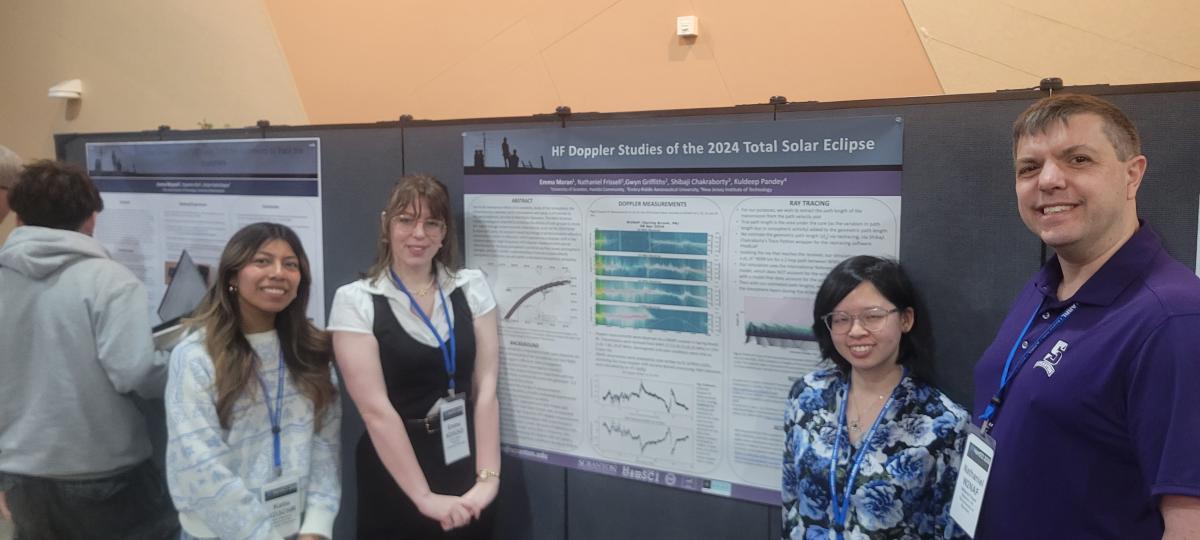
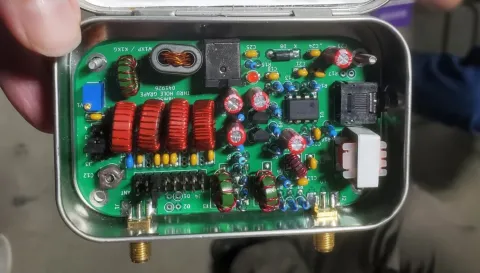
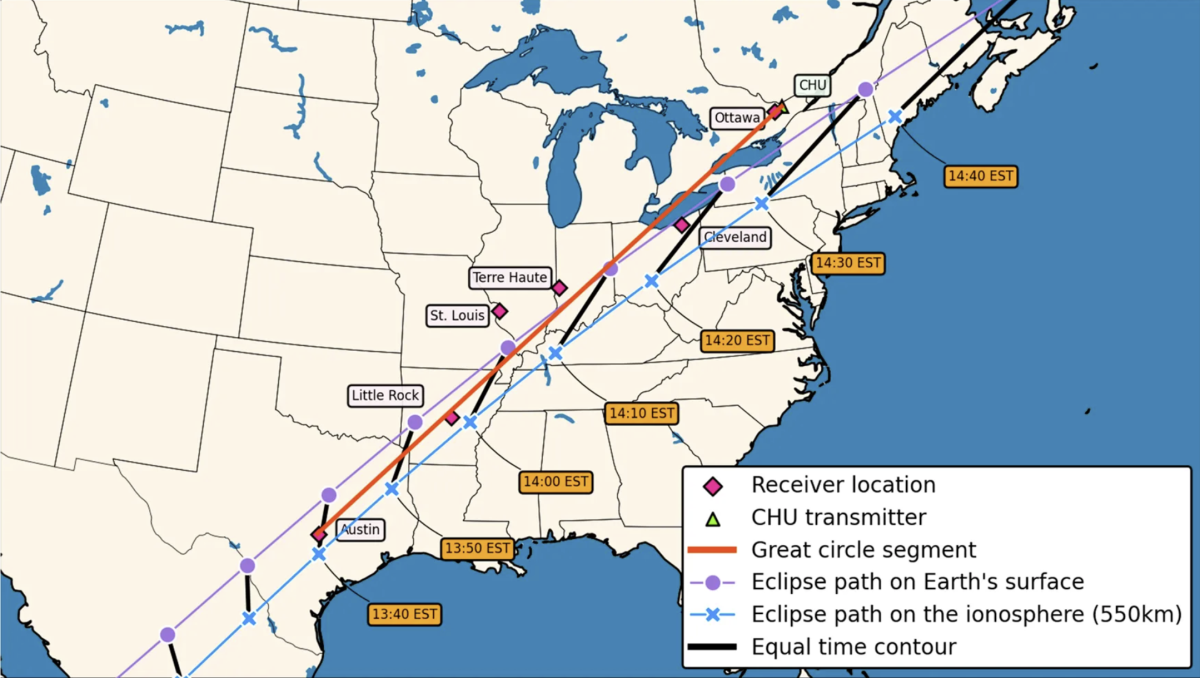
Recently, CHU played a crucial role in a first-of-its-kind citizen science remote sensing campaign along the path of the 2024 total solar eclipse traversing North America, as described in Usis et al 2025. Receivers built by undergraduate students were deployed and maintained by citizen scientists along the eclipse path from Ottawa to Austin, including high school students and members of the Radio Amateurs of Canada, with a goal of monitoring the effect of the eclipse on the radio propagation of CHU’s second ticks. No other time standard station could have fulfilled this role in the same manner and with the same unique spatial sampling of upper atmospheric variations triggered by eclipse passage. The CHU eclipse campaign was a triumph of frontier citizen science: a co-designed campaign that produced high-quality open science results, with all participants engaged in the full scientific process and recognized through coauthorship. The first author, M. Usis, further extended this work beyond the above reference to a full masters thesis in 2025.
Other members of the HamSCI community actively use CHU as a propagation beacon for frontier, independent research projects as well. For instance, Gwyn Griffiths MBE G3ZIL, observing at long distances from the UK, uses CHU to quantify propagation effects during solar flare disturbances in ionization production within the upper atmosphere. This research is particularly important as well for transatlantic HF propagation studies, as CHU provides a signal that is less affected by geomagnetic disturbances than those from WWV. CHU’s favorable location also greatly mitigates the problem of isolating the transmitter location as opposed to other international time signal broadcast locations.
Professor Christopher Stubbs AB1WN, leading a team at Harvard University, uses combined observations of CHU and WWV to assess details of radio wave polarization effects imposed by the ionosphere. Professor David Kazdan AD8Y at Case Western Reserve University has conducted daily time-of-flight measurements using CHU's second tick as a reference for several years. These data contain numerous scientific quality phenomena ranging from ionospheric disturbances to possible meteor scatter in the recordings. The team at CWRU plans further ionospheric eclipse measurements in August of 2026 to study ionospheric physics and chemistry transient responses, which are directly indicative of space weather reaching into Canadian provinces.
CHU enables frontier scientific observations of complex space weather
Beyond HamSCI activities, CHU is valuable for a range of international scientific studies in geospace regions. Geospace’s field of study by definition crosses international boundaries, and the study of high-latitude regions and the aurora, a key component of the complex transfer of energy throughout the geospace system, is particularly relevant for Canada as a northern nation. The complexity of this system, its natural variability, and its response to geomagnetic storm activity is particularly intense both north and south of the CHU transmitter complex operated by NRC in Ottawa, as it lies within the plasmasphere boundary layer. This geophysical region is marked by a huge number of not-yet fully characterized instabilities and variations as cold, dense plasma from lower latitudes overlaps the hot, more tenuous plasma of the mid-latitude ionospheric electron density trough and high latitude auroral regions. Geospace community scientists are still working on understanding the fundamentals of this system and its behavior, and the situation remains data-starved.
Understanding space weather is also an increasingly imperative societal need for all nations including the North American continent in the modern era, as commercial use of near-Earth space by large satellite constellations grows at a highly accelerated pace. CHU transmissions provide valuable information for advancing crucial fundamental and applied understanding of the planet’s surrounding charged and neutral atmosphere, which forms the background environment for low Earth orbit satellite networks and their operations.
Summary: CHU should continue its enabling transmissions for ionospheric space weather understanding
In the end, the loss of CHU will invariably - and significantly - impact unique remote sensing data that instrument networks return daily, and this data has significant and proven scientific yields for study of the upper atmosphere and its dynamics. For this reason, we can say with certainty that the global community of citizen and professional scientists alike will be poorer for its silence, if current NRC plans are made a reality.
Therefore, we strongly recommend the continuation of CHU’s signal for the benefit of many Canadian and international scientific research projects and space weather studies targeting the complexities of Earth’s atmosphere.
Signatories
† = HamSCI Science Advisory Board
* = Canadian Citizen or Resident
Dr. Philip J. Erickson† W1PJE. Director, Massachusetts Institute of Technology (MIT) Haystack Observatory, Westford MA USA.Principal Research Scientist, MIT, Cambridge MA USA. Co-chair, Panel on the Physics of Ionospheres, Thermospheres, and Mesospheres, US National Academies of Science, Engineering, and Medicine (NASEM) Decadal Survey for Solar and Space Physics (Heliophysics) 2024-2033
Prof. Nathaniel Frissell† W2NAF. Associate Professor, Physics and Engineering, University of Scranton, Scranton, PA USA.
HamSCI Principal Investigator.
Dr. Kristina Collins† KD8OXT. Research Scientist, Space Science Institute, Boulder, CO USA.
Lead, WWV/H Scientific Modulation Working Group.
Travis Atkison, Ph.D†. Associate Professor of Computer Science, Cyber Security Program Director, The University of Alabama, Tuscaloosa, AL USA.
Dr. Ethan Miller†. Principal Scientist, STR, Beavercreek, OH USA.
Gary Mikitin† AF8A. BSEE (retired). HamSCI Amateur Radio Community Coordinator, Cleveland, OH USA.
Dr. Mary Lou West†, Physics and Astronomy Department, Montclair State University, Montclair, NJ USA.
William Liles†, NQ6Z. Liles Innovations LLC, Reston, VA USA.
H. Ward Silver†, N0AX. Missouri University of Science and Technology, Rolla, MO USA. Contributing Editor (ret.), ARRL Handbook and ARRL Antenna Book.
Prof. Gareth Perry*† KD2SAK, New Jersey Institute of Technology, Newark, NJ USA.
Nick Hall-Patch* VE7DXR, Victoria, British Columbia.
Dr. Pierre Fogal*, Senior Research Associate, Dept. of Physics, University of Toronto. Site Manager, Polar Environment Atmospheric Research Laboratory (PEARL), Canadian Network for Detection of Atmospheric Change (CANDAC)
29 May 2026