Publications

HamSCI Workshop 2020: The Auroral Connection
HamSCI 2020 Workshop Logo

March 20-21, 2020
A Virtual Workshop Hosted by The University of Scranton

Come join HamSCI at its third annual workshop! Due to restrictions caused by the COVID-19 Coronavirus, this year's workshop will he held as a virtual, eletronic workshop.  The meeting will take place March 20-21, 2020 using Zoom Webinar Services hosted by The University of Scranton in Scranton, PA . The primary objective of the HamSCI workshop is to bring together the amateur radio community and professional scientists. The theme of the 2020 HamSCI Workshop is "The Auroral Connection: How does the aurora affect amateur radio, and what can we learn about the aurora from radio techniques?" Invited speakers include Dr. Elizabeth MacDonald, NASA Scientist and founder of AurorasaurusDr. James LaBelle, Dartmouth Space Scientist and expert on radio aurora, and Dave Hallidy K2DH, an expert in ham radio auroral communication.

This workshop will also serve as a team meeting for the HamSCI Personal Space Weather Station project, an NSF-funded project to develop a citizen science instrument for studying space weather from your backyard. The PSWS is led by the University of Scranton, and includes participation from TAPRCase Western Reserve University/W8EDU, the University of Alabama, the New Jersey Institute of Technology CSTRMIT Haystack ObservatoryDartmouth College, and the ham radio community at large.

Participation and Registration

Participation in the 2020 HamSCI Workshop will be via Zoom Webinar. Registration and participation is free and open to all. To prepare and make sure you are ready to participate in the 2020 HamSCI Workshop, please visit the Zoom Website and create free account. You can then download the client software and test it by creating your own free test meeting. The Zoom client will work on Windows, Apple OS X, Linux, Android, iPad, and iPhone.

This meeting is being recorded and will be available later.

Community Participation Guidelines

All participants in the HamSCI workshop must adhere to the HamSCI Community Participation Guidelines. Those that do not follow these guidelines will be asked to leave.

Presenter Information

Oral presentations will be given in the same format as if they were at the in-person workshop. Please familiarize yourself with the Zoom teleconferencing software by creating a free Zoom account, downloading the client software, and testing it by creating your own free test meeting.

Posters and demonstrations will also be presented via Zoom, but there are special instructions to adapt the poster session to electronic format. If you are a Poster or Demonstration presenter, please click here for updated information.

Invited Speakers

Invited Talk: Tim Duffy, K3LR, “Let’s Push the Exploration of the Ionosphere to The Next Level”
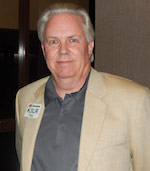
Photo of Tim Duffy K3LR
Tim has been an active amateur radio operator for 47 years. He has hosted 132 different operators from around the world as part of the K3LR Multi-Multi DX radio sport contest efforts since 1992. He was the ARRL Atlantic Division Technical Achievement award winner in 1998. Tim has been the moderator of the Hamvention Antenna forum for 34 years. K3LR serves as chairman of Contest University (13 years), the Dayton Contest Dinner (27 years), chairman of the Top Band Dinner – as well as coordinator of the Contest Super Suite (34 years) in Dayton during the yearly Hamvention. He is founder and moderator of the popular RFI Reflector ([email protected]) since 1999. Tim serves on the board of directors of the World Wide Radio Operators Foundation (WWROF) as Chairman and is President Emeritus of the Radio Club of America (RCA). Tim is President of the Mercer County Amateur Radio Club (W3LIF). Tim was elected to the CQ Contest Hall of Fame in 2006. He was honored with the prestigious Barry Goldwater Amateur Radio service award by the RCA in 2010. K3LR was honored as Hamvention Amateur of the Year in 2015 by the Dayton Amateur Radio Association. Tim is the Chief Executive Officer and General Manager at DX Engineering. He is a graduate of the Pennsylvania State University.

Invited Talk: David Hallidy, K2DH, “Amateur Auroral Communications”
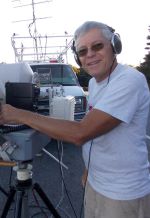
Photo of Dan Hallidy K2DH
Dave is a retired microwave engineer, having been employed in the RF and Microwave field for most of his adult life. He has been a licensed amateur radio operator for 53 years, since the age of 16. For many years, Dave “chased DX”- that is, attempted to contact amateurs in as many foreign countries as possible and now has confirmed contacts with 330 “entities”. In 1983, he became interested in the frequencies above 30MHz, and has experimented with signal propagation on the HF, VHF, UHF and SHF amateur bands ever since. His interests today include Aurora, Meteor Scatter, MoonBounce, Tropospheric Ducting and other unusual modes of signal propagation unique to the VHF, UHF, and SHF bands. He first experienced Auroral signal propagation in 1985, while living in Texas. An intense Aurora occurred, affecting signals as far as South Texas. Not understanding the phenomenon, he was surprised to hear some of his fellow amateurs attempting to talk and use Morse code, but with highly distorted signals- the usual pure tones of radiotelegraphy were merely a broken hissing sound and voice signals sounded like people whispering. After a while he realized that this was due to distortion caused by reflection of the signals via the Auroral Curtain. During that event, he made contacts as far away as 1000 miles on the 144 and 432MHz amateur bands. After that, he was “hooked”- whenever there were reports of Aurora, he was there, attempting to make contacts with friends around the country. After moving back to New York State, where radio Aurora is more frequent due to the closer proximity to the Auroral Curtain, he has continued to experiment with making contacts on the higher frequencies. In 1989 during a particularly intense Auroral event, he successfully made an Auroral contact with a station in Northern Canada on the 902MHz band, where it had never been achieved before. Dave lives with his wife in Rochester, NY and can be reached by email at: [email protected].

Invited Talk: Dr. Elizabeth MacDonald, “Aurorasaurus: Citizen Science Observations of the Aurora”
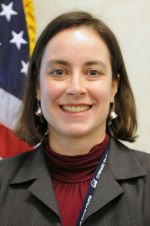
Photo of Liz MacDonald

Liz MacDonald's research has focused on experimental particle measurement techniques and data analysis in the magnetosphere and ionosphere for the last 15 years. Liz is currently a Co-Investigator (Co-I) on the Helium, Oxygen, Proton, and Electron Spectrometer on the NASA Van Allen Probes mission. At Los Alamos National Laboratory, Liz was the Principal Investigator (PI) for the Z-Plasma Spectrometer on the DOE Space and Atmospheric Burst Reporting System (SABRS) geosynchronous payload. Liz also led the Innovative Research and Integrated Sensing (IRIS) team. In the recent past Liz led the DoE-funded Technology Infusion Project entitled Modular Advanced Space Environment Instrumentation (from 2009-2011) and served as the PI for the Advanced Miniaturized Plasma Spectrometer on the DOE SABRS Validation Experiment payload (2007-2008). Liz has a blend of expertise in both instrument development and data analysis and interpretation that comes from sounding rocket and satellite instrumentation experience. This experience ranges over the complete cycle of instrument production, including design and modeling, integration and testing, calibration, satellite operations, and in situ scientific data analysis. General interests include instrument technology development, basic magnetospheric science, and space situational awareness national priorities. Specific research interests include wave-particle interactions and the effect of plasma on radiation belt dynamics, mapping, coupling, and transport between the ionosphere and the inner magnetosphere, and the impact of heavy ions on geomagnetic storm processes. Liz holds Masters and PhD degrees from the University of New Hampshire and a Bachelor's in Physics from the University of Washington (largely funded by a NASA Space Grant scholarship). Liz is the founder and leader of Aurorasaurus, a citizen science project for the study of the aurora.

Invited Talk: Dr. James LaBelle, “Observing Radio Signals of Auroral Origin”
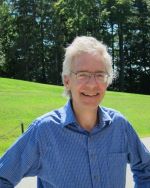
Photo of Jim LaBelle
Jim LaBelle is an experimental space plasma physicist. He has been at Dartmouth since 1989. He earned his undergraduate degree in physics from Stanford University (1980), followed by masters and doctorate degrees in applied physics from Cornell University (1982 and 1985). He did post-doctoral work at the Max-Planck Institute for Extraterrestrial Physics in Garching, Germany (1985-7) and at Utah State University in Logan, Utah (1987-9). He is a member of the American Geophysical Union and the International Union of Radio Scientists. He has had visiting fellowships at the Max-Planck Institute for Extraterrestrial Physics (1997, 2000-2001) and at the University of Sydney (2008). In 2010, he was appointed to the inaugural Lois L. Rodgers Professorship at Dartmouth.

Science/Program Committee

  • Dr. Nathaniel Frissell, W2NAF, University of Scranton, Chair
  • Dr. Phil Erickson, W1PJE, MIT Haystack Observatory
  • Dr. Cathryn Mitchell, M0IBG, University of Bath
  • Dr. Elizabeth MacDonald, NASA Goddard Space Flight Center
  • Mr. Bill Liles, NQ6Z, HamSCI Community

Local Organizing Committee (University of Scranton)

  • Dr. Mohammad A. Maktoomi, Chair
  • Dr. Declan Mulhall
  • Ms. Laurie McCoy, Administrative Assistant
  • Ms. Frani Mancuso, Executive Director of Conference & Event Services

Questions?

Please e-mail [email protected].


University of Scranton and NSF Logos

The 2020HamSCI Workshop is hosted by The University of Scranton. Financial support is provided by the United States National Science Foundation.
Josh Walker


Friday, 22 November 2019: This page is under construction
All information is tentative.


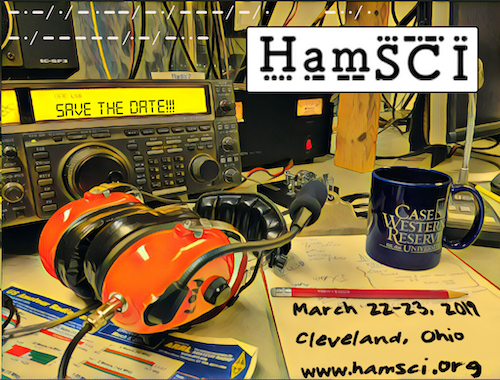
hamsci savethedate.png


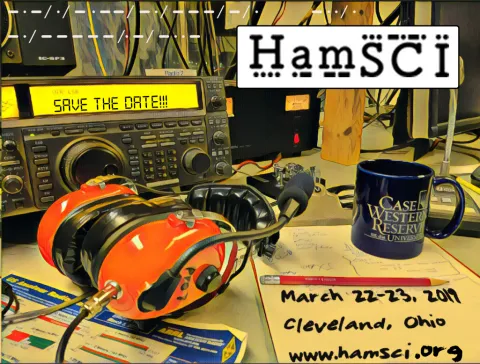
Come join HamSCI at its second annual workshop! The workshop will be held March 22-23, 2019 at Case Western Reserve University in Cleveland, OH and seeks to bring together the amateur radio community and professional scientists. Anyone interested in this workshop is invited to join.

Cost and Registration

  • Friday Registration: $100 (Includes Breakfast, Lunch, and Banquet Ticket)
  • Saturday Registration: $50 (Includes Breakfast, Lunch, and Dinner)
  • Friday Banquet Ticket Only: $50

Call for Speakers

We are especially looking for speakers with presentations showing analysis of ionospheric observations, ideas and proposals for the design of the Personal Space Weather Station and instrumentation for the 2024 eclipse. We will also accept other presentations related to amateur radio and science. Presentations will be in the form of oral talks, posters, lightning talks, and demo room tables. Abstract and acceptance and presentation format will be chosen by the Science Program Committee. If you would like to present, please e-mail your abstract to Nathaniel Frissell, W2NAF, at [email protected] by February 10, 2019. Presenters will be notified by March 1, 2019.

In your abstract e-mail to [email protected], please include:

  • Title of Presentation
  • Name of Presenter
  • Co-Author List with Call Signs and Affiliations
  • Abstract, limited to 1 paragraph and 350 words
  • Request of presentation or demo room table

You may request a poster presentation format. Due to time constraints requests for oral presentation slots are not guaranteed.

Program

This year’s theme will be “Ionospheric Effects and Sensing,” which includes the use of amateur radio techniques for the characterization and study of ionospheric phenomena such as traveling ionospheric disturbances, sporadic E, response to solar flares, geomagnetic storms, the 2024 total solar eclipse other space weather events. In order to facilitate this science, continued development of the HamSCI Personal Space Weather Station and discussion of integration of amateur radio into the collegiate curriculum will also take place. Featured speakers include well-known amateur radio author Ward Silver, N0AX, propagation specialist Carl Luetzelschwab, K9LA, and MIT Haystack Observatory Ionospheric Scientist Dr. Larisa Goncharenko. We will also accept presentations relating to amateur radio and science, particularly space and atmospheric science, space weather, and radio astronomy. 

On Saturday afternoon, after lunch, the conference proceedings will continue at CWRU's think[box], a student manufacturing facility and makerspace that is open to the public. Attendees will participate in tours of think[box] facilities; tours of the Case Amateur Radio Club, W8EDU; and an amateur radio licensing session. There will also betime available for breakout sessions and committee discussions. The conference will close on Saturday evening with a screening of Contact at CWRU Film Society. Tickets to the film are complimentary with a conference badge.

View Agenda, Videos, and Presentation PDFs


Friday Keynote: Tim Duffy, K3LR

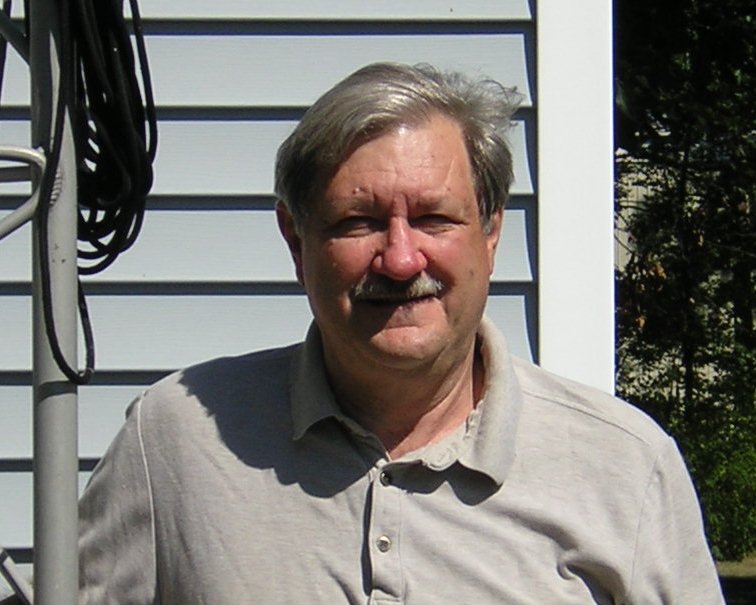
Tim Duffy Photo
Tim has been an active amateur radio operator for 47 years. He has hosted 132 different operators from around the world as part of the K3LR Multi-Multi DX radio sport contest efforts since 1992. He was the ARRL Atlantic Division Technical Achievement award winner in 1998. Tim has been the moderator of the Hamvention Antenna forum for 34 years. K3LR serves as chairman of Contest University (13 years), the Dayton Contest Dinner (27 years), chairman of the Top Band Dinner – as well as coordinator of the Contest Super Suite (34 years) in Dayton during the yearly Hamvention. He is founder and moderator of the popular RFI Reflector ([email protected]) since 1999. Tim serves on the board of directors of the World Wide Radio Operators Foundation (WWROF) as Chairman and is President Emeritus of the Radio Club of America (RCA). Tim is President of the Mercer County Amateur Radio Club (W3LIF). Tim was elected to the CQ Contest Hall of Fame in 2006. He was honored with the prestigious Barry Goldwater Amateur Radio service award by the RCA in 2010. K3LR was honored as Hamvention Amateur of the Year in 2015 by the Dayton Amateur Radio Association. Tim is the Chief Operating Officer and General Manager at DX Engineering. He is a graduate of the Pennsylvania State University

Invited Talk: Carl Luetzelschwab, K9LA, "Ham Radio for Space Scientists"

Carl Luetzelschwab Photo
Carl started his radio career as a shortwave listener in the late 1950s, and received his Novice license (WN9AVT) in October 1961. He selected K9LA in 1977. He enjoys propagation, DXing (he’s at the top of the Honor Roll), contesting (he was NCJ Editor from 2002-2007), playing with antennas and fixing/using vintage equipment. Carl is a graduate of Purdue University (BSEE 1969, MSEE 1972) and worked for Motorola and Magnavox/Raytheon as an RF design engineer (mostly designing solid-state RF power amplifiers). He retired in October 2013. He and his wife Vicky (AE9YL) reside in Fort Wayne and enjoy traveling, which has included DXpeditions to Syria, Market Reef and numerous trips to the Cayman Islands. Carl is currently the ARRL Central Division Vice Director. He has received the Bill Orr W6SAI Technical Writing Award, the YASME Foundation Excellence Award and the Indiana Radio Club Council Technical Excellence Award.

Invited Talk: Dr. Larisa Goncharenko, "Space Science for Ham Radio Operators"

Larisa Goncharenko Photo
Dr. Larisa Goncharenko is a research scientist at the Haystack Observatory, Massachusetts Institute of Technology. Her major areas of interest are ionospheric-thermospheric coupling, and the dynamics and electrodynamics of the ionosphere and thermosphere, with an emphasis on processes in the lower thermosphere and coupling with lower altitudes. Goncharenko's undergraduate and graduate education was in Physics (High Honors), 1988, at Kharkiv National Polytechnic University, Kharkiv, Ukraine. She has held research positions at Kharkiv National Polytechnic University (1988-1996) and Haystack Observatory, MIT (Visiting Scientist, 1994-1995; Postdoctoral Fellow, 1996-1997; Research Scientist, 1997 to present). Goncharenko's research in Ukraine was focused on ionospheric modification by HF heating facility (similar to those in Arecibo or EISCAT) and diagnostics of modifications with the Kharkov incoherent scatter radar. Her research at MIT includes experimental studies using multiple incoherent scatter radars, GPS TEC data, ionosondes, satellite data, and collaborations with multiple modeling groups. She is the recipient of the CEDAR Prize Lecture award (2012), NASA Group Achievement Award (2008), and an MIT Excellence Award (2003). She is the author or coauthor of more than 70 refereed publications.

Meeting Location and Parking

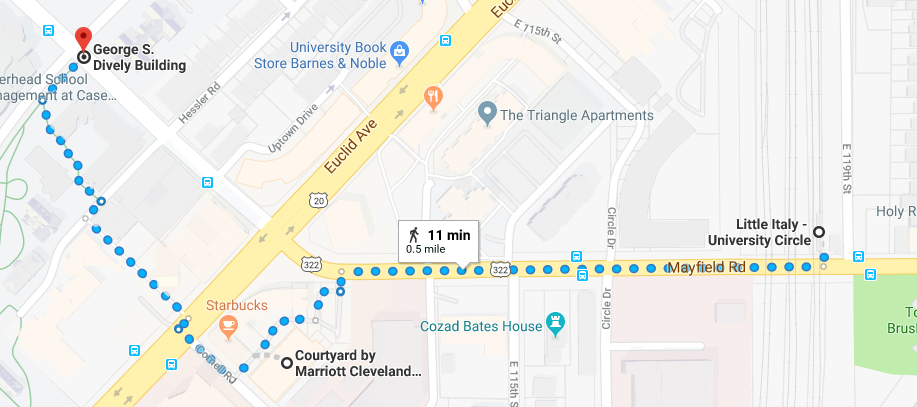
The Friday sessions and Saturday morning sessions will be held in the Premier Industrial Lecture Hall in the Dively Building on the CWRU campus. The Friday evening banquet will be held at Nighttown. On Saturday afternoon, proceedings will move to CWRU think[box] for workshops and demonstrations, as well as tours of the Case Amateur Radio Club, W8EDU. The conference will conclude with a screening of Contact at Strosacker Auditorium, presented by the CWRU Film Society.

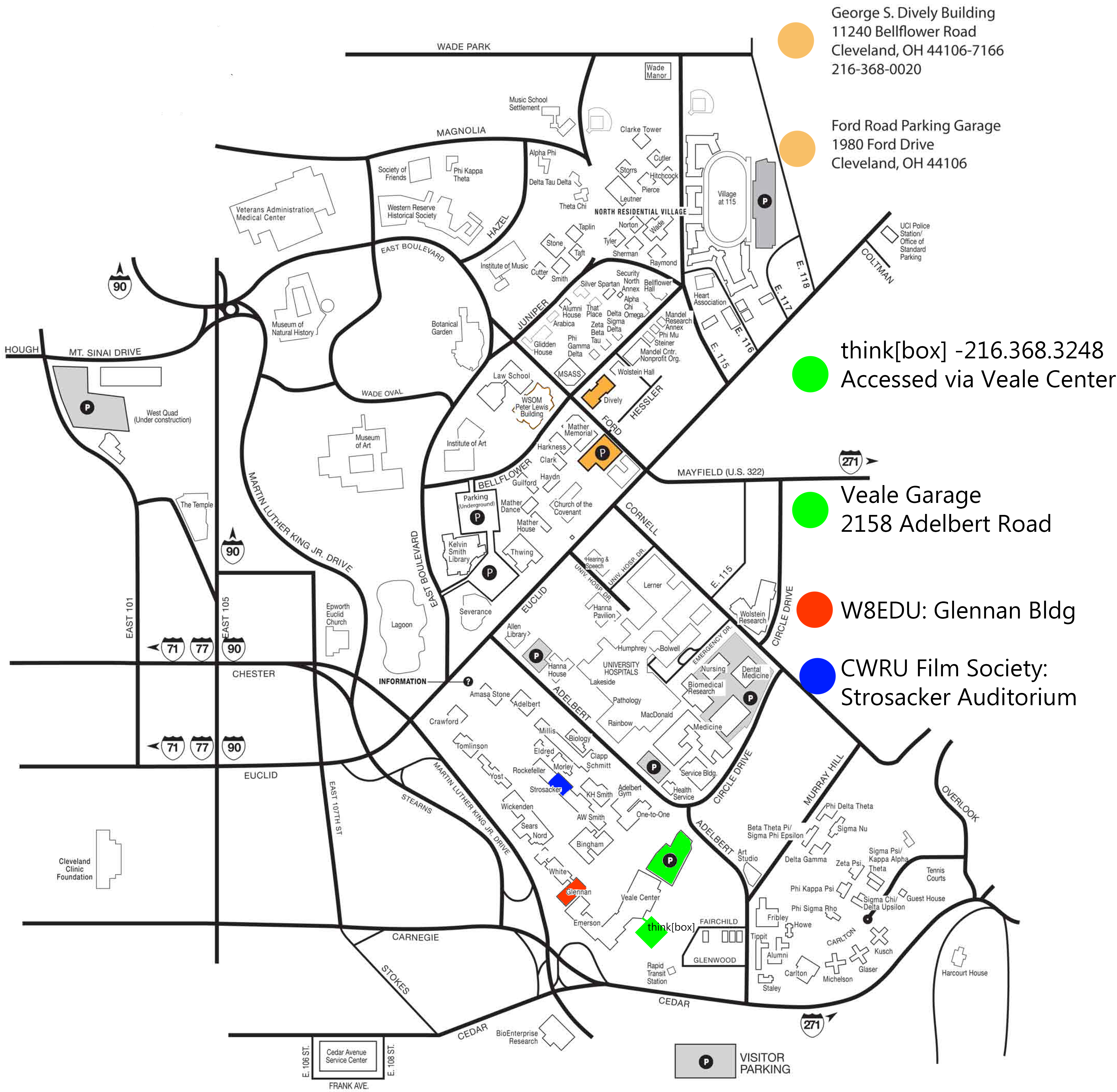
Paid parking is available near each venue. Near Dively, participants are advised to park in the Ford Garage. Parking for Nighttown is available next to the restaurant.  When visiting think[box] and the other destinations on the Case quad (W8EDU, Film Society), attendees should park in the Veale Garage and enter think[box] through Veale Center.

HamSCI_2019_CWRU_Parking.png

Breakfasts, Lunches, and Friday Banquet

Breakfasts, lunches, and coffee breaks are included with registration for both Friday and Saturday. Special dietary needs can be specified when registering.

The Friday Banquet Dinner will be hosted at Nighttown, with keynote speaker Ward Silver N0AX. Banquet tickets are included with Friday registration. Separate/additional banquet tickets may be purchased for $50 each.

Nighttown
12383 Cedar Rd
Cleveland, OH 44106


Lodging

A block of hotel rooms has been reserved at the Cleveland Courtyard by Marriott, a short walk from the Dively Building. For the nights of March 21, 22, and 23, rooms are available at the CWRU nightly rate of $165. Participants may reserve a room by calling 1-800-MARRIOTT and identifiying themselves as part of the HamSCI group under CWRU. Reservations must be placed by March 1, 2019 in order to receive the discounted rate.

Other nearby hotel options include Glidden House, a short walk from the conference, and the Tudor Arms Hotel, a short drive.

Flight Information and Ground Transportation

Easy access to CWRU and the HamSCI meeting is available through the RTA Red Line, which connects directly to Cleveland Hopkins International Airport. If coming from the airport, take the Red Line to the Little Italy station.

Talk-In Frequencies

Every party should have a call-in frequency; if you have an HT, check in en route to ask directions or say hello.

  • Primary Simplex: 146.55 MHz
  • Secondary Simplex: 432.10 MHz
  • Repeater: KD8LDE/R 442.28750 MHz + 131.8 Hz

Local Organizing Committee

  • Ms. Kristina Collins, KD8OXT, Chair
  • Dr. David Kazdan, AD8Y, Advisor
  • Mr. Nathaniel Vishner, KB1QHX

Science/Program Committee

  • Dr. Nathaniel Frissell, W2NAF, NJIT, Chair
  • Dr. Phil Erickson, W1PJE, MIT Haystack Observatory
  • Dr. Ethan Miller, K8GU, JHU/APL
  • Mr. Bill Liles, NQ6Z, HamSCI Community

Questions?

If you have questions, please e-mail [email protected]. Logistics questions will be directed to Kristina Collins, KD8OXT (216-368-3579) and science/program questions will be directed to Nathaniel Frissell, W2NAF (973-787-4506).


cwru_logo.png NSF Logo

NJIT_C_PF_noReg.jpg

The 2019 HamSCI Workshop is hosted by Case Western Reserve University in collaboration with the New Jersey Institute of Technology. Financial support is provided by the United States National Science Foundation.
 

Switch to plain text editor More information about text formats Text format Web page addresses and e-mail addresses turn into links automatically. Convert [icon:%bundle:%icon] tags. Global tokens will be replaced with their respective token values (e.g. HamSCI or Publications). Lines and paragraphs break automatically. Image Files must be less than 512 MB. Allowed file types: png gif jpg jpeg. FILE Add a new file Files must be less than 512 MB. Allowed file types: txt. HIDDEN IMAGES Add a new file Files must be less than 512 MB. Allowed file types: png gif jpg jpeg. Vertical Tabs Menu settings Not in menu (active tab) URL path settings Alias: hamsci2019 Revision information New revision URL redirects 1 enabled redirect Authoring information By kd8oxt on 2018-12-01 23:56:35 -0500 Publishing options Published Provide a menu link Query Home Dashboard Content Structure Appearance People Modules Configuration Reports Help Log out Hello jwalker

Keegan


NOTICE: Web-page Under Construction

All Information is Tentative

hamsci savethedate.png


Come join HamSCI at its second annual workshop! The workshop will be held March 22-23, 2019 at Case Western Reserve University in Cleveland, OH and seeks to bring together the amateur radio community and professional scientists. Anyone interested in this workshop is invited to join.

Cost and Registration

  • Friday Registration: $100 (Includes Breakfast, Lunch, and Banquet Ticket)
  • Saturday Registration: $50 (Includes Breakfast, Lunch, and Dinner)
  • Friday Banquet Ticket Only: $50

Call for Speakers

We are especially looking for speakers with presentations showing analysis of ionospheric observations, ideas and proposals for the design of the Personal Space Weather Station and instrumentation for the 2024 eclipse. We will also accept other presentations related to amateur radio and science. Presentations will be in the form of oral talks, posters, lightning talks, and demo room tables. Abstract and acceptance and presentation format will be chosen by the Science Program Committee. If you would like to present, please e-mail your abstract to Nathaniel Frissell, W2NAF, at [email protected] by February 10, 2019. Presenters will be notified by March 1, 2019.

In your abstract e-mail to [email protected], please include:

  • Title of Presentation
  • Name of Presenter
  • Co-Author List with Call Signs and Affiliations
  • Abstract, limited to 1 paragraph and 350 words
  • Request of presentation or demo room table

You may request a poster presentation format. Due to time constraints requests for oral presentation slots are not guaranteed.

Program

This year’s theme will be “Ionospheric Effects and Sensing,” which includes the use of amateur radio techniques for the characterization and study of ionospheric phenomena such as traveling ionospheric disturbances, sporadic E, response to solar flares, geomagnetic storms, the 2024 total solar eclipse other space weather events. In order to facilitate this science, continued development of the HamSCI Personal Space Weather Station and discussion of integration of amateur radio into the collegiate curriculum will also take place. Featured speakers include well-known amateur radio author Ward Silver, N0AX, propagation specialist Carl Luetzelschwab, K9LA, and MIT Haystack Observatory Ionospheric Scientist Dr. Larisa Goncharenko. We will also accept presentations relating to amateur radio and science, particularly space and atmospheric science, space weather, and radio astronomy. 

On Saturday afternoon, after lunch, the conference proceedings will continue at CWRU's think[box], a student manufacturing facility and makerspace that is open to the public. Attendees will participate in tours of think[box] facilities; tours of the Case Amateur Radio Club, W8EDU; and an amateur radio licensing session. There will also betime available for breakout sessions and committee discussions. The conference will close on Saturday evening with a screening of Contact at CWRU Film Society. Tickets to the film are complimentary with a conference badge.

View Agenda, Videos, and Presentation PDFs


Friday Keynote: Tim Duffy, K3LR

Tim Duffy Photo
Tim has been an active amateur radio operator for 47 years. He has hosted 132 different operators from around the world as part of the K3LR Multi-Multi DX radio sport contest efforts since 1992. He was the ARRL Atlantic Division Technical Achievement award winner in 1998. Tim has been the moderator of the Hamvention Antenna forum for 34 years. K3LR serves as chairman of Contest University (13 years), the Dayton Contest Dinner (27 years), chairman of the Top Band Dinner – as well as coordinator of the Contest Super Suite (34 years) in Dayton during the yearly Hamvention. He is founder and moderator of the popular RFI Reflector ([email protected]) since 1999. Tim serves on the board of directors of the World Wide Radio Operators Foundation (WWROF) as Chairman and is President Emeritus of the Radio Club of America (RCA). Tim is President of the Mercer County Amateur Radio Club (W3LIF). Tim was elected to the CQ Contest Hall of Fame in 2006. He was honored with the prestigious Barry Goldwater Amateur Radio service award by the RCA in 2010. K3LR was honored as Hamvention Amateur of the Year in 2015 by the Dayton Amateur Radio Association. Tim is the Chief Operating Officer and General Manager at DX Engineering. He is a graduate of the Pennsylvania State University

Invited Talk: Carl Luetzelschwab, K9LA, "Ham Radio for Space Scientists"

Carl Luetzelschwab Photo
Carl started his radio career as a shortwave listener in the late 1950s, and received his Novice license (WN9AVT) in October 1961. He selected K9LA in 1977. He enjoys propagation, DXing (he’s at the top of the Honor Roll), contesting (he was NCJ Editor from 2002-2007), playing with antennas and fixing/using vintage equipment. Carl is a graduate of Purdue University (BSEE 1969, MSEE 1972) and worked for Motorola and Magnavox/Raytheon as an RF design engineer (mostly designing solid-state RF power amplifiers). He retired in October 2013. He and his wife Vicky (AE9YL) reside in Fort Wayne and enjoy traveling, which has included DXpeditions to Syria, Market Reef and numerous trips to the Cayman Islands. Carl is currently the ARRL Central Division Vice Director. He has received the Bill Orr W6SAI Technical Writing Award, the YASME Foundation Excellence Award and the Indiana Radio Club Council Technical Excellence Award.

Invited Talk: Dr. Larisa Goncharenko, "Space Science for Ham Radio Operators"

Larisa Goncharenko Photo
Dr. Larisa Goncharenko is a research scientist at the Haystack Observatory, Massachusetts Institute of Technology. Her major areas of interest are ionospheric-thermospheric coupling, and the dynamics and electrodynamics of the ionosphere and thermosphere, with an emphasis on processes in the lower thermosphere and coupling with lower altitudes. Goncharenko's undergraduate and graduate education was in Physics (High Honors), 1988, at Kharkiv National Polytechnic University, Kharkiv, Ukraine. She has held research positions at Kharkiv National Polytechnic University (1988-1996) and Haystack Observatory, MIT (Visiting Scientist, 1994-1995; Postdoctoral Fellow, 1996-1997; Research Scientist, 1997 to present). Goncharenko's research in Ukraine was focused on ionospheric modification by HF heating facility (similar to those in Arecibo or EISCAT) and diagnostics of modifications with the Kharkov incoherent scatter radar. Her research at MIT includes experimental studies using multiple incoherent scatter radars, GPS TEC data, ionosondes, satellite data, and collaborations with multiple modeling groups. She is the recipient of the CEDAR Prize Lecture award (2012), NASA Group Achievement Award (2008), and an MIT Excellence Award (2003). She is the author or coauthor of more than 70 refereed publications.

Meeting Location and Parking

The Friday sessions and Saturday morning sessions will be held in the Premier Industrial Lecture Hall in the Dively Building on the CWRU campus. The Friday evening banquet will be held at Nighttown. On Saturday afternoon, proceedings will move to CWRU think[box] for workshops and demonstrations, as well as tours of the Case Amateur Radio Club, W8EDU. The conference will conclude with a screening of Contact at Strosacker Auditorium, presented by the CWRU Film Society.

Paid parking is available near each venue. Near Dively, participants are advised to park in the Ford Garage. Parking for Nighttown is available next to the restaurant.  When visiting think[box] and the other destinations on the Case quad (W8EDU, Film Society), attendees should park in the Veale Garage and enter think[box] through Veale Center.

HamSCI_2019_CWRU_Parking.png

Breakfasts, Lunches, and Friday Banquet

Breakfasts, lunches, and coffee breaks are included with registration for both Friday and Saturday. Special dietary needs can be specified when registering.

The Friday Banquet Dinner will be hosted at Nighttown, with keynote speaker Ward Silver N0AX. Banquet tickets are included with Friday registration. Separate/additional banquet tickets may be purchased for $50 each.

Nighttown
12383 Cedar Rd
Cleveland, OH 44106


Lodging

A block of hotel rooms has been reserved at the Cleveland Courtyard by Marriott, a short walk from the Dively Building. For the nights of March 21, 22, and 23, rooms are available at the CWRU nightly rate of $165. Participants may reserve a room by calling 1-800-MARRIOTT and identifiying themselves as part of the HamSCI group under CWRU. Reservations must be placed by March 1, 2019 in order to receive the discounted rate.

Other nearby hotel options include Glidden House, a short walk from the conference, and the Tudor Arms Hotel, a short drive.

Flight Information and Ground Transportation

Easy access to CWRU and the HamSCI meeting is available through the RTA Red Line, which connects directly to Cleveland Hopkins International Airport. If coming from the airport, take the Red Line to the Little Italy station.

Talk-In Frequencies

Every party should have a call-in frequency; if you have an HT, check in en route to ask directions or say hello.

  • Primary Simplex: 146.55 MHz
  • Secondary Simplex: 432.10 MHz
  • Repeater: KD8LDE/R 442.28750 MHz + 131.8 Hz

Local Organizing Committee

  • Ms. Kristina Collins, KD8OXT, Chair
  • Dr. David Kazdan, AD8Y, Advisor
  • Mr. Nathaniel Vishner, KB1QHX

Science/Program Committee

  • Dr. Nathaniel Frissell, W2NAF, NJIT, Chair
  • Dr. Phil Erickson, W1PJE, MIT Haystack Observatory
  • Dr. Ethan Miller, K8GU, JHU/APL
  • Mr. Bill Liles, NQ6Z, HamSCI Community

Questions?

If you have questions, please e-mail [email protected]. Logistics questions will be directed to Kristina Collins, KD8OXT (216-368-3579) and science/program questions will be directed to Nathaniel Frissell, W2NAF (973-787-4506).


cwru_logo.png NSF Logo

NJIT_C_PF_noReg.jpg

The 2019 HamSCI Workshop is hosted by Case Western Reserve University in collaboration with the New Jersey Institute of Technology. Financial support is provided by the United States National Science Foundation.
 

NSF Awards Grant for the Development of the HamSCI Personal Space Weather Station

By Stan Zygmunt, University of Scranton

A $1.3 million National Science Foundation (NSF) grant awarded to University of Scranton physics and electrical engineering professor Nathaniel Frissell, Ph.D., seeks to harness the power of a network of licensed amateur radio operators to better understand and measure the effects of weather in the upper levels of Earth’s atmosphere.

The highly-competitive grant awarded by NSF’s Aeronomy Program for the project titled Distributed Arrays of Small Instruments (DASI) will be implemented over a three-year period. As lead principal investigator, Dr. Frissell, a space physicist, will lead a collaborative team that will develop modular, multi-instrument, ground-based space science observation equipment and data collection and analysis software. He will also recruit multiple universities and ham radio users to operate the network of “Personal Space Weather Stations” developed.

The space weather equipment will be developed at two levels of sophistication: one at a low-cost, easy-to-use level for the ham radio operators; and one that is more complex for university partners that will allow for the collection of additional data.

“The equipment and network allows us to measure and characterize ionospheric and geomagnetic short-term, small scale variability on a large geographic scale in order to understand the response of the ionosphere to sources from above (space weather) and below (atmospheric forcing),” said Dr. Frissell in the grant project proposal. “By designing Personal Space Weather Stations variants at multiple price points, open sourcing the hardware and software, and directly engaging with the ham radio community, this project maximizes the chances of widespread adoption of this system.”

In the U.S., there are more than 730,000 licensed amateur radio operators and nearly 3 million worldwide. For this initiative, Dr. Frissell will target the ham radio community through the Ham Radio Science Citizen Investigation collective, which he leads, and the TAPR (Tucson Amateur Packet Radio) amateur radio engineering organization.

According to Dr. Frissell, measuring and better understanding modulations in the upper atmosphere – specifically the ionosphere – is important because these changes can affect radio transmissions as well as satellites, which then can affect the internet, cellphones, GPS systems and more. He also explained that radio remains a very important communication tool because it is a way of communicating worldwide that doesn’t rely on infrastructure. Radio communications can bounce (refract) off the ionosphere and return to earth. This process can repeat multiple times – for example, allowing people in the U.S. to communication with people in Australia – without the use of expensive satellites.

Already published research by Dr. Frissell using data collected by existing Ham radio users shows the sensitivity of the existing technology and the capacity of network of licensed radio enthusiasts to measure modulations produced in the ionosphere. In the study “Modeling Amateur Radio Soundings of the Ionospheric Response to the 2017 Great American Eclipse,” published in Geophysical Research Letters, Dr. Frissell measured changes in the ionosphere during the solar eclipse. The data he used was collected by hundreds of licensed ham radio operators in the U.S. who participated in a contest he ran that allowed him to collect the data he needed for the analysis. The new initiative expands this model and provides additional equipment to add to the data to be collected and analyzed.

Collaborators in the NSF funded DASI project with Dr. Frissell include: William Engelke and Travis Atkison, Ph.D., of the University of Alabama; David Kazdan, Ph.D., and Soumyajit Mandal, Ph.D., of Case Western University; Hyomin Kim, Ph.D., of the New Jersey Institute of Technology Center for Solar-Terrestrial Research; Phil Erickson, Ph.D., of MIT’s Haystack Observatory; and Scotty Cowling of TAPR and Zephyr Engineering; among others.

Dr. Frissell joined the faculty at Scranton in the fall of 2019. He earned a doctorate and a master’s degree in electrical and computer engineering from Virginia Polytechnic Institute and State University in Blacksburg, and a bachelor’s degree in physics and music education from Montclair State University in New Jersey. He is the founder and lead organizer of the international citizen science space physics research collective known as the Ham Radio Science Citizen Investigation (HamSCI.org).

TangerineSDR Mockup at ARRL-TAPR Digital Communications Conference

As part of the HamSCI Personal Space Weather Station project, TAPR is charged with developing a Scientific Software Defined Radio that operates from a few kHz up to 30 MHz with a focus on flexibility, high precision stability, and accurate time stamping. TAPR has taken this charge to develop the TangerineSDR, a modular software defined radio that will not only meet HamSCI's PSWS needs, but also many other applications. In the videos below, the chief architect of the TangerineSDR, Scotty Cowling, WA2DFI, shows off a mock-up of the new radio at the 39th Annual ARRL-TAPR Digital Communications Conference that took place in Detroit, MI from September 11-13, 2020. People who would like to participate in PSWS and TangerineSDR development are encouraged to visit tangerinesdr.com, join the TAPR TangerineSDR listserv, and join in the Monday night TeamSpeak telecons.


WWV Centennial Festival of Frequency Measurements

HamSCI and the Case Amateur Radio Club W8EDU is sponsoring a distributed experiment during the WWV 100th anniversary celebrations.  The Festival of Frequency Measurement invites all interested to record WWV's 5 MHz carrier for the UTC day 1 October 2019--and then to upload the resulting data file.  Amateur radio operators, shortwave listeners, physics laboratories, and anyone else with a radio receiver and computer may participate.

The data will be collated into a study of one day in the life of the ionosphere.  Maybe that day will mark a solar storm and an actively changing ionosphere; maybe it will only have the basic daily rhythm of sunup and sunset shaping the layers.  We will find out!  This is a study in the function of personal space weather stations and will be extended into future work.

Instructions for setting up the fldigi frequency analysis software and for participating in the Festival may be found on the HamSCI Festival of Frequency Measurement Page.

We recommend that you practice recording the files and renaming them for upload a few times before the event.  Note that 1 October 2019 UTC will begin Monday evening in the Americas.

WWV Centennial Festival of Frequency Measurements

Looking for information on the June Eclipse Festival of Frequency Measurement? Click here to be redirected.

8 December 2019: Data from the FFM is currently being processed.If you submitted data to the Festival of Frequency Measurement, and your callsign is omitted from the list below, contact [email protected]:
AA8K, AC6SL, AG7PQ, AJ4YA, K0ANS, K2LYV, K4BSE, K7JKM, K7KMQ, KA6WKE, KE0ARE, KG4ARN, KM4YMI, N1IRO, N1NAZ, N2MD, N7IVV, N7QNM, N7XZ, N8OBJ, N9MVO, NA0B, NU0C, VA3ROM, VE3OAT, VE3YX, VE6GRT, VE6IXD, VE7CNF, VK3ZAZ, W1KU, W3FAY, W6BM, W6MSU, W6OQI, W8EDU, W9INE, WA5FRF, WA7BNM, WB4HIR, WB6HYD, WV5L, WX4US, XE3I

Data is available at https://zenodo.org/record/3707210.

Wednesday, 25 September 2019: This page is in (mostly) final form
(one week before the event)
The page may change in small details, but please plan your activities on these instructions.
 
We celebrate the centennial of National Institute of Standards and Technology radio station WWV with

The Festival of Frequency Measurement

01 October 2019 0000 to 2359 UTC
(begins Monday evening 30 September 2019 in the Americas)

Introduction

Changes in ionospheric electron density caused by space weather and diurnal solar changes are known to cause Doppler shifts on HF ray paths. For example, see Figure 7 in Boitman et al., 1999. HamSCI's first attempt at a measurement of these Doppler shifts was during the August 2017 total solar eclipse.  We plan a careful measurement during the 2024 eclipse.
As part of the WWV centennial, HamSCI and the Case Amateur Radio Club of Case Western Reserve University W8EDU request that all amateur radio stations, shortwave listeners, and others capable of making high-quality HF frequency measurements participate in the next "phase" of this experiment and publish their data to the HamSCI community on the open-data sharing site zenodo.org.
 

Contact information:

https://groups.google.com/forum/#!forum/festival-of-frequency-measurement/join

David Kazdan: [email protected]

Research Questions

  • How does WWV 5 MHz's HF propagation path vary over one UTC calendar day?
  • How do various measurement techniques for understanding the path variation compare?

Objective

  • Measure Doppler shifts caused by space weather's effects on the ionosphere.
  • Use a specified measurement protocol available to amateur radio operators and other citizen-scientists.

Times

  • (Control Day was 01 August 01 2019, 0000 – 2359 UTC)
  • Centennial Day: 01 October 2019, 0000 – 2359 UTC
Please begin measurements before the day's start time and end them after the finish time, if possible.

The Beacons

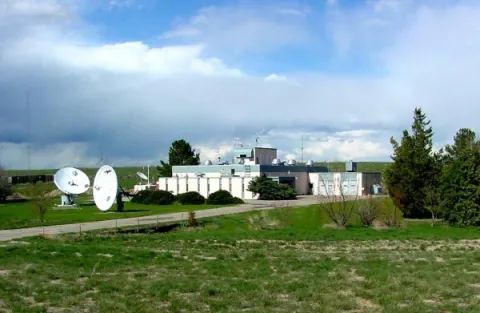
The NIST beacon station WWV in Fort Collins, Colorado, USA (and co-located WWVB) is shown here:

WWV broadcasts on 2.5, 5, 10, 15, 20, and 25 MHz.  This experiment will use only the 5 MHz transmissions. If you want to participate and cannot record the 5 MHz signal, use whichever WWV frequency you can and make sure the file is labeled appropriately.


The recordings in this experiment are expected to show formations of the D-layer at stations' local sunrise and other daily events of the ionosphere.  Space weather varies day to day and some features may be prominent.  We'll see what we get!


Procedures

1) Prepare Your Receiver, Computer, and Software (fldigi)

Use your most stable receiver.  Use a good sound card (the one inside your receiver, if it is so equipped).
Fldigi has a mode called "WWV" for calibrating the soundcard.  Run it if you can easily; if not, leave your soundcard as is and we will adjust the file if necessary.
We specifically request that you use of the open-source software package fldigi.  Its "frequency analysis" mode generates a file of frequency deviations, automatically named "analysis.csv." It will be in the directory /fldigi/temp/, or .fldigi/temp/, or some equivalent.
  • Download fldigi, install it, verify that it's working correctly.  Find the "frequency analysis" module in the "op mode" pulldown menu.
  • Set your receiver's mode to USB (upper sideband).  Tune an AM station's carrier to 1000 Hz audio by setting your receiver that much below the carrier frequency.  For 5 MHz WWV, tune to 4.999 MHz and listen for the 1000 Hz tone (musicians: 1000 Hz is musically below C two above middle C [i.e., C6] if you want to check that way).
  • Look for the 1000 Hz line on fldigi's waterfall.  Click the cursor there or use the offset frequency box at the bottom of fldigi's screen.  Look for "writing CSV file" on the lower line of fldigi, toward the left.
  • Now, leave fldigi alone.  Every time you make a change or move that cursor, the CSV file ("comma-separated variables," the data file you're recording) will be erased and a new one started.  It's maddeningly easy to delete your work and fldigi does not make a backup.
  • Robert, VA3ROM, has offered a batch file for automating the renaming.  It is for Windows.  It may be found at the end of this document; use it if you wish but do try it before the event.
  • At the end of your recording period, close fldigi. The file "analysis.csv" should be in your /fldigi/temp/ directory.
  • Try all this before the day of the event.

2) Collect the data: Make sure Windows cannot be shut down by an automatic update!

  • Start as above. Now, leave fldigi alone.  Every time you make a change or move that cursor, the CSV file ("comma-separated variables," the data file you're recording) will be erased and a new one started.  It's maddeningly easy to delete your work and fldigi does not make a backup.
  • At the end of your recording period, close fldigi. The file "analysis.csv" should be in your /fldigi/temp/ directory.
  • Rename the file with your callsign and location.
  • Again, try all this before the day of the event.

3) Rename the Data File

  • You should finish with one data file named "analysis.csv". It should be about 2 MB.
  • Rename it with your callsign and location and frequency: "AD8Y 41.49 -81.58 5 MHz.csv"
  • Use the Maidenhead locator if you don't have latitude/longitude: "AD8Y EN91fl 5 MHz.csv"

4) Upload to Zenodo

We ask that all data generated by these experiments be uploaded to the HamSCI community on zenodo.org. The upload should include your .csv file from fldigi; you may upload other files that you feel are pertinent. By uploading to zenodo.org, a permanent, citable, centralized record of the data that is openly available to both researchers and the general public will be created. 
 
To upload your data create an account on https://zenodo.org. You can create a login using your github account or via their account creation. Once you have an account and you are logged into the service visit “https://zenodo.org/deposit/new?c=hamsci”. Select your file(s), click “Start Upload”, select “Dataset” as your upload type, fill in all relevant information regarding contributors, and finally click "Save" and then “Publish” in the bottom right.
 
Here is an example completed Zenodo sample upload.

Data Description

In the data description box, please include: "Festival of Frequency Measurement 1 October 2019

Data Notes

Also in the Data Description box, you may include your personal comments regarding your observations. The "Description" block accepts multiple lines.

  • Your Name and Callsign
  • Latitude and Longitude of the Recording
  • Start time of the .csv file
  • A description of station hardware configuration, including
    • Antenna type
    • Antenna pointing direction (if applicable)
    • Receiver type
    • Frequency reference type
    • Frequency measurement technique
  • Any other information you believe would be necessary for proper scientific interpretation of your measurements

If you find it helpful, you may copy the following template and include it with your submission. Again, you are encouraged to include any other information you feel may be helpful.


Festival of Frequency Measurement Submission

—-

event: WWV Centennial

UTC date:

beacon frequency:


station name:

latitude and longitude and/or maidenhead grid square: 

city:

state or region:


Difficulties had:


Anything you know about the stability of your equipment:


soapbox:


Data License

Please license your data as:

  • Open Source
  • Creative Commons Attribution 4.0


----------------------------------------------------------------

VA3ROM batch file:

rem -----------------------------------------------------------------------
 
rem Set fldigi.files directory path for your specific system
set "FLDIGI=c:\Users\Administrator\fldigi.files\temp\"
 
rem Default fldigi frequency analysis file name
set "FILE=analysis.csv"
 
rem Save copy of analysis file with date/time stamp if it exists
if exist %FLDIGI%%FILE% goto save
 
rem Tell user what has happened
@echo File "analysis.csv" not found . . .
 
pause
 
exit
 
:save
    
rem Get current computer system date/time
for /f "tokens=2 delims==" %%a in ('wmic OS Get localdatetime /value') do set "dt=%%a"
 
rem Break up date/time into separate variables (local time used unless clock set to UTC)
set "YY=%dt:~2,2%" & set "YYYY=%dt:~0,4%" & set "MM=%dt:~4,2%" & set "DD=%dt:~6,2%"
   set "HH=%dt:~8,2%" & set "Min=%dt:~10,2%" & set "Sec=%dt:~12,2%"
 
rem Rebuild date/time stamps into ISO standard format YYYYMMDDHHMMSS
set "datestamp=%YYYY%%MM%%DD%" & set "timestamp=%HH%%Min%%Sec%"
   set "fullstamp=%YYYY%-%MM%-%DD%-%HH%%Min% UTC"
 
rem Copy old analysis file into new one with appended date/time stamp (fldigi will delete old analysis.csv file on startup)
copy %FLDIGI%%FILE% %FLDIGI%"analysis_%fullstamp%.csv"
 
rem Tell user what has happened 
@echo File "analsys.csv" copied using current date/time stamp . . .
 
pause
 
exit
 
rem -----------------------------------------------------------------------


Page Contributors: WA9VNJ, N8UR, W8RKO, W2NAF, KD2JAO, KM4EGE, AD8Y, KB3UMD, VA3ROM

Last edit: 19 Septembr 2019

Scientists and Amateur Radio Operators Come Together at the 2019 HamSCI Workshop

By Nathaniel A. Frissell (W2NAF), Philip J. Erickson (W1PJE), Ethan S. Miller (K8GU), William Liles (NQ6Z), Kristina Collins (KD8OXT), David Kazdan (AD8Y), and Nathaniel Vishner (KB1QHX)

Photo by Laura Gooch (N8NFE)

The Ham Radio Science Citizen Investigation (HamSCI) is an international collective of professional researchers and amateur radio operators working together to simultaneously advance the fields of space science and amateur (ham) radio activities. The 2nd US HamSCI meeting was held March 22-23, 2019, organized by Nathaniel Frissell of the New Jersey Institute of Technology (NJIT) and hosted by the Case Amateur Radio Club (Case ARC) at Case Western Reserve University (CWRU) in Cleveland, OH. The theme of this year’s meeting was “Ionospheric Effects and Sensing,” which includes the use of amateur radio techniques for the characterization and observational study of ionospheric phenomena such as traveling ionospheric disturbances, sporadic E, response to solar flares, geomagnetic storms, and other space weather events.

The annual HamSCI meeting is designed to provide an opportunity for both the amateur radio and professional research communities to come together and share ideas. There are over 730,000 hams in the United States, and about 3 million worldwide, ranging in age from very young to very old, and in experience from neophyte to highly experienced with advanced technical degrees. Hams are federally licensed and identified by a station call sign, such as W8EDU, the Case ARC call. Many hams have significant amounts of practical experience using their radios to communicate under all sorts of geophysical conditions, and have developed a keen observational ability to maximize their enjoyment and communications ability. This quality provides a unique perspective and excellent citizen science potentials when asking scientific questions or even analyzing observations. Conversely, the professional research community brings to the table a deep knowledge of space and ionospheric physics based on years of research, an understanding of where the boundaries of that knowledge lie, what science questions are of greatest interest in the field, and the rigor of the scientific process.

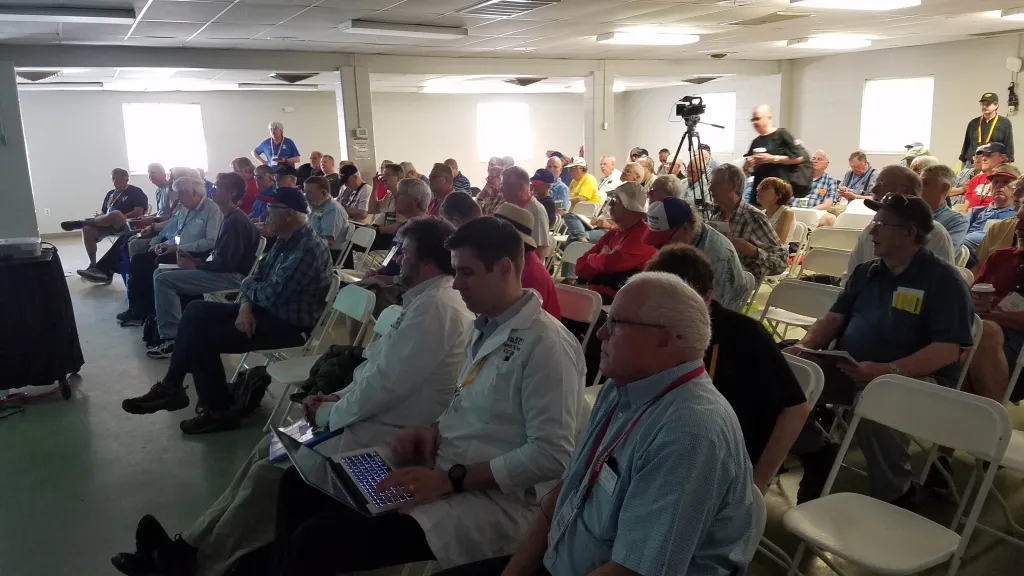
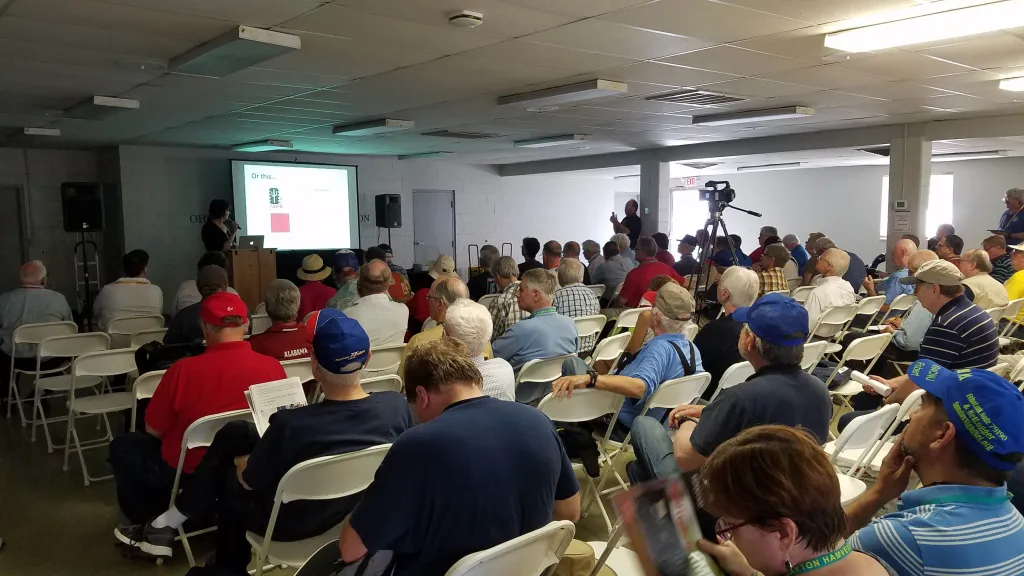
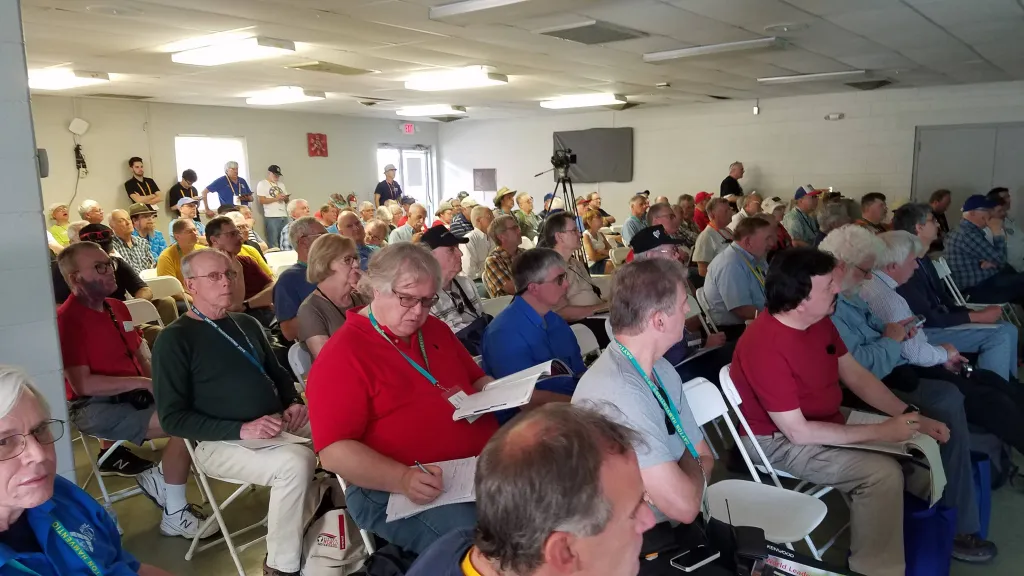
Every aspect of the HamSCI 2019 meeting was designed to create a forum that was both interesting and accessible to both the amateur and professional communities. The meeting took place on a Friday and Saturday, allowing both professionals and amateurs to attend at least one day. Friday was organized in the format of a traditional science workshop, with a full day’s program of oral technical and scientific presentations. Workshop participants presented results of experiments conducted using data from large-scale amateur radio observation networks such as the Reverse Beacon Network (RBN) and the Weak Signal Propagation Reporting Network (WSPRNet).  Also covered were Doppler shift and timing variability measurements using signals of opportunity such as US National Institute of Standards and Technology time dissemination station WWV, and discussions on plans for citizen science experiments studying ionospheric impacts of the upcoming 8 Apr 2024 total solar eclipse. On Friday afternoon, presentations focused on the design and development of a Personal Space Weather Station, a HamSCI project to create a citizen science device for making ground-based space weather measurements.

The Saturday program departed from the standard convention of oral technical presentations, including invited tutorials and a demonstration room, along with tours of the W8EDU Case Amateur Radio Station and the CWRU think[box] center for innovation and entrepreneurship. The invited tutorials entitled Ham Radio for Space Scientists and Space Science for Ham Radio Operators, were given by prominent amateur radio operator Carl Luetzelschwab, K9LA, and MIT Haystack Observatory Research Scientist Larisa Goncharenko, respectively. The demonstration room on Saturday afternoon featured hands-on presentations of new technologies by ham radio operators with the potential to be used as instrumentation in scientific investigations.

Amateur radio author Ward Silver, N0AX, addressed the workshop as keynote speaker on the Friday night banquet. “Science, Service, and Skill” are the words Silver emphasized in his talk, noting that the people at the HamSCI Workshop have the skills and desire to make meaningful contributions to science and create “Ham Radio 2.0.”

Space and radio science are now at a very exciting point in history, and the amateur radio community has both the technical skills and the desire to make significant contributions to these fields. By working with professional researchers who know the scientific process and open questions in the field, these efforts will be most fruitful. The 2019 HamSCI Workshop was able to successfully bring together leading members of both communities and has proven to be a fertile ground for the sharing and development of ideas between the amateurs and professionals. Workshop report, videos, and PDFs are available at https://hamsci.org/hamsci2019.

Acknowledgements

The 2019 HamSCI Workshop was hosted by the Case ARC W8EDU and Case Western Reserve University. The local organizing committee consisted of Kristina Collins (KD8OXT, Chair), David Kazdan (AD8Y, Advisor), and Nathaniel Vishner (KB1QHX). The Science/Program Committee comprised of Nathaniel Frissell (W2NAF, Chair, NJIT), Phil Erickson (W1PJE, MIT Haystack Observatory), Ethan Miller (K8GU, JHU/APL), and William Liles (NQ6Z, HamSCI Community). AV support was provided by George Byrkit (K9TRV, TAPR). We gratefully acknowledge the support of NSF Grant AGS-1916690.

AM Broadcast Observations of 2017 Solar Eclipse from Western America

HamSCI contributor Nick Hall-Patch, VE7DXR, presents observations of changes in AM Broadcast propagation during the 21 August 2017 Total Solar Eclipse. Full text of the article is available here.

This article starts with a brief description of historical observations that have been made concerning the effects of solar eclipses on the strengths of distant medium wave signals.  It continues with a description of how medium-wave DXers used software defined radios (SDRs) for the first time during the solar eclipse of August 2017 to record  the entire AM broadcast band (535-1705kHz) for later analysis.  Although no plan had been made to create a formal experiment, it appears to be possible to use the data collected to analyze the effect of the eclipse on radio propagation.  An example is presented, derived from recordings made at four different receiver locations in western North America, describing large variations in the signal strength from Salt Lake City's KSL-1160kHz during the course of the eclipse.  The times that peak signal strengths occurred at the four locations are then compared relative to the times of eclipse totality along the signal paths.

Nick Hall-Patch, VE7DXR, has been a radio amateur since 1989, but for many years previous to that, had been  interested in medium-wave DXing, particularly in the propagation of medium-wave signals from other continents. This interest has continued to the present day, though conclusions about propagation have not come as easily as observations.   Prior to retirement, Nick assisted oceanographic researchers by designing, building, modifying and maintaining electronic instrumentation.

NASA Photo / Carla Thomas / 21 August 2017

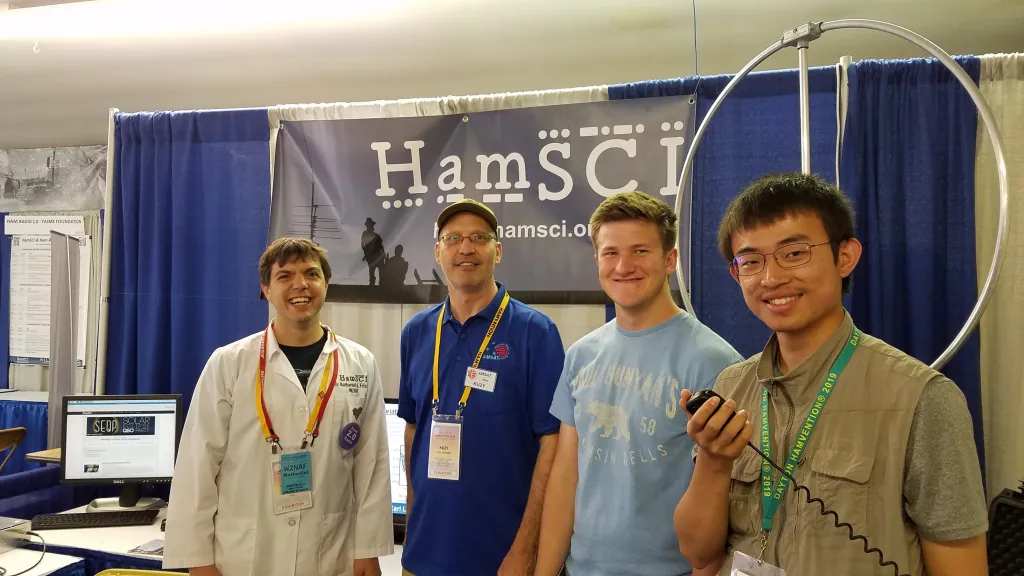
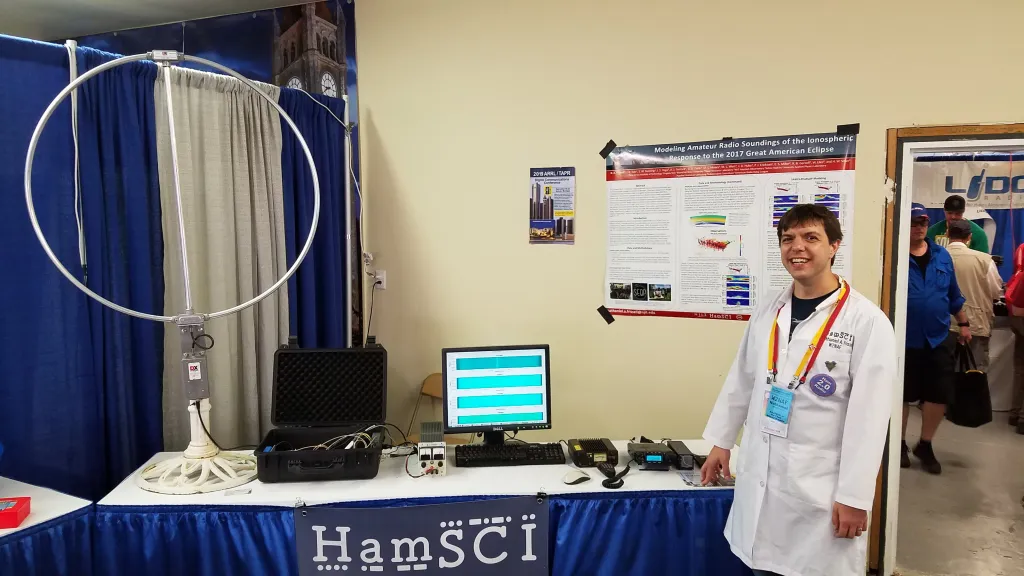
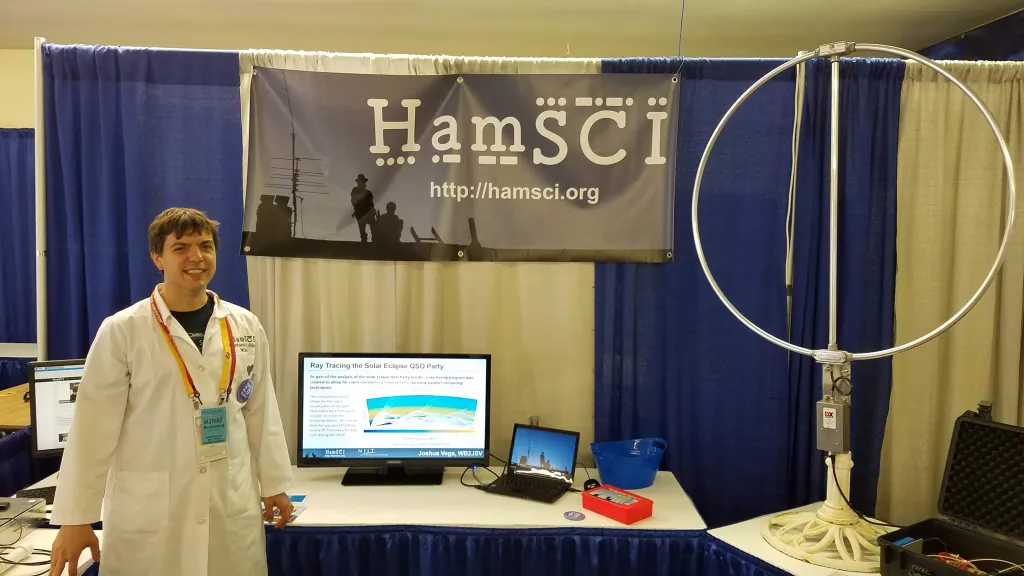
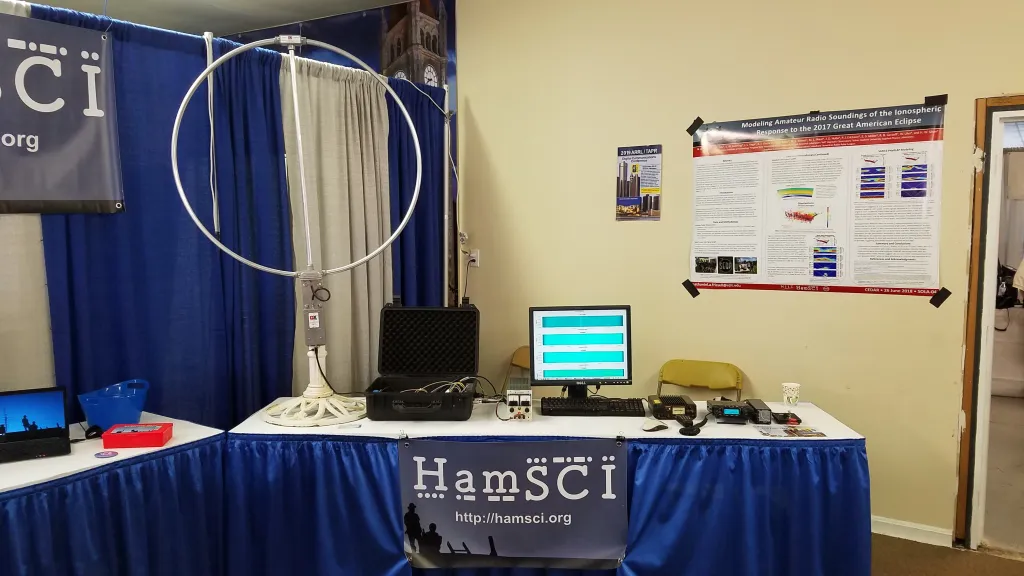
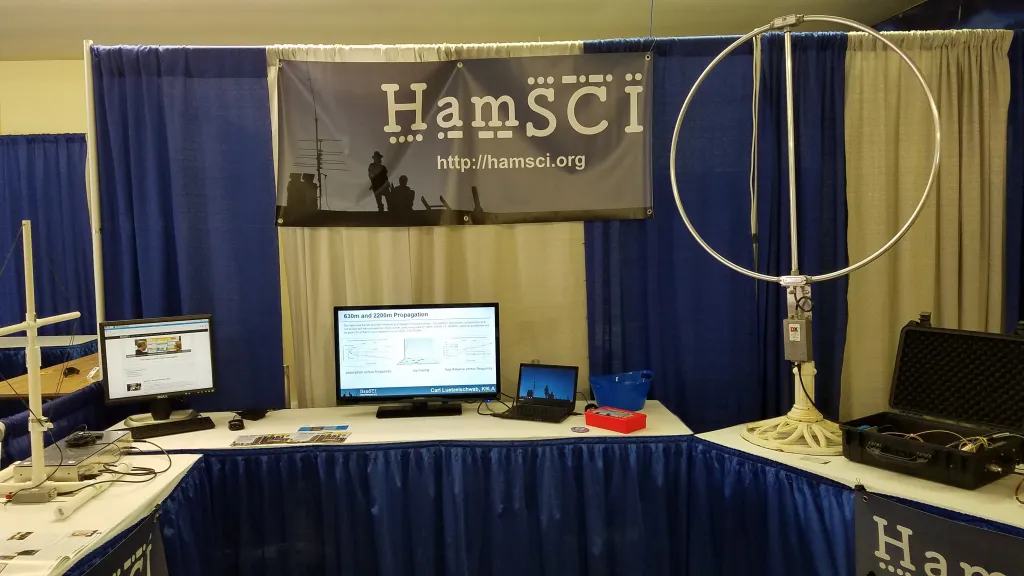
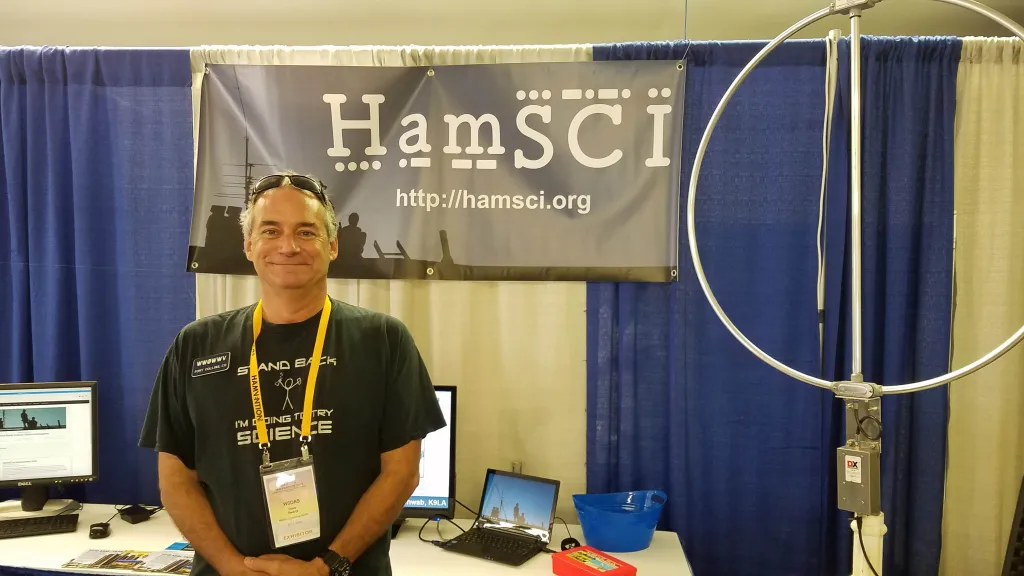
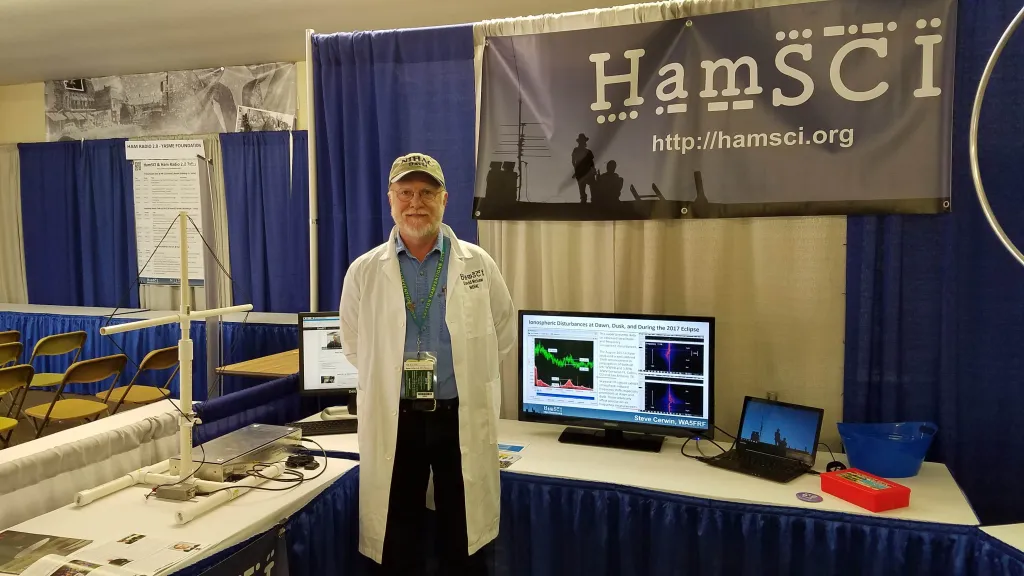
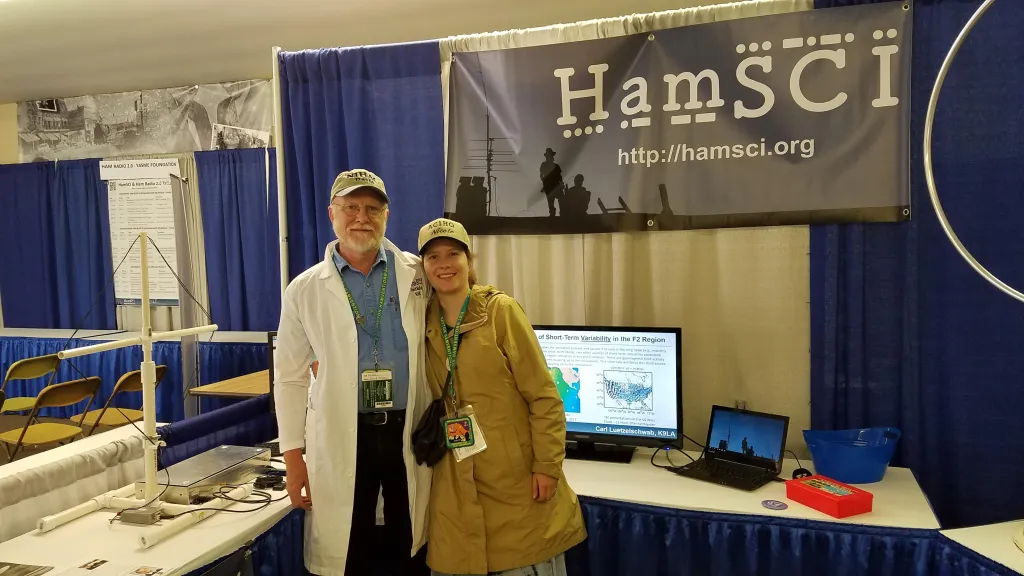
HamSCI at Hamvention 2019

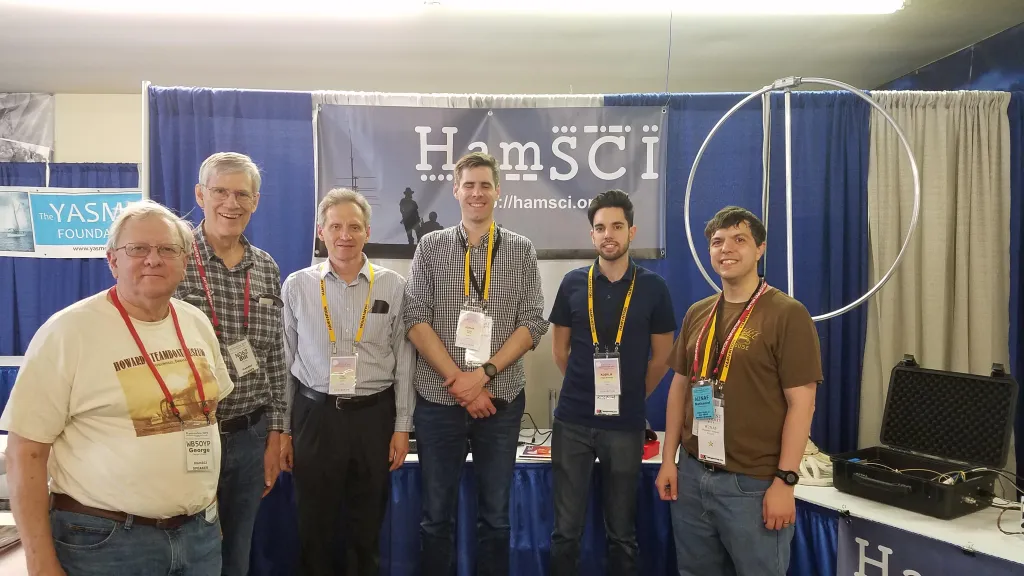
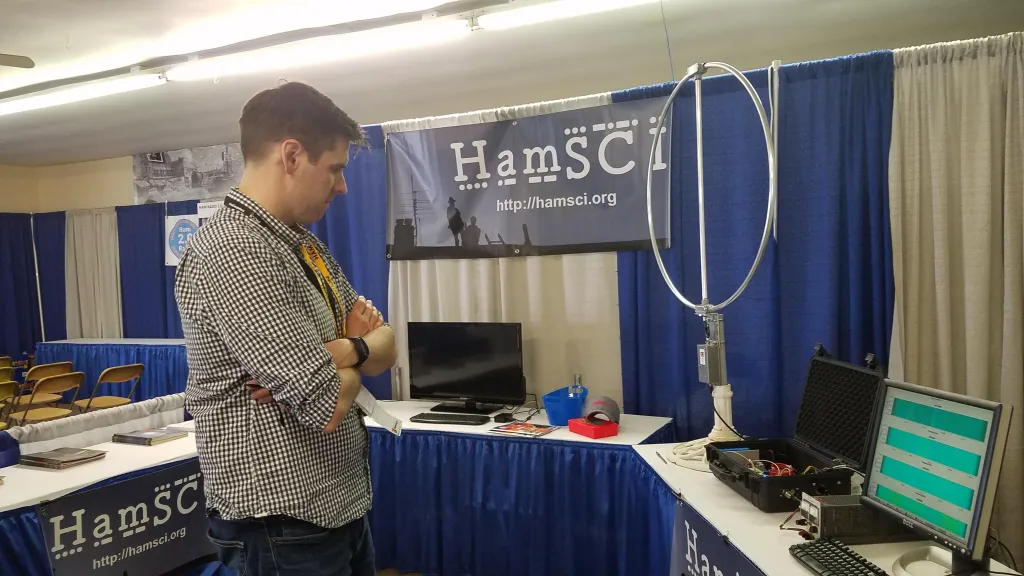
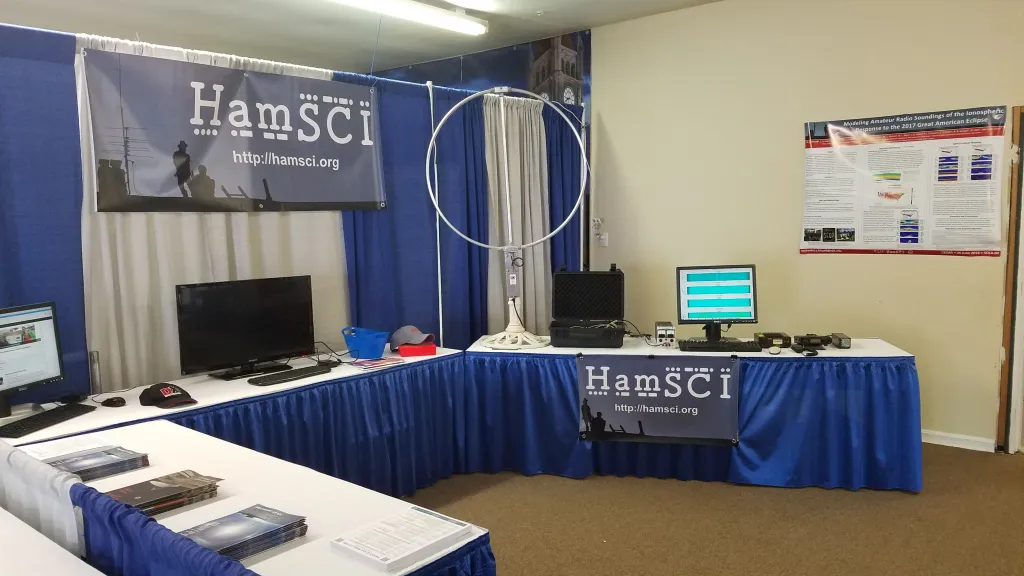
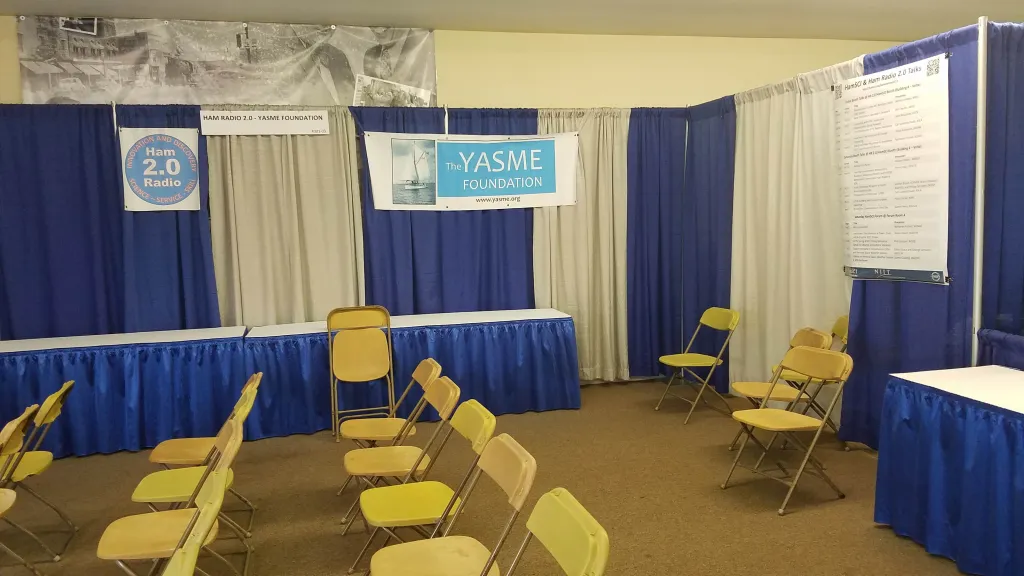
HamSCI will again be at the Dayton Hamvention as part of the new Ham Radio 2.0: Innovation and Discovery area sponsored by the Yasme Foundation. Come visit the HamSCI Booth and Forum to learn about projects on the cutting edge of ham radio science and engineering research, including new directions in Sporadic E research, causes of F region ionospheric variability, how propagation works on the new 630 and 2200 m bands, the Personal Space Weather Station, and more. Hamvention will be held May 17-19, 2019 at the Greene County Fairgrounds in Xenia, Ohio.
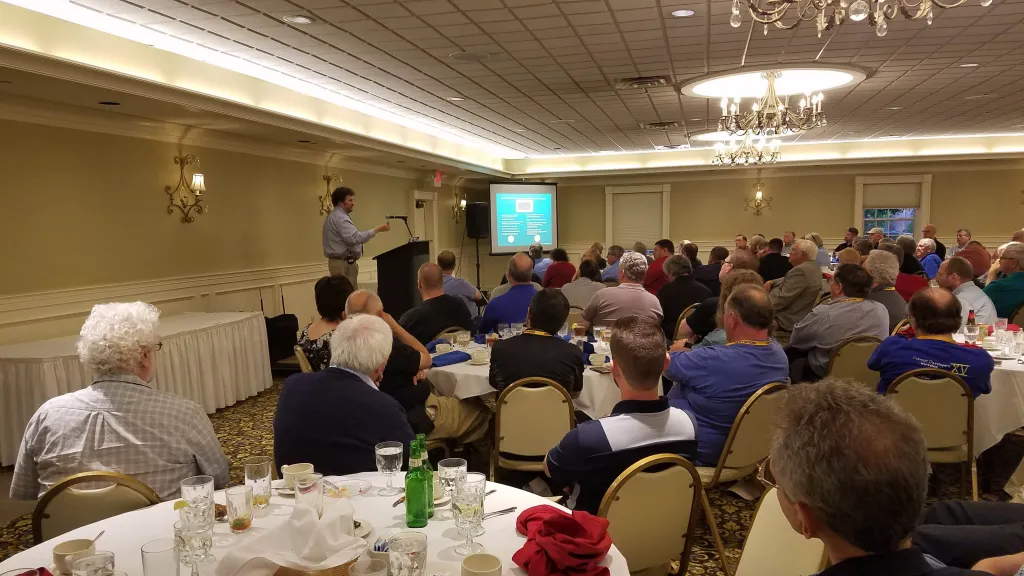
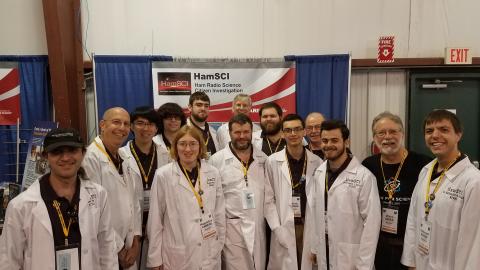
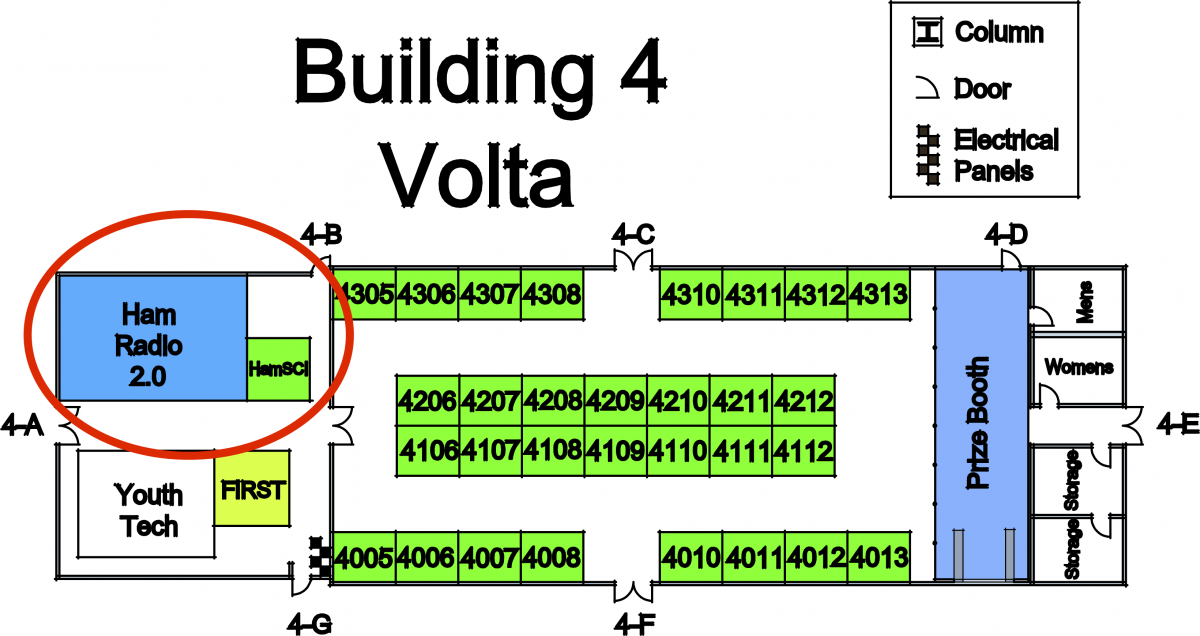
Most HamSCI activity will take place in at Booth 4304 in Building 4 (Volta), which is part of the Ham Radio 2.0: Innovation and Discovery area. Also known as 2.0 Row, this area is intended to be a gathering spot for innovative groups and organizations. The 2.0 Row is located close to the FIRST Robotics, the Society of Amateur Radio Astronomers, and the NASA Radio Jove Booths. You can meet many members of the HamSCI effort at the booth, including Nathaniel Frissell (W2NAF) and Gareth Perry (KD2SAK) of the New Jersey Institute of Technology, Carl (K9LA) and Vicky (AE9YL) Luetzelschwab, Phil Erickson (W1PJE) of the MIT Haystack Observatory, Bill Engelke (AB4EJ) of the University of Alabama, Bill Liles (NQ6Z), and George Lemaster (WB5OYP).

Booth talks will again be presented this year, in which speakers will present on a diverse set of topics right in the Ham Radio 2.0 gathering area. Talks from both HamSCI and Ham Radio 2.0 will be interleaved. Some highlights include New Directions in Sporadic-E Research by Bill Engelke (AB4EJ), RBN & WSPRNet Response to September 2017 Solar Flares and Storms by Nathaniel Frissell (W2NAF), Propagation on 630m and 2200m by Carl Luetzelschwab (K9LA), The Polar Environment Atmospheric Research Laboratory (PEARL) and VY0ERC: Atmospheric Science and Ham Radio at 80 Degrees N by Pierre Fogal (VE3KTB), and HF Satellite Observations of Field Day by Gareth Perry, KD2SAK. See below for the complete schedule.

On Saturday, the HamSCI Forum will take place in Forum Room 4 from 9:15 - 10:30 AM. Steve Cerwin (WA5FRF) will present on Ionospheric Disturbances at Dawn, Dusk, and During the 2017 Eclipse. Dr. Phil Erickson (W1PJE) of the MIT Haystack Observatory will present on using WWV Timing Reference Signals to observe ionospheric variation. HamSCI members Ethan Grace and George Lemaster (WB5OYP) will talk about Sudden Ionospheric Disturbances (SIDs) and Personal Space Weather stations, and TAPR member Scotty Cowling (WA2DFI) will present an update on the Personal Space Weather Station & SDR Hardware.
Support for the 2019 HamSCI Hamvention activities comes from the  New Jersey Institute of Technology Center for Solar-Terrestrial Research, the Yasme Foundation, the National Science Foundation, and the volunteers of HamSCI booth forum.

Hamvention 2017.jpg

HamSCI at Hamvention 2017


HamSCI Presentations

Booth talks include both HamSCI and Ham Radio 2.0 Talks.

Friday Booth Talks

Friday, May 17, 2019 Group Title Presenter Organization Home QTH
10:00 AM HR 2.0 Moonbounce Via the MIT Remote Linked EME Station Marty Sullaway, NN1C   Waban, MA
11:00 AM HamSCI-50x11.png New Directions in Sporadic-E Research Bill Engelke, AB4EJ University of Alabama Tuscaloosa, AL
12:00 PM HR 2.0 Contesting with FT4 - Issues and Opportunities Going Forward John Pescatore, K3TN   Ashton, MD
1:00 PM HamSCI-50x11.png The Third Source of F2 Region Variability Carl Luetzelschwab, K9LA   Fort Wayne, IN
2:00 PM HR 2.0 How Real-Time Scoreboards Change Contesting Victor Androsov, VA2WA and Randy Thompson, K5ZD   Boucherville, QC, Canada and Uxbridge, MA
3:00 PM HamSCI-50x11.png RBN & WSPRNet Response to September 2017 Solar Flares and Storms Nathaniel Frissell, W2NAF New Jersey Institute of Technology Newark, NJ

Saturday Booth Talks

Saturday, May 18, 2019 Group Title Presenter Organization Home QTH
10:00 AM HR 2.0 Balloon Pico Races William Brown, WB8ELK   Madison, AL
11:00 AM HamSCI-50x11.png The Polar Environment Atmospheric Research Laboratory (PEARL) and VY0ERC:  Atmospheric Science and Ham Radio at 80N Pierre Fogal, VE3KTB Polar Environment Atmospheric Research Laboratory (PEARL) / University of Toronto Ellesmere Island, Canada
12:00 PM HR 2.0 Youth Contesting Program in North America and Europe Jocelyn Brault, KD8VRX, Bryant Rascoll, KG5HVO, and Philipp Springer, DK6SP   Liberty Township, OH, Montgomery, AL, and Erding, Germany
1:00 PM HamSCI-50x11.png Propagation on 630m and 2200m Carl Luetzelschwab, K9LA   Fort Wayne, IN
2:00 PM HR 2.0 SOTA and New Methods of Portable Operating Paula Uscian, K9IR   Hoffman Estates, IL
3:00 PM HamSCI-50x11.png HF Satellite Observations of Field Day Gareth Perry, KD2SAK New Jersey Institute of Technology Newark, NJ
 

HamSCI Forum

Saturday, May 18, 2019, 9:15 AM - 10:30 AM, Forum Room 4
Saturday, May 18, 2019 Title Presenter Organization Home QTH
9:15 AM What is HamSCI? Nathaniel Frissell, W2NAF New Jersey Insititute of Technology Newark, NJ
9:20 AM Ionospheric Disturbances at Dawn, Dusk, and During the 2017 Eclipse Steve Cerwin, WA5FRF HamSCI Mico, TX
9:35 AM IonTV: Using WWV Timing Reference Signals to Observe Ionospheric Variation Phil Erickson, W1PJE MIT Haystack Observatory Westford, MA
9:50 AM Sudden Ionospheric Disturbances (SIDs) and Personal Space Weather stations Ethan Grace and George Lemaster, WB5OYP HamSCI Falls Church, VA
10:05 AM Update on Personal Space Weather Station & SDR Hardware Scotty Cowling, WA2DFI TAPR Tempe, AZ
 

Booth Location

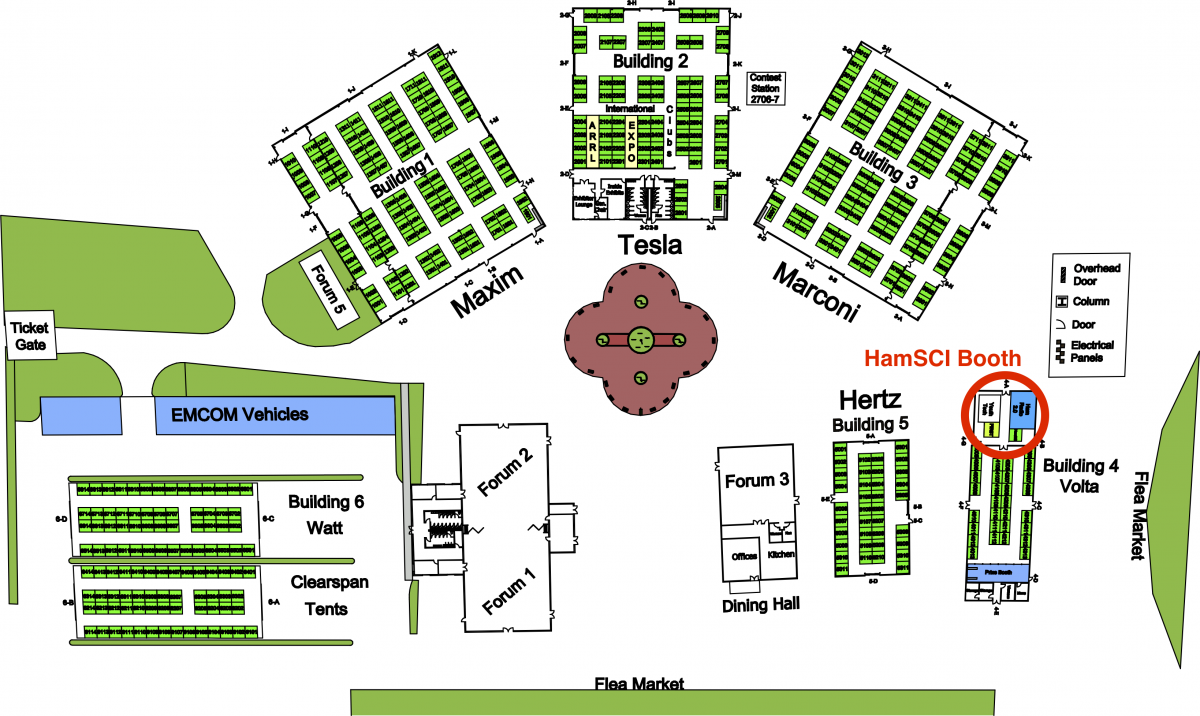
HamSCI will be at Booth 4304 in the Ham Radio 2.0: Innovation and Discovery Area.

Booths-Exhibits-Overview-2018v3-HamSCI.png

Booths-Building-4-2018v4-HamSCI.png

Questions?

If you have questions, please contact Nathaniel W2NAF at [email protected].

Photos

Case ARC W8EDU Wins 2nd Place in ARRL FMT

By Aidan Montare, KB3UMD

Congratulations to the Case Amateur Radio Club for their second place score (out of 114 entries nation-wide) in the ARRL’s Frequency Measurement Test! The hosts of this year’s HamSCI workshop, W8EDU was able to measure the frequency of one 80 meter and one 40 meter transmission from K5CM to 0.03 and 0.02 Hertz, respectively. First place station W4VU in North Carolina won by only a slight margin of 0.01 Hz on 80 meters (a difference of one part per billion in the measurement).

The Frequency Measurement Test (FMT) is a competitive frequency estimation problem in which radio operators use their stations to identify with the highest possible accuracy the frequency of particular radio transmissions. For the April 2019 event, scheduled transmissions from K5CM in Oklahoma were used. The test also challenges participants to understand the problems of ionosphere characterization and estimating resulting Doppler shift at the time of measurement. The competition requires thorough understanding of the physics, engineering, and mathematics involved.

Additionally, HamSCI presenters Bill Engelke, AB4EJ, and John Gibbons, N8OBJ (also technical advisor for W8EDU) participated in the event.

For more results and details about the event, see http://fmt.arrl.org/

Hamvention 2019 HamSCI Team

Hamvention 2017.jpg

HamSCI at Hamvention 2017

Overview

HamSCI will be present at the 2019 Dayton Hamvention in order to further its goal of connecting the ham radio and scientific communities. Support for the 2018 HamSCI Hamvention activities comes from the  New Jersey Institute of Technology Center for Solar-Terrestrial Research, the Yasme Foundation, the National Science Foundation, and volunteers like you. This year, HamSCI will again host a booth in the "Ham Radio 2.0: Innovation and Discovery" row, host booth talks, demos, and the HamSCI Forum. To help out, please sign up to volunteer at the booth or offer to give a booth talk.

Booth Volunteering

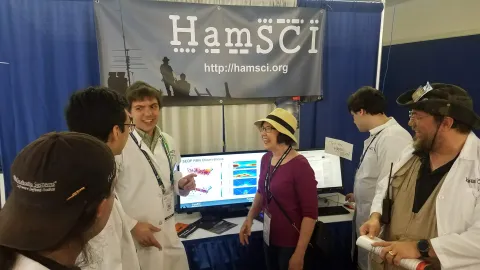
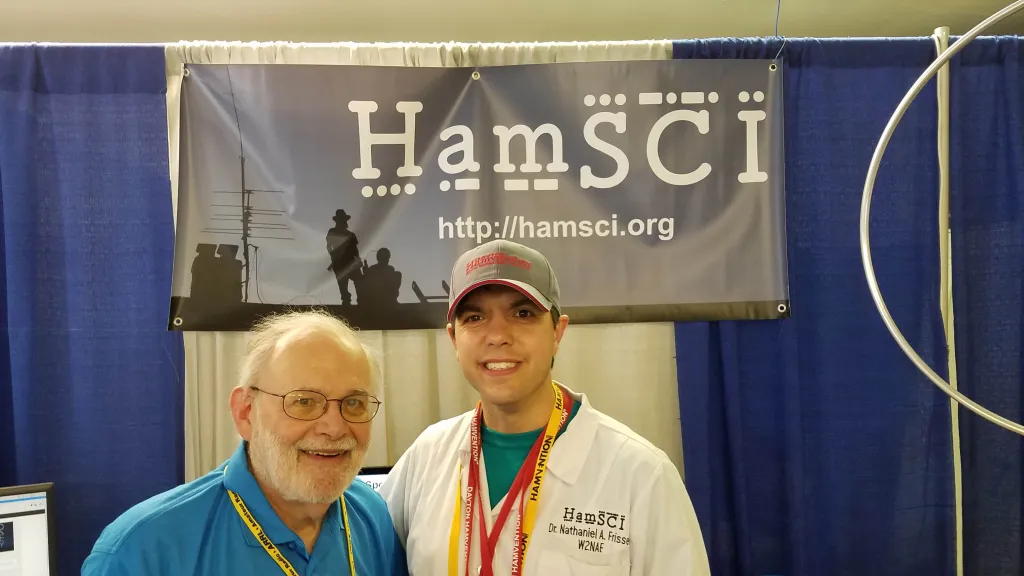
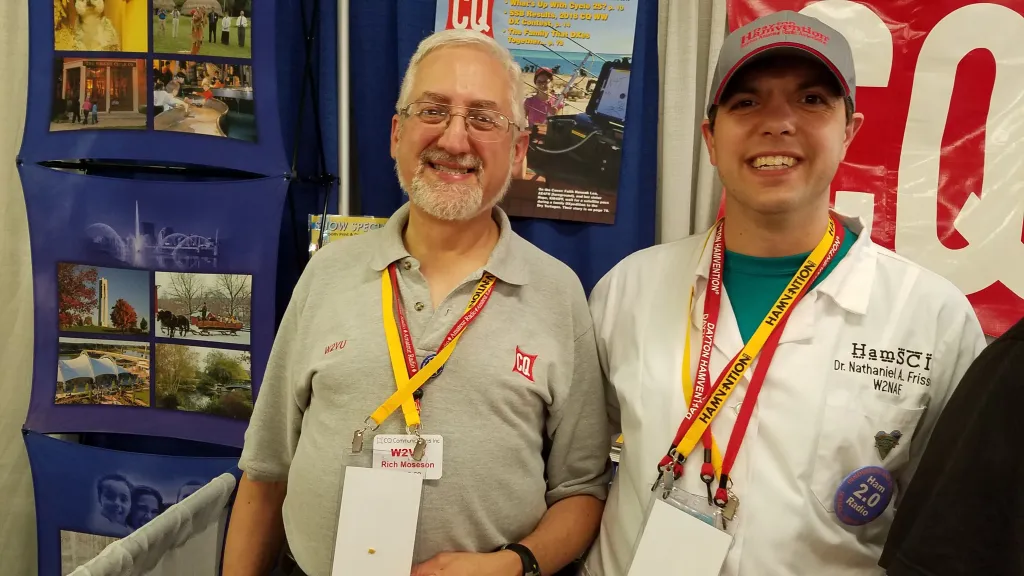
Please use sign up to volunteer at the booth using the SignUp.com. As a volunteer, we ask that you stand at the HamSCI booth and talk to booth vistors about HamSCI and your specific research interests. Feel free to bring demonstation items and materials and to talk about what you know best. The goal of HamSCI is to connect ham radio with scientific research. So, any topic that supports this goal is a good topic to talk about. The booth uniform are HamSCI labcoats, which can be purchased below. For questions regarding booth volunteering, please e-mail Bill Liles NQ6Z at [email protected] and George Lemaster WB5OYP at [email protected].

Volunteer Sign-Up


Lab Coats

HamSCI labcoats may be ordered from https://www.allheart.com/product.aspx?p=ah8200. Please use custom logo code C_5163_Q5D and place the logo on the left chest. Put your whole name on Line 1, and your call sign on Line 2. Use block style lettering.

Example Order

Natural Uniforms Unisex 41" Lab Coat
Item #: AH-8200---WHTLGE
Color: WHT White
Size: LGE
Personalization - Left Chest
  Embroidery Style: Block Style
  Thread Color: Black
  Letter Height: 1/2 inch (25 characters)
  Text Line #1: Dr. Nathaniel A. Frissell
  Custom Emblem: C_5163_Q5D
  Text Line #2: W2NAF

Exhibitor Badges

If you are volunteering at the booth or giving a talk, you may purchase an exhibitor badge for $20. These badges give you full access to the Hamvention, including the set-up and break-down times. However, these badges will not enter you in the prize drawings the way a normal Hamvention ticket will. If you would like an exhibitor badge, please e-mail Bill Liles NQ6Z at [email protected] and George Lemaster WB5OYP at [email protected].

Group Photo

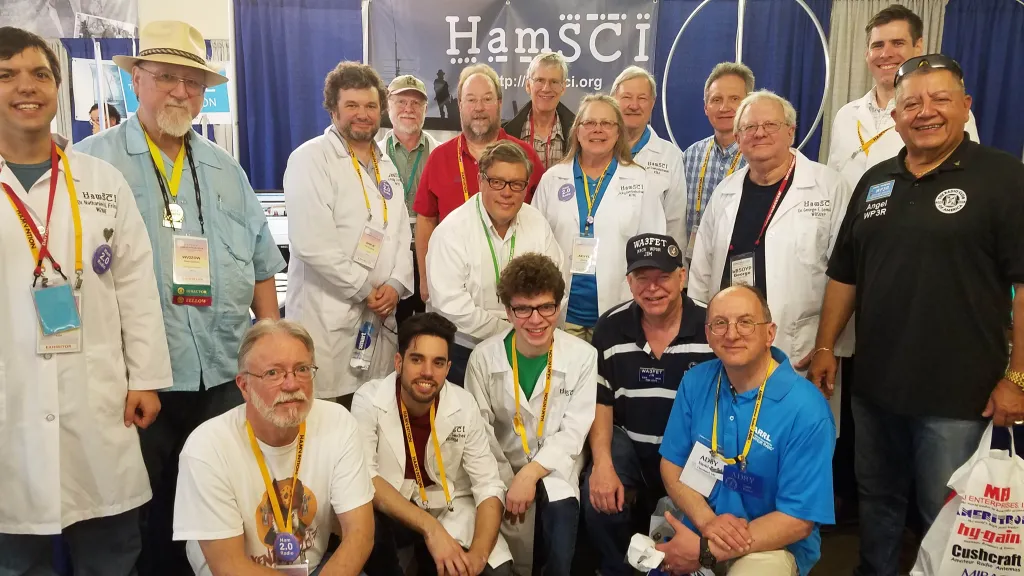
A HamSCI group photo will be taken during the Hamvention on Friday at 12:00 PM at the HamSCI booth. Wear your labcoats!

HamSCI Presentations

Booth Talks

Booth talks include both HamSCI and Ham Radio 2.0 Talks.

Friday Booth Talks

Friday, May 17, 2019 Group Title Presenter Organization Home QTH
10:00 AM HR 2.0 Moonbounce Via the MIT Remote Linked EME Station Marty Sullaway, NN1C   Waban, MA
11:00 AM HamSCI-50x11.png New Directions in Sporadic-E Research Bill Engelke, AB4EJ University of Alabama Tuscaloosa, AL
12:00 PM HR 2.0 Contesting with FT4 - Issues and Opportunities Going Forward John Pescatore, K3TN   Ashton, MD
1:00 PM HamSCI-50x11.png The Third Source of F2 Region Variability Carl Luetzelschwab, K9LA   Fort Wayne, IN
2:00 PM HR 2.0 How Real-Time Scoreboards Change Contesting Victor Androsov, VA2WA and Randy Thompson, K5ZD   Boucherville, QC, Canada and Uxbridge, MA
3:00 PM HamSCI-50x11.png RBN & WSPRNet Response to September 2017 Solar Flares and Storms Nathaniel Frissell, W2NAF New Jersey Institute of Technology Newark, NJ

Saturday Booth Talks

Saturday, May 18, 2019 Group Title Presenter Organization Home QTH
10:00 AM HR 2.0 Balloon Pico Races William Brown, WB8ELK   Madison, AL
11:00 AM HamSCI-50x11.png The Polar Environment Atmospheric Research Laboratory (PEARL) and VY0ERC:  Atmospheric Science and Ham Radio at 80N Pierre Fogal, VE3KTB Polar Environment Atmospheric Research Laboratory (PEARL) / University of Toronto Ellesmere Island, Canada
12:00 PM HR 2.0 Youth Contesting Program in North America and Europe Jocelyn Brault, KD8VRX, Bryant Rascoll, KG5HVO, and Philipp Springer, DK6SP   Liberty Township, OH, Montgomery, AL, and Erding, Germany
1:00 PM HamSCI-50x11.png Propagation on 630m and 2200m Carl Luetzelschwab, K9LA   Fort Wayne, IN
2:00 PM HR 2.0 SOTA and New Methods of Portable Operating Paula Uscian, K9IR   Hoffman Estates, IL
3:00 PM HamSCI-50x11.png HF Satellite Observations of Field Day Gareth Perry, KD2SAK New Jersey Institute of Technology Newark, NJ

Demonstrations

If you would like to give a demonstration, please e-mail Bill Liles NQ6Z at [email protected] and George Lemaster WB5OYP at [email protected].

Friday Demonstrations

Friday, May 17, 2019 Title Presenter Organization Home QTH
9:00 AM - 12:00 PM        
1:00 PM - 5:00 PM        

Saturday Demonstrations

Saturday, May 18, 2019 Title Presenter Organization Home QTH
9:00 AM - 12:00 PM        
1:00 PM - 5:00 PM        

HamSCI Forum

Saturday, May 18, 2019, 9:15 AM - 10:30 AM, Forum Room 4
Saturday, May 18, 2019 Title Presenter Organization Home QTH
9:15 AM What is HamSCI? Nathaniel Frissell, W2NAF New Jersey Insititute of Technology Newark, NJ
9:20 AM Ionospheric Disturbances at Dawn, Dusk, and During the 2017 Eclipse Steve Cerwin, WA5FRF HamSCI Mico, TX
9:35 AM IonTV: Using WWV Timing Reference Signals to Observe Ionospheric Variation Phil Erickson, W1PJE MIT Haystack Observatory Westford, MA
9:50 AM Sudden Ionospheric Disturbances (SIDs) and Personal Space Weather stations Ethan Grace and George Lemaster, WB5OYP HamSCI Falls Church, VA
10:05 AM Update on Personal Space Weather Station & SDR Hardware Scotty Cowling, WA2DFI TAPR Tempe, AZ

Booth Location

HamSCI will be at Booth 4304 in the Ham Radio 2.0: Innovation and Discovery Area.

Booths-Exhibits-Overview-2018v3-HamSCI.png

Booths-Building-4-2018v4-HamSCI.png

Questions?

If you have questions, please contact Nathaniel W2NAF at [email protected].

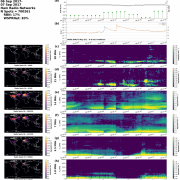
RBN-WSPRNet Histograms Explanation

RBN-WSPRNet Daily Histograms

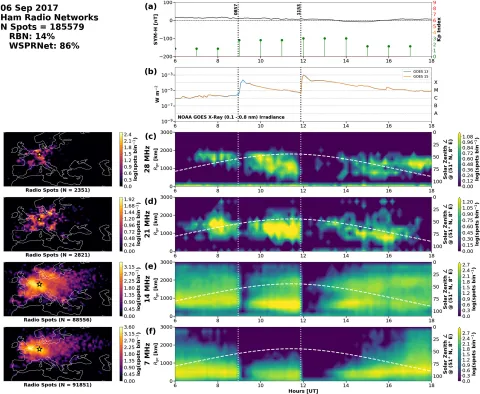
The RBN-WSPRNet Daily Histograms are used to monitor global high frequency (HF) ham radio communications in relation to space weather activity. The following data are shown:

  • Panel (a) shows geomagnetic activity indices derived from ground-based magnetometer data, including the SYM-H index (black line) and Kp Index (colored stems).
  • Panel (b) shows X-ray flux measurements made by the GOES satellites for monitoring solar flares.
  • Panels (c) - (h) show density maps and histograms of ham radio spots/QSOs from the Reverse Beacon Network and WSPRNet. The data are located at the midpoint of the transmitter and receiver. Map bin sizes are 1˚ lat by 1˚ lon, and histogram bin sizes are 10 min by 250 km. When a user‐reported location is not available, a lookup to a public database such as http://qrz.com or http://hamcall.net is made. If location is not provided and a database lookup is not available, the spot is discarded.

HF Ham Radio Data

To monitor HF radio communications, we use data from two separate automated amateur radio monitoring networks, the Reverse Beacon Network (RBN) and the Weak Signal Propagation Reporting Network (WSPRNet). These networks operate continuously and are built, operated, and maintained on a volunteer basis by members of the amateur radio community. For a detailed analysis of a solar flare and geomagnetic storm event using this type of data, please see Frissell et al. (2019). RBN and WSPRNet data have been aggregated and provided by Bill Engelke, AB4EJ, University of Alabama DXDisplay. Visualizations by Nathaniel Frissell, W2NAF, NJIT CSTR.

Kp Index

The Planetary K (Kp) index is a quasi‐logarithmic scale from 0 to 9 that quantifies the level of geomagnetic disturbance (Menvielle & Berthelier, 1991). This index is calculated using observations from 13 midlatitude (±44°–60° magnetic latitude) ground magnetometers located in North America, Europe, and Australia. Hence, Kp is most indicative of geomagnetic conditions in these regions. At each station, fluctuations in the strength of the horizontal component of the magnetic field are observed over a 3‐hr interval. The resulting value is subsequently associated with an individual K value based on the geomagnetic latitude of the measurement station, such that a station near the equator requires less geomagnetic fluctuation than a station near the poles in order to record the same K value. Finally, the weighted mean of measurements from all Kp observatories allows calculation of a global Kp value. Kp was obtained from the NASA Goddard Space Flight Center OMNIWeb (King & Papitashvili, 2006).

SYM-H Index

The SYM‐H index is a measure of disturbances from background in the low‐latitude horizontal component of the magnetic field and is considered a high‐time resolution (1 min) version of the hourly disturbance storm time Dst index (Iyemori, 1990; Sckopke, 1966; Wanliss & Showalter, 2006). Observations from 6 out of 11 possible ground magnetometer stations evenly distributed in longitude and in the range of ±10°–50° magnetic latitude contribute to the SYM‐H index. SYM‐H monitors the intensity of the magnetospheric ring current. A negative SYM‐H value indicates an intensification of the ring current and is associated with geomagnetic storm activity. SYM‐H was obtained from the Kyoto World Data Center for Geomagnetism.

GOES X-Ray Flux

In addition to the two previously described indices, data from the Geostationary Operational Environmental Satellite (GOES) system is also used. This consists of observations from the GOES‐13 (GOES‐EAST, θ = −75°E) and GOES‐15 (GOES‐WEST, θ = −135°E) platforms. Each satellite carries an XRS providing 0.1–0.8 nm X‐ray irradiance observations (Chamberlin et al., 2009). A solar flare can cause sudden and unexpected fluctuations in solar X‐ray irradiance. GOES XRS measurements were retrieved from the NOAA National Center for Environmental Information (NCEI).

Software Acknowledgments

We acknowledge the use of the Free Open Source Software projects used in this analysis: Ubuntu Linux, python (van Rossum, 1995), matplotlib (Hunter, 2007), NumPy (Oliphant, 2007), SciPy (Jones et al., 2001), pandas (McKinney, 2010), xarray (Hoyer & Hamman, 2017), iPython (Pérez & Granger, 2007), and others (e.g., Millman & Aivazis, 2011).

References

Chamberlin, P. C., Woods, T. N., Eparvier, F. G., & Jones, A. R. ( 2009). Next generation X‐ray sensor (XRS) for the NOAA GOES‐R satellite series, Solar Physics and Space Weather Instrumentation III. San Diego, CA: Society of Photo‐Optical Instrumentation Engineers (SPIE). https://doi.org/10.1117/12.826807

Frissell, N. A., Vega, J. S., Markowitz, E., Gerrard, A. J., Engelke, W. D., Erickson, P. J., et al. ( 2019). High‐frequency communications response to solar activity in September 2017 as observed by amateur radio networks. Space Weather, 17, 118– 132. https://doi.org/10.1029/2018SW002008

Hoyer, S., & Hamman, J. ( 2017). xarray: N‐D labeled arrays and datasets in Python. Journal of Open Research Software, 5( 1), 10. https://doi.org/10.5334/jors.148

Hunter, J. D. ( 2007). Matplotlib: A 2D graphics environment. Computing in Science & Engineering, 9( 3), 90– 95. https://doi.org/10.1109/MCSE.2007.55

Iyemori, T. ( 1990). Storm‐time magnetospheric currents inferred from mid‐latitude geomagnetic field variations. Journal of Geomagnetism and Geoelectricity, 42( 11), 1249– 1265. https://doi.org/10.5636/jgg.42.1249

Jones, E., Oliphant, T., & Peterson, P. ( 2001). SciPy: Open source scientific tools for Python. Retrieved from http://www.scipy.org/

King, J., & Papitashvili, N. ( 2006). One minute and five minute solar wind data sets at the Earth's bow shock nose. Greenbelt, MD: NASA Goddard Space Flight Center/Space Physics Data Facility. http://omniweb.gsfc.nasa.gov/html/HROdocum.html

McKinney, W. ( 2010). Data structures for statistical computing in Python. In S. van der Walt & J. Millman (Eds.), Proceedings of the 9th Python in Science Conference (pp. 51– 56). Austin, TX: SciPy.org. https://conference.scipy.org/proceedings/scipy2010/pdfs/mckinney.pdf

Menvielle, M., & Berthelier, A. ( 1991). The K‐derived planetary indices: Description and availability. Reviews of Geophysics, 29( 3), 415– 432. https://doi.org/10.1029/91RG00994

Millman, K. J., & Aivazis, M. ( 2011). Python for scientists and engineers. Computing in Science & Engineering, 13( 2), 9– 12. https://doi.org/10.1109/MCSE.2011.36

Oliphant, T. E. ( 2007). Python for scientific computing. Computing in Science & Engineering, 9( 3), 10– 20. https://doi.org/10.1109/MCSE.2007.58

Pérez, F., & Granger, B. E. ( 2007). IPython: A system for interactive scientific computing. Computing in Science & Engineering, 9( 3), 21– 29. https://doi.org/10.1109/MCSE.2007.53

Rossum, G. ( 1995). Python tutorial (Technical Report CS‐R9526). Amsterdam: Centrum voor Wiskunde en Informatica, (CWI). https://ir.cwi.nl/pub/5007/05007D.pdf

Sckopke, N. ( 1966). A general relation between the energy of trapped particles and the disturbance field near the Earth. Journal of Geophysical Research, 71( 13), 3125– 3130. https://doi.org/10.1029/JZ071i013p03125

Wanliss, J. A., & Showalter, K. M. ( 2006). High‐resolution global storm index: Dst versus SYM‐H. Journal of Geophysical Research, 111, A02202. https://doi.org/10.1029/2005JA011034

Data

large_example_histogram.png

Aggregated PSKReporter, WSPRNet, and RBN Data

Aggregated and geolocated PSKReporterWeak Signal Propagation Reporting Network (WSPRNet), and Reverse Beacon Network (RBN) is now available on the CEDAR Madgrigal Database. To access the data, select the "HF Radars" instrument category and the "Amateur Radio Signal Report" instrument. This data can be processed and visualized with the HamSCI Amateur Radio Communications Database Plotting Toolkit (HARC PLOT). These networks operate continuously and are built, operated, and maintained on a volunteer basis by members of the amateur radio community. For a detailed analysis of a solar flare and geomagnetic storm event using this type of data, please see Frissell et al. (2019). HARC data on the CEDAR Madrigal database is made possible by NASA Grant 80NSSC21K1772.

psws_data_web.png

Personal Space Weather Station Data

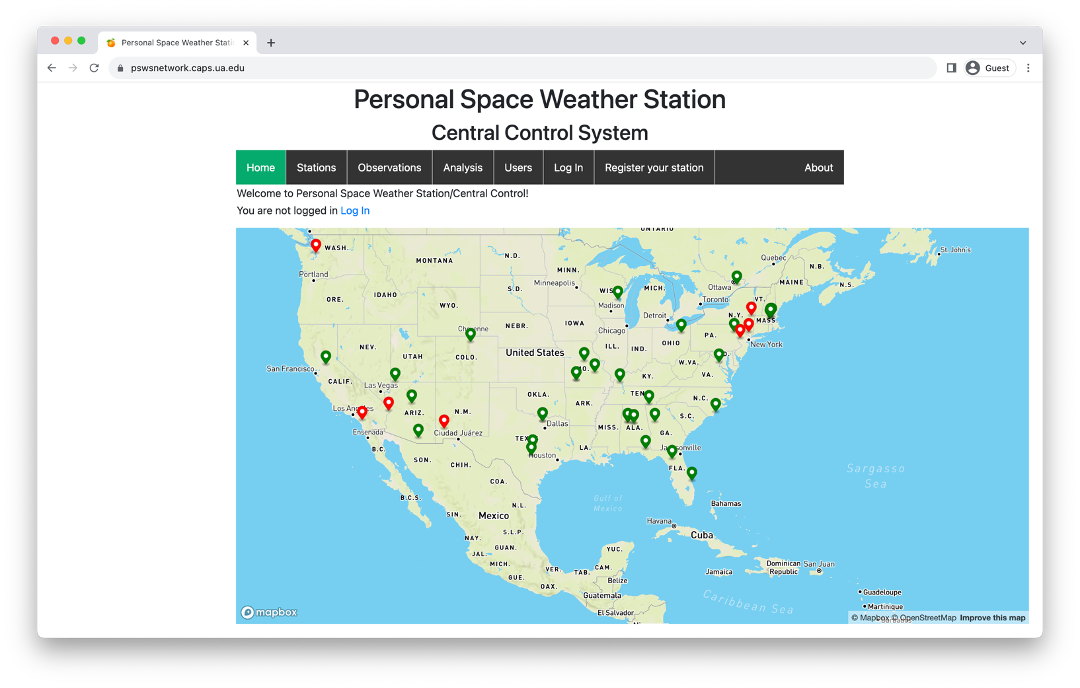
HF Doppler and ground magnetometer data from the HamSCI Personal Space Weather Station Network is available from http://psws.hamsci.org, hosted by the University of Alabama. This data is made possible by NSF Grants supporting the Personal Space Weather Station project.

RBN-WSPR Daily Histograms


Panel (a) shows geomagnetic activity indices derived from ground-based magnetometer data, including the SYM-H index (black line) and Kp Index (colored stems). Panel (b) shows X-ray flux measurements made by the GOES satellites for monitoring solar flares. Panels (c) - (h) show density maps and histograms of ham radio spots/QSOs from the Reverse Beacon Network and WSPRNet. The data are located at the midpoint of the transmitter and receiver. Map bin sizes are 1˚ lat by 1˚ lon, and histogram bin sizes are 10 min by 250 km. When a user‐reported location is not available, a lookup to a public database such as http://qrz.com or http://hamcall.net is made. If location is not provided and a database lookup is not available, the spot is discarded. Click here for a detailed explanation.
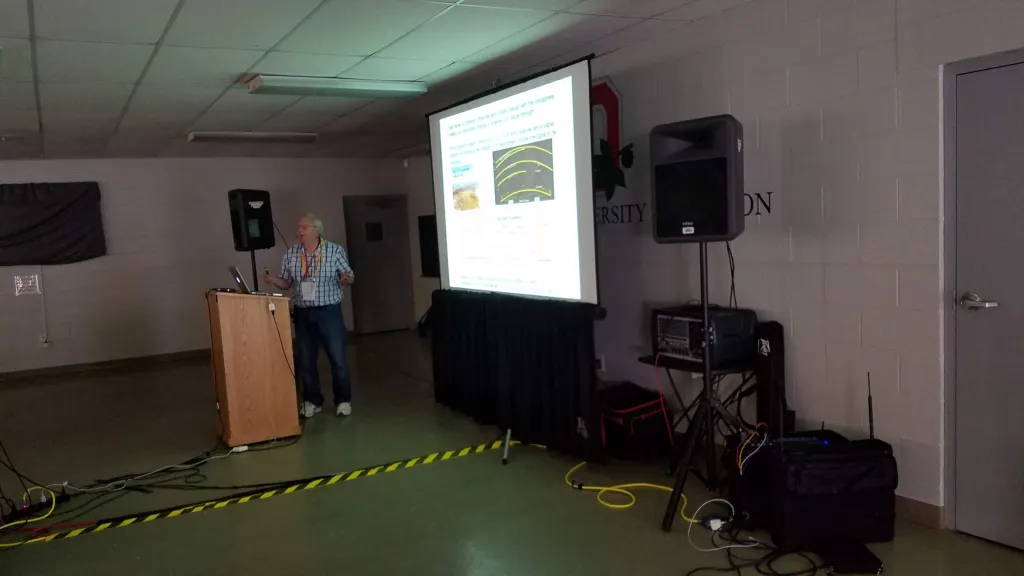
Visualizations by Nathaniel Frissell, W2NAFNJIT CSTR. Kp was obtained from the NASA Goddard Space Flight Center OMNIWeb (King & Papitashvili, 2006). SYM‐H was obtained from the Kyoto World Data Center for Geomagnetism. GOES XRS measurements were retrieved from the NOAA National Center for Environmental Information (NCEI). RBN and WSPRNet data have been aggregated and provided by Bill Engelke, AB4EJUniversity of Alabama DXDisplay.

This page is developed and maintained by Nathaniel Frissell W2NAF, Evan Markowitz KD2IZW, and Diego Sanchez KD2RLM.

About HamSCI

Motivation

Since the beginning of the United States amateur radio service in 1912, amateur radio operators have made significant contributions to radio technology and the understanding of radio science.  This work must be continued today, as Part 97 of the FCC rules states that a primary purpose of the amateur radio service is the “Continuation and extension of the amateur's proven ability to contribute to the advancement of the radio art.”  Recent advances in the fields of computing, software defined radio, and signal processing provide unprecedented opportunities to meet this mandate, specifically in the field of radio science.  These opportunities are already beginning to be realized with the advent of systems such as the Reverse Beacon Network (RBN), the Weak Signal Propagation Reporting Network (WSPRNet), and PSKReporter.  In addition, enabling amateurs to make and contribute legitimate scientific observations will expose amateur radio to a wider community of people interested in science around the world.

What is HamSCI?

HamSCI, the Ham Radio Science Citizen Investigation, is a platform for the publicity and promotion of projects that are consistent with the following objectives:

  • Advance scientific research and understanding through amateur radio activities.
  • Encourage the development of new technologies to support this research.
  • Provide educational opportunities for the amateur community and the general public.

HamSCI serves as a means for fostering collaborations between professional researchers and amateur radio operators. It assists in developing and maintaining standards and agreements between all people and organizations involved.

What is HamSCI's scientific focus?

HamSCI was started by ham-scientists who study upper atmospheric and space physics. These scientists recognized that projects such as the Reverse Beacon Network, WSPRNet, PSKReporter, DX Cluster, ClubLog, and more are generating big data sets that could provide useful observations of the Earth's ionosphere and related systems. Because of this, HamSCI's initial focus is on these fields of research. In the future, other researchers may join HamSCI and broaden its scope. For scientists, working with the amateur radio community is a way to access individually managed stations, available by the hundreds in dozens of countries, with receive and transmit capabilities across the electromagnetic spectrum, easily identified in areas of interest and deployed to remote locations, for free. You can read more about the utility of amateur radio as a teaching tool in this Eos article. 

Science Questions

  • How does the ionosphere respond to inputs from space and from the neutral atmosphere?
  • How does the ionosphere couple with the neutral atmosphere and with space?
  • What are the sources of medium and large scale traveling ionospheric disturbances?
  • What are the causes of Sporadic E?

Amateur Radio Questions

  • How do disturbances such as solar flares, geomagnetic storms, and traveling ionospheric disturbances affect radio wave propagation?
  • How does ionospheric science help amateur radio operators improve communications?
  • How can I use my existing radio equipment to science initiatives?

What is a ham radio operator?

HamSCI is driven by data generated by the activities of ham radio operators (a.k.a. amateur radio operators). Ham radio operators are people who are interested in using radio as a hobby and have obtained a ham radio license from their state government. Ham radio is a very diverse hobby. Some operators enjoy talking to friends accross town, while others work to build stations that can communicate around the world. Ham radio operators can help with emergency communications and public service, or even help advance the boundaries of scientific knowledge.

Any interested person can become a ham radio operator. Amateur radio can introduce young people to an exciting career in the field of science and technology, or it can simply serve as a fun and productive hobby for anyone who would like to get involved. The American Radio Relay League is a great place to learn about how to become a ham radio operator.

Operating

One of the simplest ways to participate in HamSCI is simply to get on the radio! This is especially true if you enjoy operating HF CW or digital modes. Systems such as the Reverse Beacon NetworkWSPRNet, and PSKReporter will automatically hear your transmissions and report back to their respective databases.

Participate in Receiving Networks

HamSCI scientists rely on data from systems such as the Reverse Beacon NetworkWSPRNet, and PSKReporter. These systems rely on volunteers to install and operate receiving stations. Dense receiver coverage is needed globally, so installing a receiving node for one of these stations is a great way to help out!

Follow the ARRL: QST (Official Journal), QEX (Experimenter's Journal) and On the Air (new ham's magazine)

Learn more about ham radio operating by visiting the American Radio Relay League website.  Become an ARRL member to receive QST, along with the League's other publications.

Oscillator Parameters

To properly spec an oscillator, we need to establish several parameters. So we'll all be on the same page, I've outlined below the main ones.

[To the many of you who know more about this subject than I do, please forgive any oversimplification or bad examples!]

There are about five and one half specifications that define the performance of an oscillator in the frequency domain:

Accuracy

How close is the frequency or clock readout to an external reference (cesium frequency standard, or UTC time scale)?  This is a single number specified as a ratio (e.g., parts per billion) or as an absolute (e.g., +/- 0.001 Hz, or +/- 10 nanoseconds).

Short Term Stability

How much does the oscillator's frequency wobble around during measurement intervals of interest?  Short term stability is important for time interval measurements, where in effect it provides error bars around the measurement.

"Short term" doesn't have a specific cutoff, but it's usually thought of as measurement intervals of a day or less.  Short term stability is stated at a specific interval by a statistic called Allan Deviation. The measurement interval is called "tau" and saying "tau=10 seconds" means each reading is taken ten seconds apart).
Long Term Stability

How constant is the oscillator's frequency over periods of days, weeks, or longer?  Long term stability has two main components: drift, or aging, and flicker noise floor.  Most oscillators exhibit drift, or aging -- a gradual change of rate over ong time periods.  All crystal and rubidium oscillators drift; cesium beam standards do not.  Long term stability is usually considered to include averaging times of a day or more.  It is also stated as Allan Deviation, and where appropriate by an aging rate, such as "1x10e-10/day".  The flicker noise floor is usually masked by drift, but is apparent in measurements of cesium beam frequency standards because they do not drift, but even then it only shows up at tau of several hundred thousand seconds.

Allan Deviation

I mentioned Allan Deviation above.  What is it?  ADEV is a statistic similar to standard deviation but modified to better reflect the noise types exhibited by oscillators.  It is dimensionless and is usually stated in the form "2.5 x 10e-8".  Smaller is better!  ADEV varies with measurement interval ("tau"), and is often plotted on a log-log graph with stability on the Y axis (lower is better) and tau on the X axis.  From the slope of the curve, one can determine the noise processes at work n each segment of the graph.

Drift is apparent in ADEV graphs by a "bathtub" shaped curve where stability improves out to a few hundred or thousand seconds, flattens for a bit, and then goes up at longer averages as the drift becomes apparent.  I've attached a sample ADEV graph so you can see what they look like.

FTS-405B_adev.png

Temperature Stability ("tempco")

Every resonator is a thermometer, and one of the challenges in crystal oscillator design is to prevent temperature changes from impacting the oscillation frequency.  This is why we have TCXOs (temperature compensated crystal oscillator) and OCXOs (oven controlled crystal oscillator).  Tempco is usually specified as parts per degree over a temperature range.

Phase Noise

How much unwanted phase modulation does the oscillator output carry? This is an important specification in RF systems because excessive phase noise increases the noise floor and impairs signal recovery by the receiver.  On the transmit side, broadband phase noise can cause interference to nearby receivers.

Phase noise is specified as dB down from the carrier (dBc) of the single sideband noise, normalized to 1 Hz bandwidth, at a given offset from the carrier -- e.g., 130 dBc/Hz @ 1 kHz offset.  It is often plotted on a log-log graph.  Various noise processes are shown by the slope of the PN plot.  Most oscillators have a PN curve that drops at slope 1 to 2 from the carrier out to some point where the noise floor is reached and the PN remains constant from that offset outward.  The closest offset usually measured is between 1 and 100 Hz, depending on the quality of the oscillator, and in the HF/VHF range region is usually measured out to 100 kHz or 1 MHz offset.Phase noise is really a short term stability at very short tau, and you can derive phase noise from an ADEV graph.  PN is usually used for offsets of more than 1 Hz (which equals tau of 1 second), and ADEV for longer tau.  I've also attached a sample phase noise graph.

Fun fact: phase noise increases by a minimum of 20log(N) with frequency multiplication.  Double the frequency, increase the PN by 6 dB; multiply by 10 and add 20 dB to the noise.  This is why phase noise is a major hassle in microwave systems.
FTS-405B-ULN_pn.png

Jitter

This is the 1/2 parameter mentioned above, because it is a different way of defining phase noise.  It tries to reduce to one number the noise performance of an oscillator across a wide range of offset frequencies. Jitter is widely used in telecom clock specifications and is usually specified in femtoseconds or picoseconds of bit edge displacement.  It's really another way of describing phase noise, and can be calculated from a phase noise plot.  The gotcha is that you need to know the bandwidth over which the phase noise is integrated, and that's often not clearly stated in the data sheet.


Page Courtesy of John Ackermann N8UR

HamSCI Meeting Receives NSF Support

The United States National Science Foundation (NSF) has recognized the need to join the amateur radio and professional science communities through a recent grant award to support the upcoming HamSCI Workshop from March 22-23, 2019 in Cleveland, OH. The conference is hosted by the Case Western Reserve University Amateur Radio Club and organized and administered by the New Jersey Institute of Technology (NJIT). The NSF conference grant from the Geosciences Directorate will provide important facilitation for conference activities and associated logistics.

The theme of the 2019 HamSCI Workshop will be “Ionospheric Effects and Sensing,” which includes the use of amateur radio techniques for the characterization and study of ionospheric phenomena such as traveling ionospheric disturbances, sporadic E, response to solar flares, geomagnetic storms, the 2024 total solar eclipse other space weather events. In order to facilitate this science, continued development of the HamSCI Personal Space Weather Station and discussion of integration of amateur radio into the collegiate curriculum will also take place. Featured speakers include well-known amateur radio author Ward Silver, N0AX, propagation specialist Carl Luetzelschwab, K9LA, and MIT Haystack Observatory Ionospheric Scientist Dr. Larisa Goncharenko.

Papers and presentations relating to amateur radio and science, particularly space and atmospheric science, space weather, and radio astronomy will be accepted. The HamSCI workshop seeks to not only advance science, but also strengthen the synergy between professional scientific and amateur radio communities and develop open technologies and observation networks that can be used in conjunction with existing space science and space weather infrastructure. Registration for the workshop is open. Please visit http://hamsci.org/hamsci2019 for more information.
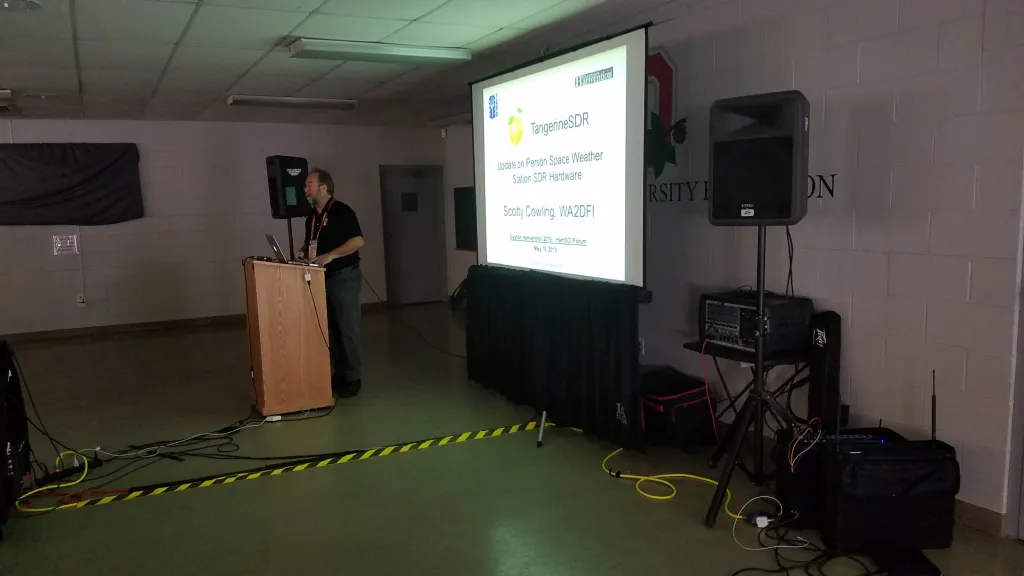
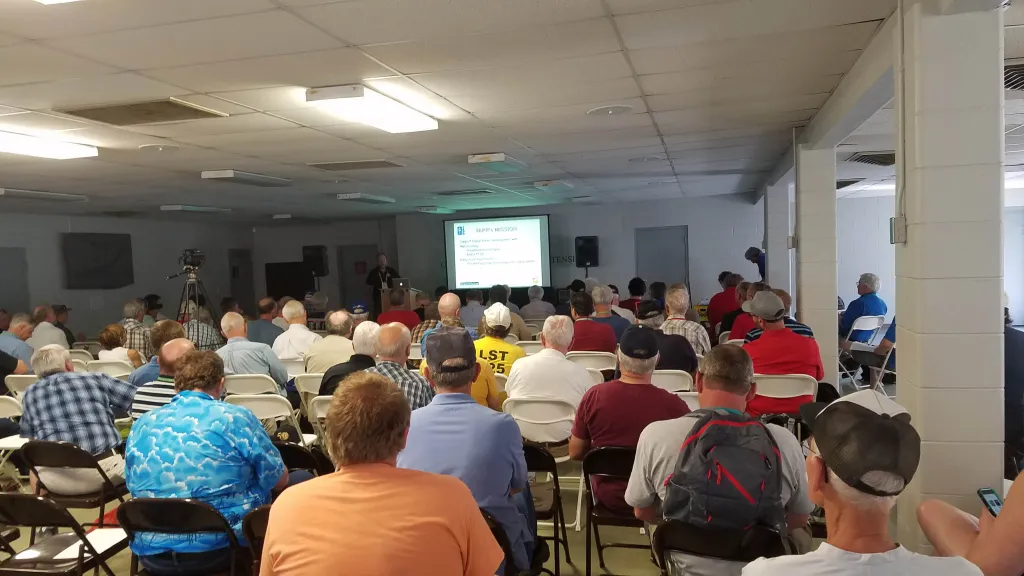
RBN/WSPRNet Response to September 2017 Storms Published in Space Weather

A new study, High‐Frequency Communications Response to Solar Activity in September 2017 as Observed by Amateur Radio Networks, by HamSCI researchers has been published in the American Geophysical Union journal Space Weather. The article is available for free from the journal website.

Plain Language Summary: Radio communications using the high‐frequency (HF) bands (3–30 MHz) is important for emergency communications because it is the only form of electronic communications that can travel over the horizon without relying on man‐made infrastructure such as the Internet, satellite systems, or phone networks. This is possible because HF rays can be bent back to Earth by the ionosphere, an electrically charged layer of the upper atmosphere. Space weather events such as X‐ray flares from the Sun and geomagnetic storms can alter the ionosphere to disrupt these communications. During September 2017, a significant number of solar flares and geomagnetic activity occurred. Simultaneously, major hurricanes, including Hurricane Irma and Hurricane Jose, caused situations in the Caribbean region requiring the use of emergency HF communications, often provided by ham (amateur) radio operators. This paper shows the impacts of these space weather disturbances on HF communications as observed by multiple ham radio monitoring systems.

How to play an RRI raw IQ file on Gqrx

This is a how to page for Gqrx an "open source software defined radio receiver".  Gqrx has many bells and whistles, one of which is the ability to listen to "raw" IQ files, speficially, "raw" IQ files from RRI.  This page is desinged to help set-up and listen to "raw" RRI IQ files using Gqrx.

Currenlty, Gqrx is available for Linux, and some instances of Mac OS.  Information about that can be found here.  This instructions and screen captures shown here are from Ubutu 18.04 LTS.  These instructions will be very similar - if not identical - for a Mac Gqrx install.  Gqrx may be downloaded directrly from the site, or it may be installed through the normal Linux APT software.  Gqrx user support is provided via a Gqrx Google group.

As you will see, Gqrx has lots of options and settings.  Here we are only concerned with playing "raw" I/Q files assoicated with RRI's dataset.

Gqrx Startup

When starting up Gqrx (assuming that your install went smoothly) you should see something similar to the following screen-grab.

Gqrx_instructions_startup.png

Receiver settings

The raw I/Q files do not contain any metadata. RRI's settings related to the data file must be manually entered into Gqrx.  To do this, click on Configure I/O devices icon on the left side of the toolbar at the top of the window, as shown (the incon looks like a piece of computer hardware).  Then enter the important information contained in the file name of the RRI raw file into the Configure I/O devices window.  For example, here we have entered information for an RRI data file that was recorded at 7.025 MHz.  Under Device String, the field freq=7025e3 (7025 kHz = 7.025 MHz) and rate=625e2 (625E2 Hz = 62.5 kHz) are the only fields that have been changed.  Under LNB LO enter the tuned frequency RRI was at, in this example LNB LO = 7.025000 MHz.  Ensure the Audio Output settings are correct so that you'll be able to hear the audio.

Gqrx_instructions_settings.png

Selecting an RRI raw IQ file to play

Next, to load up an RRI raw IQ file, click on the Record and play I/Q data icon on the top toolbar (the icon looks liek a screen with a voltage trace).  In the Record and play I/Q data window, be sure to set your path to the audio file correctly.  When this is done, you see all of the files in the *.raw format.  You will then be able to select the file you want to play.

Gqrx_instructions_load.png

Playing an RRI raw IQ file

To play the selected file, hit Play in the I/Q recording and replay tool.  Ensure that Mode in the Receiver Options panel to the right is set on Raw I/Q.  Then select the Start DSP processing icon in the top toolbar (the icon looks like a traditional 'play' button).  The raw IQ audio file should start playing.  You should see a waterfall plot similar to the one shown below.  Notice that the  I/Q recording and replay toohas a timer and a slider which allows you to locate and reposition your place in the audio file.

Gqrx_instructions-play.png

If you have any comments, questions, or suggestions, please do not hesitate to contact Gareth Perry

HamSCI Workshop 2019 Agenda

Main workshop page: http://hamsci.org/hamsci2019

2019 HamSCI Workshop Report [PDF]

Friday, March 22, 2019

Friday
March 22, 2019
Title Presenter Organization Home QTH
7:30 AM Breakfast/Registration      
8:30 AM Opening Remarks
Location: Dively Premier Lecture Hall - Room 202

Dr. Jim McGuffin-Cawley, Senior Associate Dean, Case School of Engineering
Nathaniel Frissell, W2NAF
David Kazdan, AD8Y


9:00 AM Ionospheric Disturbances at Dawn, Dusk, and During the 2017 Eclipse Steve Cerwin, WA5FRF   Mico, TX
9:20 AM IonTV: Using WWV Timing Reference Signals to Observe Ionospheric Variation Phil Erickson, W1PJE MIT Haystack Observatory Westford, MA
9:40 AM WWV Doppler Shift Observations

David Kazdan, AD8Y
Aidan Montare, KB3UMD
Skylar Dannhoff, KD9JPX
John Gibbons, N8OBJ

CWRU Cleveland, OH
10:00 AM Plans for EclipseMob 2024 Bill Liles, NQ6Z   Reston, VA
10:20 AM Coffee Break      
10:50 AM Sudden Ionospheric Disturbances (SIDs) and Personal Space Weather stations Ethan Scott Grace George Marshall HS Falls Church,VA
11:10 AM Doppler Shift from Earth-Orbiting Satellites Mic Miller, N8ZYL amateurgeophysics.com Millersburg, OH
11:30 AM New Directions in Sporadic-E Research Bill Engelke, AB4EJ University of Alabama Tuscaloosa, AL
11:50 AM High Frequency Communications Response to Solar Activity in September 2017 as Observed by Amateur Radio Networks Nathaniel Frissell, W2NAF NJIT CSTR Newark, NJ
12:10 PM Hot Lunch      
1:20 PM Science Questions for a Personal Space Weather Station Nathaniel Frissell, W2NAF NJIT CSTR Newark, NJ
1:40 PM HamSCI Magnetometer Network for Space Weather Monitoring Hyomin Kim, KD2MCR NJIT CSTR Newark, NJ
2:00 PM HamSCI HF Receiver Requirements Tom McDermott, N5EG TAPR Medford, OR
2:20 PM Review of SDR Hardware for the Personal Space Weather Station John Ackermann, N8UR TAPR Dayton, OH
2:40 PM Introduction to the KiwiSDR Rob Robinett, AI6VN   Berkeley, CA
3:00 PM Coffee Break      
3:30 PM A Modular SDR for HamSCI and Other Users Scotty Cowling, WA2DFI TAPR Tempe, AZ
3:50 PM Conquering The Skip Zone: Short Range Voice and Digital NVIS Communication Stephen Hamilton, KJ5HY Army Cyber Institute West Point, NY
4:10 PM Crazy Antennas Bob Romanofsky, KE8ERX NASA Glenn Research Center Cleveland, OH
4:30 PM GPS Time Synchronization and Radio Detection for Ultra High Energy Cosmic Rays Rob Halliday, KD9HVY CWRU Cleveland, OH
4:50 PM Sounding the Ionosphere with Signals of Opportunity in the High-Frequency (HF) Band Ethan Miller, K8GU JHU APL Laurel, MD
7:00 PM Banquet at Nighttown Restaurant      
  Keynote Address: "Ham Radio 2.0 - Science, Service, Skill" Ward Silver, N0AX   St. Charles, MO

Saturday, March 23, 2019

Saturday
March 23, 2019
Title Presenter Organization Home QTH
7:30 AM Breakfast/Registration      
8:30 AM History of Case ARC and W8EDU
Location: Dively Premier Lecture Hall - Room 202
Jim Galm, W8WTS CWRU Cleveland, OH
9:00 AM Invited: Ham Radio for Space Scientists Carl Luetzelschwab, K9LA   Fort Wayne, IN
9:40 AM Invited: Space Science for Ham Radio Operators Larisa Goncharenko MIT Haystack Observatory Westford, MA
10:20 AM Coffee Break      
10:50 AM Hams: The First Makers

Frankie Bonte, KE8HPA
Seamus Bonte, KE8GTT

DeSales High School Columbus, OH
11:10 AM ARISS: Talking to the astronauts via ham radio and how it inspires students Nancy Hall, KC4IYD NASA Glenn Research Center Cleveland, OH
11:30 AM The New Arecibo Ionospheric Modification HF Facility Dual Array Cassegrain Antenna – History and Design Jim Breakall, WA3FET Penn State/Arecibo Observatory State College, PA
11:50 AM Digital Mobile Radio Support of High Altitude Balloons for a 2017 Total Solar Eclipse Cloud Formation Experiment Mike Pappas, W9CN Edge of Space Sciences Parker, CO
12:10 PM Boxed Lunch Pickup      
2:00 PM

Lightning Talks & Demo Room Introductions
Location: think[box]

     
Demo Room Case Western ARC W8EDU Station Tour Case ARC Members CWRU Cleveland, OH
think[box] Tour Case ARC Members CWRU Cleveland, OH
HF Spectrum Playback using Gnuradio John Ackermann, N8UR TAPR Dayton, OH
Wideband Spectrum Analyzer using HackRF One John Ackermann, N8UR TAPR Dayton, OH
FPGA-based HF transceiver running on an RPi with a MW loop antenna that works well indoors Scotty Cowling, WA2DFI TAPR Tempe, AZ
KiwiSDR Rob Robinett, AI6VN   Berkeley, CA
WWV Doppler Receiver David Kazdan, AD8Y CWRU Cleveland, OH
Red Pitaya SDR Recorder for Antarctica Nathaniel Frissell, W2NAF NJIT CSTR Newark, NJ
N2PK Vector Network Analyzer; A sophisticated portable HF VNA for field work Robert Melville, WB3EFT NJIT CSTR Newark, NJ
VLF Sudden Ionospheric Disturbance Receiver

Ethan Scott Grace
George Lemaster, WB5OYP

George Marshall HS Falls Church, VA
Affordable Scientific Grade Ground Magnetometer Hyomin Kim, KD2MCR NJIT CSTR Newark, NJ
A Research Quality, Low Power and Cost Magnetometer Package for use in Citizen Science

Kit Ng, N9KIT
Maya Pandya
Leonardo Regoli

University of Michigan Ann Arbor, MI
Web-Based Scientific Visualizations of RBN/WSPR Data

Diego Sanchez, KD2RLM

Evan Markowitz, KD2IZW

Nathaniel Frissell, W2NAF

Essex County College

NJIT CSTR

NJIT CSTR

Newark, NJ
GPS-disciplined MEMS oscillators for amateur radio applications (Poster) Mohammad S. Islam CWRU Cleveland, OH
4:15 PM PSWS Science Requirements Panel Discussion Moderator: Ward Silver, N0AX
  1. Phil Erickson, W1PJE, MIT Haystack Observatory, Radio, Ionospheric, & Magnetospheric Science
  2. Nathaniel Frissell, W2NAF, NJIT, Radio, Ionospheric, & Magnetospheric Science
  3. Hyomin Kim, KD2MCR, NJIT, Magnetospheric Physics
  4. Bill Liles, NQ6Z, VLF Science
  5. John Ackermann, N8UR, TAPR, Radio Engineering
  6. Scotty Cowling, WA2DFI, TAPR, Radio Engineering
  7. Tom McDermott, N5EG, TAPR, Radio Engineering
5:00 PM Dinner at think[box] Catered by Ohio City Burrito
Ham Radio License Exam Session/VE Session (Laurel VEC - Free!)
     
6:30 PM

Closing Remarks
Location: Strosacker Auditorium

     
7:00 PM Movie: Contact at CWRU Film Society      

Papers Submitted But Not Presented

Title Author Home QTH
Meteor scattering communication using JS8CALL and its possibilities Dai Nagakura, JF2IWL/ND1R Takayama City, Gifu, Japan

HamSCI Workshop 2019 Registration and Call for Papers

Registration is now open for the 2019 HamSCI Workshop to be held at Case Western Reserve University, W8EDU, in Cleveland, OH from March 22- 23, 2019. This year’s theme will be “Ionospheric Effects and Sensing,” which includes the use of amateur radio techniques for the characterization and study of ionospheric phenomena such as traveling ionospheric disturbances, sporadic E, response to solar flares, geomagnetic storms, the 2024 total solar eclipse other space weather events. In order to facilitate this science, continued development of the HamSCI Personal Space Weather Station and discussion of integration of amateur radio into the collegiate curriculum will also take place. Featured speakers include well-known amateur radio author Ward Silver, N0AX, propagation specialist Carl Luetzelschwab, K9LA, and MIT Haystack Observatory Research Scientist Dr. Larisa Goncharenko. Participants are invited to submit abstracts and present. Please visit http://hamsci.org/hamsci2019 for registration and abstract submission. This workshop is hosted by Case Western Reserve University in collaboration with New Jersey Institute of Technology.

Meetings

2027 HamSCI Workshop

w3usr_qsl_1000.png


April 17-18, 2027 at The University of Scranton in Scranton, PA

April is Global Citizen Science Month and April 18 is World Amateur Radio Day!


HamSCI Science Telecons

There are currently three regularly scheduled telecons to support HamSCI work. All are open to the public, please see the calendar confirm teleconference times and view conference call connection information. Please visit the Get Involved page for the current telecon schedule.

Archival recordings of HamSCI and TangerineSDR telecons are available here.

Past Meetings

HamSCI Workshops

Dayton Hamvention

ARRL-TAPR Digital Communicatons Conference

American Geophysical Union Meeting

SEQP Logs and Spot Data Now Available

Solar Eclipse QSO Party Logo
Tags: SEQP

SEQP logs and data submitted to hamsci.org are now available for download from the Zenodo Data Repository HamSCI Community. This archive contains the locations, logs, and station descriptions submitted by operators to hamsci.org following the SEQP, as well as an aggregated, geolocated archive in CSV format of all Reverse Beacon Network (RBN), WSPRNet, PSKReporter, DXCluster, and SEQP log QSOs. The final rules of the SEQP have also been archived here. More information about the SEQP can be found at http://hamsci.org/seqp, and a published analysis of RBN observations over the United States by Frissell et al. (2018) may be found at https://doi.org/10.1029/2018GL077324.